
MBCT Seminar: Amy Orsborn - Mapping movement representations during learning and across the cortex
Continue the conversation: Join the speaker for a complimentary dinner in the Theory Center (second floor of the neurosciences building) after the seminar
Mapping movement representations during learning and across the cortex
Neural population decoding in motor areas has simultaneously advanced our understanding of how neurons coordinate to control behavior and improved brain-computer interface (BCI) therapies for people with paralysis. Most existing studies examine neural representations in well-learned motor behaviors and in neural population activity sampled across relatively small portions of frontal motor cortices. In this talk, I'll first briefly present work that leverages BCIs to precisely define the relationship between neural activity and behavior, and then study how neural representations evolve over during learning. Our results highlight that motor skill learning shapes the recruitment of individual neurons or neural populations, and that this process is influenced by the BCI algorithms. I will then present new work mapping neural representations of well-learned behaviors across locations in motor cortices using Neuropixels. Our results suggest motor cortices have heterogeneous representations when viewed both at the single neuron and population levels, which may help resolve seeming contradictions across a long history of research mapping motor cortices.
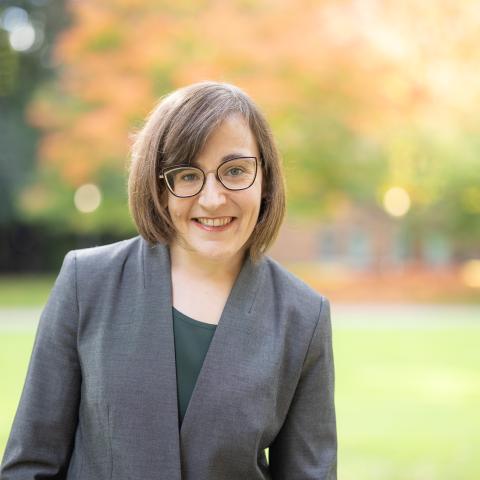
Amy Orsborn
University of Washington
Dr. Orsborn’s research explores motor control and learning, and how these neural computations influence computational approaches in brain-computer interface therapies. She completed her Ph.D. at the UC Berkeley/UCSF Joint Graduate Program in Bioengineering and her postdoctoral training at NYU’s Center for Neural Science. She recently received the NSF CAREER award, a Sloan Foundation Research Fellowship, and was named an Emerging Leader by the American Institute of Medical and Biological Engineering. She’s currently the Cherng Jia and Elizabeth Yun Hwang Associate Professor in the departments of Electrical & Computer Engineering and Bioengineering at the University of Washington.
Hosted by Hannah Lee (Stanford Profile)
About the Mind, Brain, Computation, and Technology (MBCT) Seminar Series
The Stanford Center for Mind, Brain, Computation and Technology (MBCT) Seminars explore ways in which computational and technical approaches are being used to advance the frontiers of neuroscience.
The series features speakers from other institutions, Stanford faculty, and senior training program trainees. Seminars occur about every other week, and are held at 4:00 pm on Mondays at the Cynthia Fry Gunn Rotunda - Stanford Neurosciences E-241.
Questions? Contact neuroscience@stanford.edu
Sign up to hear about all our upcoming events