
MBCT Seminar: Gert Cauwenberghs - Neuromorphic integrated bioelectronics and unobtrusive neural interfaces
Continue the conversation: Join the speaker for a complimentary dinner in the Theory Center (second floor of the neurosciences building) after the seminar
Neuromorphic integrated bioelectronics and unobtrusive neural interfaces
The convergence of neurotechnology and adaptive machine intelligence onto low-power silicon integrated systems offers opportunities to advance the effectiveness, efficiency, affordability, and comfort of mobile brain-computer and human-machine interfaces for applications ranging from hands-free voiceless communication to continuous health monitoring and biofeedback electroceutical therapy. I will highlight advances in the miniaturization and integration of neural interfaces with embedded active electronics operating at record levels of noise-energy efficiency providing microvolt and femtoampere sensitivity at microwatt power, with a focus on minimally invasive and unobtrusive wearable systems for probing and controlling brain activity with minimal contact and discomfort to the body. These include modular fully encapsulated system-on-chip electrocortical microelectrode arrays for epilepsy monitoring and remediation, and flexible in-ear sensors mounted on a user-generic earbud recording electrophysiological and electrochemical signals indicative of brain cognitive activity as well as body metabolic state for unobtrusive continuous health and wellness monitoring. I will also discuss implications of these advances and related developments in body area networks to new and emerging applications of pervasive neural interfaces for closed-loop neurological monitoring and neurofeedback therapy.
Gert Cauwenberghs
UC San Diego
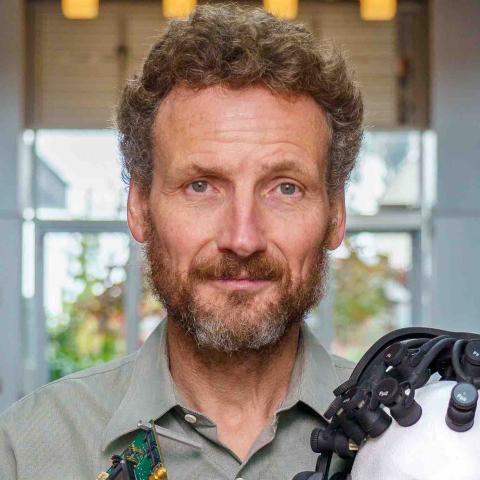
Gert Cauwenberghs is Professor of Bioengineering and Co-Director of the Institute for Neural Computation at UC San Diego. He received the Ph.D. in Electrical Engineering from Caltech and was previously Professor of Electrical and Computer Engineering at Johns Hopkins University, and Visiting Professor of Brain and Cognitive Science at MIT. His research focuses on neuromorphic engineering, adaptive intelligent systems, neuron-silicon and brain-machine interfaces, and micropower biomedical instrumentation. He is a Fellow of the Institute of Electrical and Electronic Engineers (IEEE) and the American Institute for Medical and Biological Engineering (AIMBE), and a Francqui Fellow of the Belgian American Educational Foundation. He served IEEE in a variety of roles including as Distinguished Lecturer of the IEEE Circuits and Systems Society, as VP of Technical Activities on the Executive Committee of the IEEE Engineering in Medicine and Biology Society, on the Steering Committee of IEEE Brain, and as Editor-in-Chief of the IEEE Transactions on Biomedical Circuits and Systems.
Hosted by Sean Liu (Baccus Lab)
About the Mind, Brain, Computation, and Technology (MBCT) Seminar Series
The Stanford Center for Mind, Brain, Computation and Technology (MBCT) Seminars explore ways in which computational and technical approaches are being used to advance the frontiers of neuroscience.
The series features speakers from other institutions, Stanford faculty, and senior training program trainees. Seminars occur about every other week, and are held at 4:00 pm on Mondays at the Cynthia Fry Gunn Rotunda - Stanford Neurosciences E-241.
Questions? Contact neuroscience@stanford.edu
Sign up to hear about all our upcoming events