
MBCT Seminar: Mark Churchland - Flexible problem solving in prefrontal cortex
Continue the conversation: Join the speaker for a complimentary dinner in the Theory Center (second floor of the neurosciences building) after the seminar
Flexible problem solving in prefrontal cortex
Primates can solve novel problems through logical and stepwise reasoning. No two real-world situations are the same, and how one ‘figures out’ a solution may be similarly variable. Studying reasoning has thus been challenging. How should one investigate the neural basis of internal events whose timing and nature are uncertain, and are unlikely to ever unfold the same way twice? To meet this challenge, we used large-scale Neuropixels-probe recordings and a novel task where monkeys apply abstract knowledge to determine the correct ordering of stimuli on the screen. We found that neural activity in prefrontal cortex (but not in motor cortex) reflected the sequential ‘figuring out’ of a solution. The set of internal steps, and their timing, were different on every trial. For example, the animal might sometimes figure out the last element first, and work backwards. On other trials they might use the opposite approach. In some ways neural activity was complex: a series of multiple choices could be made in any order, involved physical locations that could be anywhere on the screen, and had to respect a rule that varied on every trial. Yet in some sense neural activity was simple. At any specific moment, the animal was typically engaged in one internal choice, governed by the current rule and one stimulus. He then committed that choice to memory, and moved on to the next decision. These events were entirely internal, and occurred before a go cue was given and choices were rendered through action. These results show that step-like reasoning is used by monkeys to solve problems, and affords great flexibility. We leveraged that flexibility by presenting monkeys, on different days, with different versions of this task – including versions they had never seen before. Our results illustrate that cognition – including the solving of novel problems in unique ways – can be directly resolved at the neural level, with sufficiently large-scale recordings.
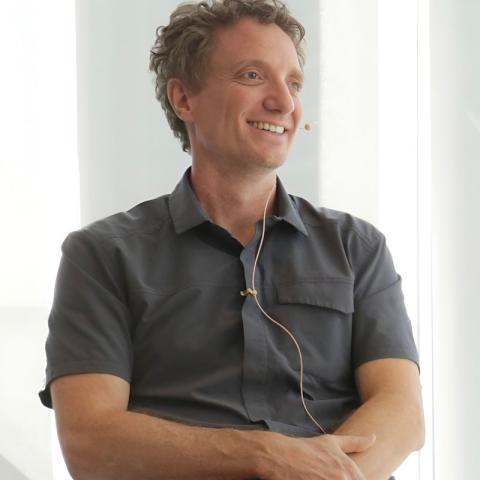
Mark Churchland
Columbia University
Professor Churchland is a Professor in the Department of Neuroscience at Columbia University Medical Center. He is the co-director of the Grossman Center for the Statistics of Mind. He received his BA in mathematics and psychology from Reed College in Portland Oregon. He received his PhD in neuroscience from the University of California San Francisco. His postdoctoral work was in the Neural Prosthetic Systems Laboratory at Stanford University. Professor Churchland’s research focuses on two related topics: how the brain generates skilled voluntary movement, and on how ‘thinking’ and ‘figuring out’ are instantiated in the activity of neural populations in the frontal cortex.
Professor Churchland is a recipient of the 2012 NIH Directors’ New Innovator Award. He received a 2015 Klingenstein-Simons Fellowship Award, a 2013 McKnight Scholar Award, a 2013 Sloan Research Fellowship, and a 2012 Searle Scholars Award. He was a 2006 recipient of the Burroughs Wellcome Fund Career Award and a 2003 recipient of the Helen Hay Whitney Research Fellowship.
Hosted by Yiqi Jiang (Stanford Profile)
About the Mind, Brain, Computation, and Technology (MBCT) Seminar Series
The Stanford Center for Mind, Brain, Computation and Technology (MBCT) Seminars explore ways in which computational and technical approaches are being used to advance the frontiers of neuroscience.
The series features speakers from other institutions, Stanford faculty, and senior training program trainees. Seminars occur about every other week, and are held at 4:00 pm on Mondays at the Cynthia Fry Gunn Rotunda - Stanford Neurosciences E-241.
Questions? Contact neuroscience@stanford.edu
Sign up to hear about all our upcoming events