
MBCT Seminar: Sa Cai & Itamar Terem
Continue the conversation: Join the speaker for a complimentary dinner in the Theory Center (second floor of the neurosciences building) after the seminar
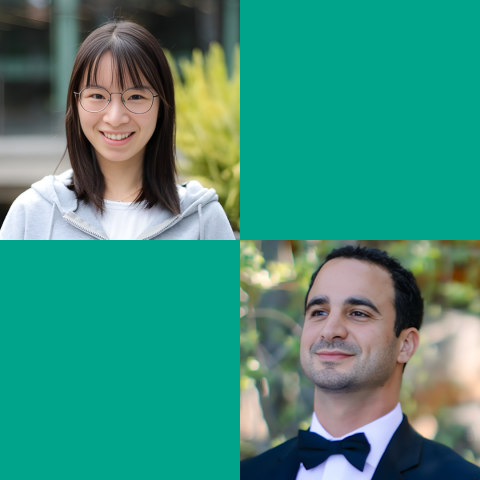
This seminar event will feature two talks presented by Stanford PhD student Sa Cai and Research Assistant Itamar Terem.
Optogenetic RNA relocalization reveals causal neural function in vivo
Abstract
RNA localization dictates where translation occurs, yet its disease role is unclear because most assays manipulate abundance, not position. We introduce an optogenetic CRISPR-dCas13 system (Opto-CRISPR-TO) that repositions endogenous RNAs with subcellular precision, second-scale kinetics, and reversibility, enabling causal tests in vivo. In cells, Opto-CRISPR-TO routes diverse RNAs to organelles and ribonucleoprotein granules with multiplex, bidirectional control, revealing distinct RNA behaviors in centrosomes and P-bodies. In mouse retina, acute (4-hour) mislocalization of Actb mRNA redirects β-actin protein, remodels synaptic architecture and cell positioning, and persistently impairs vision. Thus RNA location governs proteome topology and neural circuit output, and brief mislocalization drives lasting dysfunction. The approach generalizes across targets, compartments, and cell types, establishing a framework to probe RNA-localization mechanisms in development, plasticity, and degeneration.
Sa Cai
Qi Lab, Stanford University
Sa is a graduate student in Materials Science and Engineering. She is jointly mentored by Prof. Stanley Qi and Prof. Guosong Hong with a research focus on bio-material interface and synthetic biology.
Magnetic resonance imaging (MRI) of the pulsatile brain and its applications
Abstract
Heart–brain interactions, including cardiac-induced brain pulsatility, are increasingly recognized as critical components of brain homeostasis and function. These pulsatile dynamics arise from the transmission of cardiac pressure and flow through the cerebral vasculature and are influenced by tissue mechanical properties, vascular compliance, and cerebrovascular hemodynamics. Magnetic resonance imaging (MRI), a noninvasive and nonionizing modality, enables acquisition of high-contrast structural and functional images at macroscopic resolution. Although several MRI techniques have been developed to capture brain pulsations, they are predominantly phase-based approaches that require specialized acquisition schemes and are not routinely used in clinical imaging.
In this talk, I will present a new framework for extracting and quantifying cardiac-induced brain motion from standard magnitude cine MRI data. I will first introduce Amplified Magnetic Resonance Imaging (aMRI), a novel algorithm designed to reveal subtle pulsatile brain motion from conventional MRI acquisitions. Building on this approach, I develop quantitative amplified MRI (q-aMRI), which extends aMRI to enable quantification of sub-voxel cardiac-induced displacement fields in physical units. Using q-aMRI, I demonstrate that novel imaging biomarkers can be derived from these displacement fields, providing insight into how cardiac-induced brain motion evolves across the lifespan and how abnormal motion patterns are associated with neurodegenerative conditions such as dementia.
Itamar Terem
Setsompap Lab, Stanford University
Itamar Terem recently completed his PhD in Electrical Engineering at Stanford University, where he was supported by the NSF Graduate Research Fellowship. His work focuses on advancing Magnetic Resonance Imaging (MRI) through new computational and acquisition methodologies to characterize pulsatile brain dynamics. His research explores how cardiac-driven tissue motion and cerebrospinal fluid (CSF) flow reflect underlying brain biomechanics and clearance mechanisms, with the goal of developing novel biomarkers for aging and neurological disease.
About the Mind, Brain, Computation, and Technology (MBCT) Seminar Series
The Stanford Center for Mind, Brain, Computation and Technology (MBCT) Seminars explore ways in which computational and technical approaches are being used to advance the frontiers of neuroscience.
The series features speakers from other institutions, Stanford faculty, and senior training program trainees. Seminars occur about every other week, and are held at 4:00 pm on Mondays at the Cynthia Fry Gunn Rotunda - Stanford Neurosciences E-241.
Questions? Contact neuroscience@stanford.edu
Sign up to hear about all our upcoming events