
MBCT Seminar: Talks from Siddharth Doshi & Lara Weed
Continue the conversation: Join the speaker for a complimentary dinner in the Theory Center (second floor of the neurosciences building) after the seminar
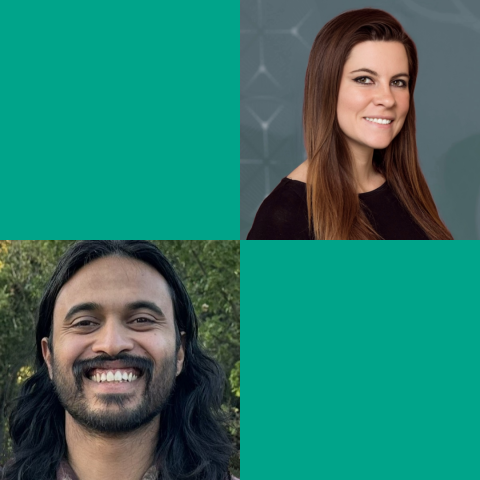
This seminar event will feature two talks presented by Stanford PhD students Siddharth Doshi and Lara Weed.
Bio-inspired adaptive photonic interfaces from nanostructured soft matter
Abstract
Devices that deliver and collect light are enabling key biotechnologies such as endoscopic imagers, spectrometers and optogenetic probes. The next generation of these photonic bio-interfaces will require mechanically adaptive, minimally invasive devices that can dynamically manipulate the shape of optical wavefronts and their spectral properties in situ. However, realizing such devices presents a substantial materials challenge - optical devices are typically made of rigid bulk materials such as glass that interface poorly with soft tissue, have limited prospects for miniaturization and static properties. To address this challenge, we drew inspiration from living systems, where shape changes in soft materials are frequently used to shape optical wavefronts.
In this talk, I will discuss how we addressed this challenge by drawing inspiration from living systems, where shape changes in soft matter are frequently used to control optical wavefronts. I will introduce how combining dynamic soft matter with engineered nanophotonic structures allows for control of light through nanoscale manipulation of geometry. By capitalizing on the electrochemical swelling of the conductive polymer, PEDOT:PSS, we were able to alter the shape and associated resonant response of nanophotonic elements. This allowed us to steer light beams and change their spectral properties at low voltages ( 1.5V) that are compatible with widely used CMOS electronics. Our devices can be realised as ultra-thin, sub-micron coatings, and provide a building block for a new generation of active opto-electronic devices amenable for integration with the human body, potentially enabling new applications in implantable light guiding and bio-imaging.
Siddharth Doshi
Melosh and Brongersma Labs, Stanford University
Siddharth is a Kavli Presidential Postdoctoral Fellow at Caltech, where he is working to develop a new generation of human-technology interfaces. Until recently, Siddharth was a PhD student in Materials Science at Stanford where he was a Meta PhD Fellow in Photonics and MBCT Trainee. His research with Nicholas Melosh and Mark Brongersma focused on developing electrically tunable active bio-photonic devices using soft polymers. He received his undergraduate degree in Engineering from the University of New South Wales (Sydney, Australia).
Circadian AI: What we can learn from mathematically modeling human sleep and circadian rhythms
Abstract
Human sleep and circadian clock timing emerge from interactions between endogenous biological oscillators, sleep debt, and environmental cues such as light. This talk explores how mathematical models, combined with modern AI approaches, can be used to study emergent timing properties, circadian misalignment, and intervention design, offering new insight into the factors influencing physiological timekeeping.
Lara Weed
Zeitzer Circadian Research Lab, Stanford University
Lara is a bioengineering PhD Candidate at Stanford University and NIH F31 Predoctoral Fellow funded through the National Heart, Lung, and Blood Institute (NHLBI). Her research is centered on understanding human health and performance through interpreting the hidden language of the body using wearable sensors measuring physiology, behavior, and biomechanics. Her thesis work, advised by Dr. Jamie Zeitzer in the Zeitzer Circadian Research Laboratory, explores the interplay between sleep, circadian rhythms, and the menstrual cycle, focusing on their influence on neuromuscular performance in women. Her research and training has previously been funded through the NeuroTech Training Program and Wu Tsai Human Performance Alliance. Prior to Stanford, she obtained my bachelor's in biomedical engineering, with minors in mathematics and chemistry, at the University of Vermont in 2020 and earned a Master’s in Bioengineering from Stanford University in 2022. She is expecting to complete her PhD in 2026.
About the Mind, Brain, Computation, and Technology (MBCT) Seminar Series
The Stanford Center for Mind, Brain, Computation and Technology (MBCT) Seminars explore ways in which computational and technical approaches are being used to advance the frontiers of neuroscience.
The series features speakers from other institutions, Stanford faculty, and senior training program trainees. Seminars occur about every other week, and are held at 4:00 pm on Mondays at the Cynthia Fry Gunn Rotunda - Stanford Neurosciences E-241.
Questions? Contact neuroscience@stanford.edu
Sign up to hear about all our upcoming events