
MBCT Seminar: Xuexin Wei - An integrative computational approach for understanding cognition
Continue the conversation: Join the speaker for a complimentary dinner in the Theory Center (second floor of the neurosciences building) after the seminar
An integrative computational approach for understanding cognition
My lab is broadly interested in understanding how the structure of the environment and the task demands determine the neural representations in the brain, and how these representations determine behavior. In this talk, I will present an integrative computational approach for studying these questions. First, I will describe a line of work that develops and tests normative theories of perception, focusing on how the structures (such as resource allocation, manifold geometry) of neural representation influence behavior. Second, I will present a new statistical approach, i.e., the split-trial analysis, to efficiently and robustly estimate the information-capacity of neural code from noise neural responses, as well as its applications. Third, I will introduce a computational technique based on decision variable correlations to compare the similarity of the decision strategies between the brain and deep neural network models. Application of this method revealed a substantial gap between the two types of systems, and such gap appeared to be increasing with the newer versions of deep network models developed for image classification. Overall, these studies highlight how generalizations of signal detection theory— a classic framework in psychophysics— can lead to new insights into the relation between neural representations and behavior.
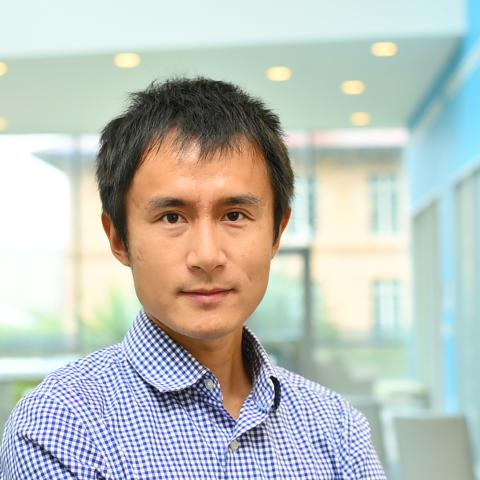
Xuexin Wei
University of Texas at Austin
Xue-Xin Wei grew up in Qingdao (or Tsingtao, known for the beer and seafood), China. He was initially interested in becoming a mathematician. In high school, he competed in the Chinese Mathematical Olympiad, but had no luck in getting a ticket for the International Mathematical Olympiad. After obtaining a Bachelor's degree in mathematics and applied mathematics at Peking University, he became interested in the brain. In 2010 he moved to UPenn to pursue a Ph.D. in Psychology (luckily, that was the only graduate program that gave him an offer). From 2016 to 2019, he worked as a postdoc in the Center for Theoretical Neuroscience at Columbia University. In 2020, he started as an Assistant professor in the Department of Neuroscience at UT Austin, with a courtesy appointment in the Department of Psychology. He is also a member of the Center for Perceptual Systems, Center for Learning and Memory, and Center for Theoretical and Computational Neuroscience at UT Austin. He is the recipient of the Louis Flexner thesis Award in 2015, and a recipient of the Sloan Research Fellowship in 2025.
Hosted by Hyunwoo Gu (Stanford Profile)
About the Mind, Brain, Computation, and Technology (MBCT) Seminar Series
The Stanford Center for Mind, Brain, Computation and Technology (MBCT) Seminars explore ways in which computational and technical approaches are being used to advance the frontiers of neuroscience.
The series features speakers from other institutions, Stanford faculty, and senior training program trainees. Seminars occur about every other week, and are held at 4:00 pm on Mondays at the Cynthia Fry Gunn Rotunda - Stanford Neurosciences E-241.
Questions? Contact neuroscience@stanford.edu
Sign up to hear about all our upcoming events