
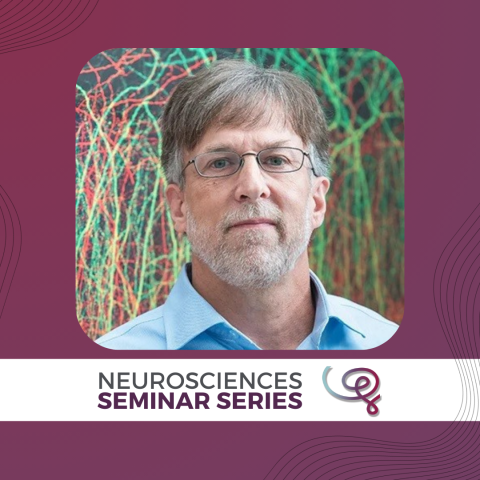
Neurosciences Seminar: Jeffrey Magee - Learning and memory mechanisms
Join the speaker for coffee, cookies, and conversation before the talk, starting at 11:45am.
Learning and memory mechanisms
Abstract
Understanding how brains learn and remember remains among the most important challenges in science. Recent studies implicate a new form of synaptic plasticity, named Behavioral Timescale Synaptic Plasticity (BTSP), in the generation of hippocampal activity patterns that are required for experience based learning and memory. BTSP is a strong, bidirectional plasticity effecting synaptic weights over many seconds of time. It is induced by single dendritic plateau potentials, as opposed to many action potentials, and is thus capable of producing new place cells in one-shot. Plateau potential initiation is controlled, at least in part, by local feedback inhibition and an instructive input from a higher-order brain region that potentially links the plasticity to current experience. The novel credit assignment procedure at work in BTSP provides a non-standard mechanism for memory storage and retrieval that could mitigate the need for widespread synapse stabilization. In addition, it may allow hippocampal networks to form both memories of specific behavioral episodes and to generalize based off past episodes. Finally, recent BTSP investigations could provide a basis for future explorations into how brains learn and remember ranging from the systems and cognitive levels down to the basic biochemical building blocks of learning and memory.
Jeffrey Magee, PhD
Baylor College of Medicine
Jeff Magee is an HHMI investigator and Professor of Neuroscience at Baylor College of Medicine in Houston Texas.
Hosted by John Huguenard (Huguenard Lab)
Sign up for Speaker Meet-ups
Engagement with our seminar speakers extends beyond the lecture. On seminar days, invited speakers meet one-on-one with faculty members, have lunch with a small group of trainees, and enjoy dinner with a small group of faculty and the speaker's host.
If you’re a Stanford faculty member or trainee interested in participating in these Speaker Meet-up opportunities, click the button below to express your interest. Depending on availability, you may be invited to join the speaker for one of these enriching experiences.
Speaker Meet-ups Interest Form
About the Wu Tsai Neurosciences Seminar Series
The Wu Tsai Neurosciences Institute seminar series brings together the Stanford neuroscience community to discuss cutting-edge, cross-disciplinary brain research, from biochemistry to behavior and beyond.
Topics include new discoveries in fundamental neurobiology; advances in human and translational neuroscience; insights from computational and theoretical neuroscience; and the development of novel research technologies and neuro-engineering breakthroughs.
Unless otherwise noted, seminars are held Thursdays at 12:00 noon PT.