
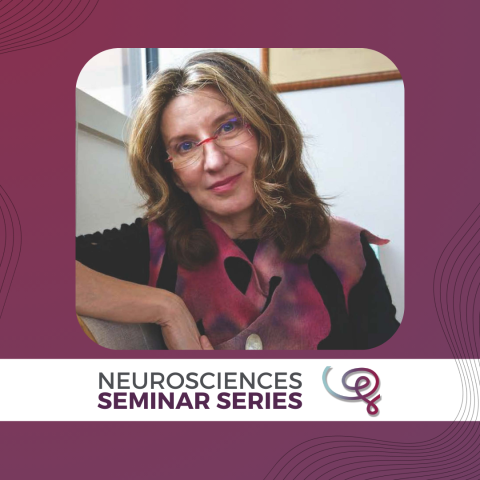
Neurosciences Seminar: Katalin Gothard - Neural mechanism linking interoception to decision-making
Join the speaker for coffee, cookies, and conversation before the talk, starting at 11:45am.
Neural mechanism linking interoception to decision-making
Abstract
Interoceptive signals convey information about the physiological state of the body to the brain and have been proposed to shape affect and decision-making. Yet it remains unclear how changes in body physiology alone are sufficient to bias complex decisions, such as choices in an approach-avoidance conflict task. We manipulated the peripheral autonomic state of rhesus macaques using pharmacological agents with minimal blood–brain barrier penetration. During peripherally restricted, sympathetic-dominated physiological states, animals terminated mildly aversive stimuli earlier even at the cost of forgoing reward. These effects generalized across different aversive modalities while leaving ordinal food preferences intact, indicating a selective effect of altered interoceptive afferents on avoidance. I will discuss the neural underpinnings of these behavioral biases in the anterior cingulate cortex (ACC) and amygdala, exploring how interoceptive states modulate neural representations of both decision commitment and spontaneous coping behaviors. Together, these findings support a causal role for interoceptive signaling in shaping decision-making and highlight specific neural substrates through which body–brain interactions may drive avoidance behavior.
Katalin Gothard, MD, PhD
Professor of Physiology and Neuroscience, The University of Arizona | she/her
Katalin Gothard obtained her M.D. in Romania, followed by postgraduate training in neurosurgery and a Ph.D. in Neuroscience. Her worked is focused on how the brain integrates internal bodily states, emotional signals, and social information to guide adaptive behavior. Her research bridges systems neuroscience, primate behavior, and affective science, combining quantitative physiology with naturalistic behavioral paradigms to uncover how the amygdala and related circuits coordinate perception, emotion, and decision-making.
Hosted by Karen Parker (Parker Lab - Social Neurosciences Research Program)
Sign up for Speaker Meet-ups
Engagement with our seminar speakers extends beyond the lecture. On seminar days, invited speakers meet one-on-one with faculty members, have lunch with a small group of trainees, and enjoy dinner with a small group of faculty and the speaker's host.
If you’re a Stanford faculty member or trainee interested in participating in these Speaker Meet-up opportunities, click the button below to express your interest. Depending on availability, you may be invited to join the speaker for one of these enriching experiences.
Speaker Meet-ups Interest Form
About the Wu Tsai Neurosciences Seminar Series
The Wu Tsai Neurosciences Institute seminar series brings together the Stanford neuroscience community to discuss cutting-edge, cross-disciplinary brain research, from biochemistry to behavior and beyond.
Topics include new discoveries in fundamental neurobiology; advances in human and translational neuroscience; insights from computational and theoretical neuroscience; and the development of novel research technologies and neuro-engineering breakthroughs.
Unless otherwise noted, seminars are held Thursdays at 12:00 noon PT.