
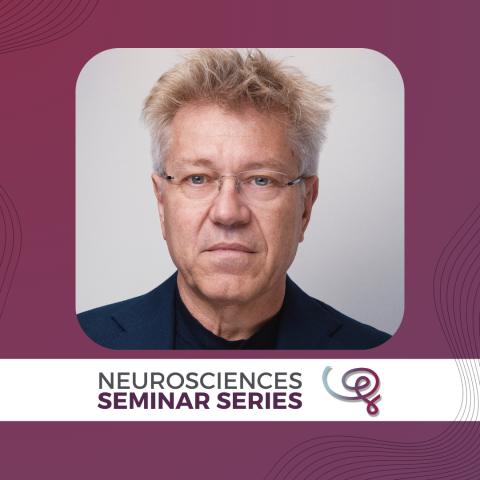
Neurosciences Seminar: Ole Kiehn - Unraveling brainstem circuits for movement: Insights into gait motor control and implications for yreatment of gait disorders
Join the speaker for coffee, cookies, and conversation before the talk, starting at 11:45am.
Unraveling brainstem circuits for movement: Insights into gait motor control and implications for yreatment of gait disorders
Abstract
Movement is the output of almost all brain functions. Among movement, locomotion is one of the most fundamental and universal to animals and humans. Locomotion is organised at many levels of the nervous system, with brainstem circuits acting as the gate between brain areas regulating innate, emotional, or motivational locomotion and the executing spinal motor circuits. To be executed, locomotion requires dynamic initiation and termination and appropriate directionally. This lecture will focus on recent advances that have elucidated the functional organization of brainstem command circuits in mammals needed to perform these roles. The lecture will provide a new framework for how basal ganglia circuits are acting via these brainstem circuits to elicit self-paced locomotion and how brainstem motor circuits may be used to define brain-wide networks involved in high-level behaviors. I will also discuss how locomotor disturbances following e.g. basal ganglia disorders may be alleviated by targeted activation of brainstem and basal ganglia circuits.
Ole Kiehn, DSc, MD
Professor of Neuroscience, University of Copenhagen | he/him
Ole Kiehn is Professor in Integrative Neuroscience at the Department of Neuroscience, University of Copenhagen, and Professor in Neurophysiology at the Department of Neuroscience, Karolinska Institutet. Ole Kiehn earned his medical degree from the University of Copenhagen in and his Doctorate of Science from the same institution. He conducted his postdoctoral work at Cornell University before returning to the University of Copenhagen as a group leader at the Institute of Neurophysiology. In 2001, he was recruited to Karolinska Institutet, where he became a professor in 2004. Since 2017, he has held a position as a professor at the Department of Neuroscience at the University of Copenhagen.
Kiehn’s research focuses on understanding the molecular, cellular, and functional organization of motor circuitries in mammals. His work has uncovered spinal circuits in mammals that control the ability to produce and coordinate locomotor movements, as well as brainstem command pathways that regulate the expression of movement in a context-dependent manner. His work links these brainstem circuits to motor circuits in the basal ganglia, and higher brain area. It provides novel insights into the role of brain circuits in the manifestation of motor disorders, like Parkinsons Disease.
Kiehn has served or serve on distinguished evaluation committees, including the Nobel Committee in Physiology or Medicine (2011-2019) the Brain Prize Committee (2024-). He is the President of the Federation of European Neuroscience Societies from 2024. His research has been recognized with numerous honors, including the Torsten and Ragnar Söderberg's Professorship, The Novo Nordisk Laureate Program, The Lundbeck Foundation Professorship, the Schellenberg Prize, the Kirsten and Freddy Johansen Preclinical Prize, and the Brain Prize 2022, which he shared with Silvia Arber and Martin Goulding. He is an elected member of Academia Europaea, EMBO, the Royal Swedish Academy of Science, and The Danish Academy of Sciences and Letters.
Hosted by Lele Cui (Shah Lab)
Sign up for Speaker Meet-ups
Engagement with our seminar speakers extends beyond the lecture. On seminar days, invited speakers meet one-on-one with faculty members, have lunch with a small group of trainees, and enjoy dinner with a small group of faculty and the speaker's host.
If you’re a Stanford faculty member or trainee interested in participating in these Speaker Meet-up opportunities, click the button below to express your interest. Depending on availability, you may be invited to join the speaker for one of these enriching experiences.
Speaker Meet-ups Interest Form
About the Wu Tsai Neurosciences Seminar Series
The Wu Tsai Neurosciences Institute seminar series brings together the Stanford neuroscience community to discuss cutting-edge, cross-disciplinary brain research, from biochemistry to behavior and beyond.
Topics include new discoveries in fundamental neurobiology; advances in human and translational neuroscience; insights from computational and theoretical neuroscience; and the development of novel research technologies and neuro-engineering breakthroughs.
Unless otherwise noted, seminars are held Thursdays at 12:00 noon PT.