
Neurosciences Seminar: X. William Yang, MD, PhD - Beyond the inherited CAG: Decoding a neuronal-selective pathogenic cascade in Huntington's disease
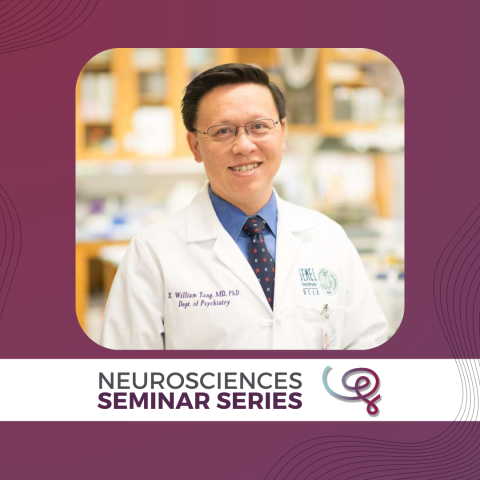
Join the speaker for coffee, cookies, and conversation before the talk, starting at 11:45am.
Beyond the inherited CAG: Decoding a neuronal-selective pathogenic cascade in Huntington's disease
Abstract
Huntington's disease (HD) is caused by a CAG repeat expansion in the huntingtin gene, and disease onset as well as clinical progression are modified by multiple GWAS loci enriched for DNA repair genes, including multiple mismatch repair (MMR) genes and FAN1. Here, I will present a series of studies—primarily using mouse genetic models of HD—to illustrate key pathogenic steps that lead to selective pathogenesis of the striatal medium spiny neurons (MSNs), the most vulnerable neuronal cell types in HD. Our studies show that a subset of HD GWAS/MMR genes (i.e.., Msh3 and Pms1) are key drivers of somatic CAG repeat expansion in the endogenous murine mutant huntingtin (mHtt), with MSNs showing the fastest rates of expansion. Consequently, these mice display somatic repeat length– and threshold-dependent, molecular and pathological phenotypes. Downstream of somatic repeat expansion, polyglutamine (polyQ)-expanded mHtt species accumulate in the nuclei of affected neurons, where they elicit proteotoxicity leading to profound chromatin defects. The latter include erosion of epigenomic signatures of MSN identity. Together, our studies reveal distinct pathogenic steps in HD pathogenesis and provide new insights and model platforms to develop therapies.
X. William Yang, MD, PhD
Professor and Terry Semel Endowed Chair in Alzheimer's Disease Research and Treatment
Department of Psychiatry and Biobehavioral Sciences, David Geffen School of Medicine, University of California at Los Angeles
Center for Neurobehavioral Genetics, Semel Institute for Neuroscience & Human Behavior, University of California at Los Angeles
he/him
Dr. X. William Yang completed his undergraduate education at Yale University, earning combined B.S./M.S. degrees from the Department of Molecular Biophysics and Biochemistry in 1991 (Mentor: Joan A. Steitz). He then pursued M.D./Ph.D. training at Rockefeller University (Ph.D., 1998; mentor: Nathaniel Heintz) and Weill Medical College of Cornell University (M.D., 2000). He completed his internship at New York-Presbyterian Hospital and is a licensed physician. Dr. Yang co-invented a powerful mouse genetic technology to engineer Bacterial Artificial Chromosomes (BACs) and generate BAC transgenic mice. His laboratory has pioneered the development of BAC transgenic mouse models for human neurodegenerative disorders, including Huntington’s, Parkinson’s, and Alzheimer’s diseases, leading to the discovery of novel disease mechanisms and therapeutic targets. The Yang lab has also applied novel genetic and systems biology approaches to decipher molecular networks in HD and AD. Importantly, they identified two genes (Msh3 and Pms1) in a distinct mismatch repair complex as key drivers of somatic CAG-repeat expansion and selective neuronal pathogenesis in HD. The lab also investigates basal ganglia circuitry in normal and pathological behaviors. They developed MORF mice for sparse, stochastic, and extremely bright labeling of single neurons and a pipeline for brain-wide mapping of dendritic morphology in genetically defined neuronal types (“dendritome mapping”). Dr. Yang is a recipient of three NIH BRAIN Initiative awards, the McKnight Foundation’s Brain Disorder Award, and the HDF’s 2014 Leslie Gehry Brenner Prize for Innovation in Science. He is an elected member of the American Society for Clinical Investigation and serves as an associate editor for Molecular Neurodegeneration and the Co-Vice Chair of the Scientific Advisory Board for the Hereditary Disease Foundation.
Hosted by Andy Tsai (Wyss-Coray Lab)
Sign up for Speaker Meet-ups
Engagement with our seminar speakers extends beyond the lecture. On seminar days, invited speakers meet one-on-one with faculty members, have lunch with a small group of trainees, and enjoy dinner with a small group of faculty and the speaker's host.
If you’re a Stanford faculty member or trainee interested in participating in these Speaker Meet-up opportunities, click the button below to express your interest. Depending on availability, you may be invited to join the speaker for one of these enriching experiences.
Speaker Meet-ups Interest Form
About the Wu Tsai Neurosciences Seminar Series
The Wu Tsai Neurosciences Institute seminar series brings together the Stanford neuroscience community to discuss cutting-edge, cross-disciplinary brain research, from biochemistry to behavior and beyond.
Topics include new discoveries in fundamental neurobiology; advances in human and translational neuroscience; insights from computational and theoretical neuroscience; and the development of novel research technologies and neuro-engineering breakthroughs.
Unless otherwise noted, seminars are held Thursdays at 12:00 noon PT.