
How brain imaging is transforming mental health
Back in the 1950s, doctors didn't know a whole lot about the heart. If someone came in with chest pain, clinicians would ask a few questions, then take a stab at treating what might be heartburn or a heart attack.
That's where mental health care is today, according to today's guest, Leanne Williams.
For example: you come into a psychiatrist’s office. The psychiatrist determines that you’ve experienced five or more depressive symptoms for at least two consecutive weeks and you get a diagnosis of major depressive disorder. Maybe you get prescribed some combination of therapy and medication. For some it works. For others it doesn’t. On average, finding an effective treatment for depression takes patients about 7 years – one of the reasons we’re in a mental health crisis.
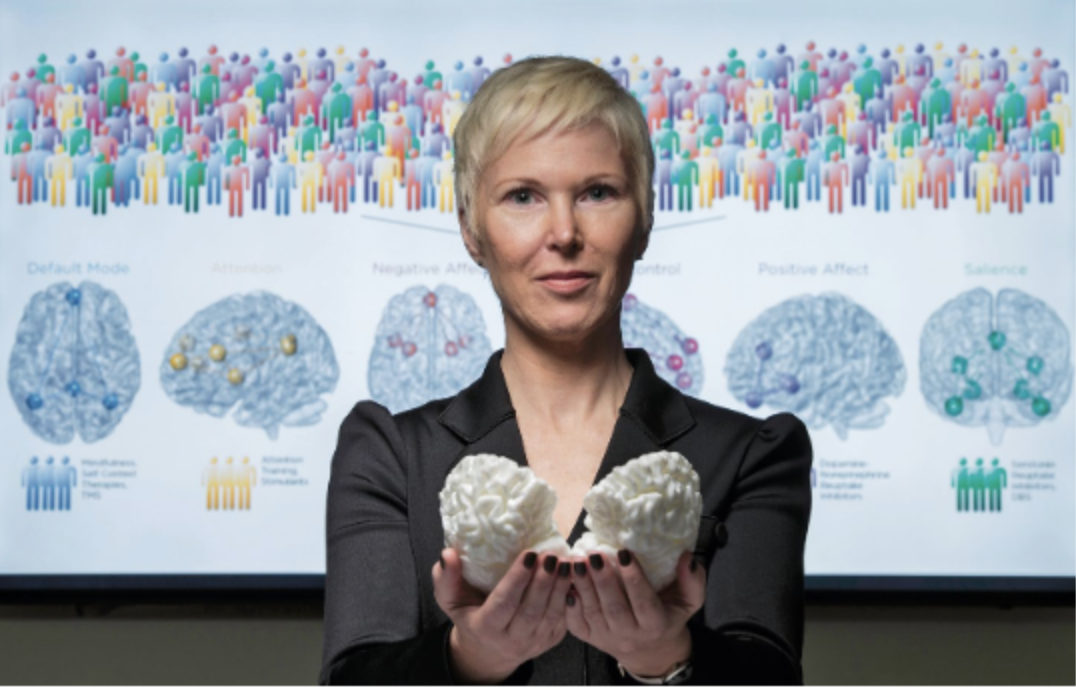
Williams says that the key issue is that psychiatry does not base its diagnoses or treatment plans on any direct test of the organ of interest: the brain. According to Leanne’s research, people with depression actually fall into clearly different categories, caused by changes in specific brain networks that can be seen using brain imaging. She’s shown that using this data can lead to much more targeted and effective therapies.
Williams leads the Precision Mental Health Center at Stanford and is helming a new international task force that aims to create a road map for transforming mental health diagnosis and treatment based on biological data and brain imaging. We invited Leanne on the show to tell us about a sea change she sees happening in psychiatry.
SUBSCRIBE on Apple Podcasts, Spotify, Amazon Music and more.
Learn More
- Stanford Center for Precision Mental Health
- Stanford PanLab: Personalized and Translational Neuroscience Lab
- Reimagining mental health: Stanford Medicine experts chosen to lead precision task force (Stanford Medicine, 2026)
- Depression's distinctive fingerprints in the brain (From Our Neurons To Yours, 2024)
- Cognitive behavioral therapy for depression can lead to lasting changes in the brain (Stanford Report, 2024)
- A study identified 6 types of depression. Here’s why that matters (CNN, 2024)
- Leanne Williams receives $18 million NIH grant to diagnose and treat depression (Stanford Report, 2024)
- Brain scans could help personalize treatment for people who are depressed or suicidal (Science, 2019)
- The Precision Mental Health Commission: transforming mental health through brain circuit science (Nature Mental Health, 2026)
- Personalized Treatment Selection in Depression Using Clinically Interpretable Neuroimaging Biotypes (Biological Psychiatry, 2026)
- Personalized brain circuit scores identify clinically distinct biotypes in depression and anxiety (Nature Medicine, 2024)
Episode credits
This episode was produced by Michael Osborne at 14th Street Studios, with sound design by Mark Bell. Social media strategy is by Julia Diaz, and additional editing by Nathan Collins. Our logo is by Aimee Garza. The show is hosted by Nicholas Weiler at Stanford's Wu Tsai Neurosciences Institute and supported in part by the Knight Initiative for Brain Resilience.
Share the show:
If you're enjoying our show, please take a moment to give us a review on your podcast app of choice and share this episode with your friends. That's how we grow as a show and bring the stories of the frontiers of neuroscience to a wider audience.
Get in touch:
We want to hear from YOUR neurons! Email us if you'd be willing to help out with some listener research, and we'll be in touch with some follow-up questions.
Transcript
Nicholas Weiler (00:10):
This is From Our Neurons to Yours, a podcast from the Wu Tsai Neurosciences Institute at Stanford University, bringing you to the frontiers of brain science. I'm your host, Nicholas Weiler.
(00:25):
When it comes to brain disorders, we generally think of two distinct categories. There are neurological disorders like stroke or epilepsy or Parkinson's where neurologists can use tools like brain imaging to identify injuries to particular brain circuits or systems or cells. And in many cases, we can now offer targeted drugs or brain stimulation to correct those problems.
(00:49):
The second category are psychiatric disorders: depression, PTSD, psychosis. For these disorders, patients have a very different experience. For example, imagine you come into a psychiatrist's office. The psychiatrist determines that you've experienced five or more depressive symptoms for at least two consecutive weeks, and you get a diagnosis of major depressive disorder. Maybe you get prescribed some combination of therapy and medication.
(01:18):
For some, this works. For others, it doesn't. On average, finding an effective treatment for depression takes patients about seven years. Across all mental health disorders, the average is more like 11 years. This is one of the reasons we're in a mental health crisis.
(01:37):
According to today's guest, Leanne Williams, the key issue is that psychiatry does not base its diagnoses or treatment plans on any direct test of the organ of interest, the brain. According to Leanne's research, people with depression actually fall into clearly different categories caused by changes in specific brain networks that can be seen using brain imaging. She's shown that using this data can lead to much more targeted and effective therapies.
(02:05):
Leanne leads the Precision Mental Health Center here at Stanford, and she's helming a new international task force that aims to create a roadmap for transforming how mental health conditions are diagnosed and treated across the board based on biological data and brain imaging.
(02:21):
Leanne's arguments are representative of what appears to be a major turning point for the field of psychiatry. So we invited Leanne on the show to tell us about the sea change in psychiatry and where the field is headed going forward. She likes to compare the state of psychiatry to where the field of cardiology was back in the 1950s. So that's where I started our conversation. Let's get to it.
Leanne Williams (02:51):
75 years ago, we did not know anything about the heart. It's hard to imagine right now. And at that point, in cardiology, we would be effectively guessing about what is the right treatment. So if I was experiencing chest pain, I would describe what the pain's like, and the doctor would ask me to report about it and try and guess the origins of it.
(03:17):
So FDR, as you may know, President FDR ended up dying from being on the wrong treatment for heart disease. And that gave rise to a huge wave of integrated activity, which led to being able to image the heart, understand its structure and function. Knowing how to measure the heart directly was the grounding for everything that we take for granted now.
Nicholas Weiler (03:44):
Right. You go in with chest pain, and immediately you're going to get an echocardiogram or you're going to get... they're going to do blood work and try to figure out, they're going to take your blood pressure and try to figure out, well, what exactly is the problem? And so you're saying that right now we're still in the old days when it comes to psychiatry, someone comes in, and what do they get?
Leanne Williams (04:10):
The situation is if now I am, or you could imagine, many of us are affected by mental illness or we know family, loved ones. You imagine I would go in and say, "I'm experiencing now some sort of angst or emotional pain. Something's not working." And it would be like cardiology used to be. The psychiatrist or mental health professional would ask me more about those experiences, my life situation. And I'd try and derive an explanation of what I'm experiencing through my words and answering questions. There are no tests. So it wouldn't be like cardiologist today. It would be about asking about the experiences, and from there coming up with the best match between what I'm describing with my symptoms and our current diagnostic checklist, which is effectively a dictionary.
(05:15):
And from there, we have a heuristic where we would say effectively treating me like I'm an example of an average. On average, we would try this treatment first. We'd wait some amount of time, a couple of months. If it doesn't work, try again. So at no point would we be referring for the imaging scan or blood work or any of those tests. So we're back where cardiology was, yes.
Nicholas Weiler (05:48):
And I mean, I was reading through the announcement of this new commission for precision mental health that you're launching. And I was struck by the statistic that you cited. You said, "Across mental health disorders, finding an effective treatment takes approximately 11 years on average. And in depression, about seven years are typically required to find an effective treatment." That's a really long time. I think I knew that it took a long time, but I didn't know it took that long.
Leanne Williams (06:15):
It's extraordinarily long. And then it makes sense for why depression and other major chronic mental illnesses are creating such an impact on people's lives, particularly young people. A really staggering statistic is that depression is now explaining more disability than any other illness combined.
Nicholas Weiler (06:39):
Wow.
Leanne Williams (06:40):
And in my mind, you can draw that direct link to how long it takes to find the right treatment. You think about maybe it's someone who's 18, so in the prime period of the first onset in which depression could occur. If they then go and seek help and the first treatment they try is not effective, they're waiting for the next one. By the time they get to the fourth trial, if that's not succeeding, their chances of getting well have dropped to about 13% remission rates.
(07:18):
So often people stay in that cycle of trying and trying. And you'll see people after that seven years. I saw an 18-year-old student after four years of struggling. And in that time, what's happening, it's not neutral. The brain, if it's not functioning well, is getting worse and worse. And that's driving this disability, unable to work effectively or study effectively.
(07:47):
The numbers are staggering. And to me, it's a major public health crisis. With depression, it's 29 years lost life expectancy from 18 if you're not finding an effective treatment.
Nicholas Weiler (08:04):
So I mean, I guess this makes me wonder why biological measures like brain imaging and genetics haven't been a part of mental healthcare before now. I mean, we've known that mental health disorders run in families. We know that there are specific neurotransmitter systems and brain systems. Everyone talks about dopamine these days. We've got serotonin-related drugs that help some people with depression. We have brain imaging and blood tests in neurology to understand stroke and epilepsy and even dementia these days. So why not in psychiatry?
Leanne Williams (08:41):
It's the question. Why not? And it boils down in my mind to several factors. You could go back to the history of psychology, which separated from neurology when it used to be combined and called neuropsychiatry.
(08:58):
At that point, the focus was on a concept of the mind. So that developed as a profession and discipline separately from the incredible advances happening in brain imaging and neuroscience and all of that understanding of depression, psychosis, other conditions as disorders of brain circuits, how that links to genetics, and so on. That all ended up occurring in the research world, separated from psychiatry as a clinical discipline. So there haven't been efforts to say, "Let's take that incredible set of advances and now deploy it clinically," until now. So now is a really exciting turning point where it's coming back together.
Nicholas Weiler (09:50):
Well, when we talked ahead of this interview, you surprised me by saying that the prevailing attitude in the field about this idea of taking a more biological approach has shifted, you said, in just maybe the past six months or maybe a year from... You said it shifted from not possible to this has to happen, which I thought was really amazing. So what changed? What's changed just in the last few months or a year?
Leanne Williams (10:15):
It's extraordinary. It's been an incredible convergence, which really rarely occurs, but a convergence of the sheer weight of the advances. It's no longer possible to say measuring your brain with functional MRI or the other available measures doesn't help. That's really clear.
(10:38):
Because the research is more and more available, families and people experiencing these illnesses know about it. So they're saying, "We want to access it. We need it to be available." And then that's combined with our professional societies nationally and globally recognizing that need and the advances in the science.
(11:02):
So the diagnostic process that we have, called the DSM, is now made a big effort, very public set of announcements, to say they actively want to bring this biological, neuroscience-based information back into the diagnostic frameworks. So that's led to this convergence and the recognition that's bringing the science and the clinical practice into alignment about the need to incorporate this information and make it actionable.
Nicholas Weiler (11:39):
I think, unfortunately, many people listening probably have had experience, given the prevalence of these disorders, with what it's like to actually try to get a diagnosis and get treatment. But for others, it may be a surprise just how diagnosis has worked in the past. So can you talk just briefly, we don't need to stick on this too long, but how the DSM, this Diagnostic and Statistical Manual that the American Psychiatric Society puts out every 15 years or so, how has that historically been organized to define these different disorders? And just give us a sense of how big the change that's being proposed now really is.
Leanne Williams (12:23):
Yeah. It really is a huge change. So the DSM stands for Diagnostic and Statistical Manual. And it's going to change to be called future DSM, Diagnostic and Scientific Manual.
Nicholas Weiler (12:38):
Scientific sounds good.
Leanne Williams (12:40):
Yes. And it goes back to World War II. That was when the split from neurology was really cemented. So there was an effort to bring together the first DSM to create a common language for describing mental illnesses. So the goal of it was more about terminology and getting a clear way of understanding each symptom and ensuring that it's reliable so that each psychiatrist or the researchers, when they talk about a particular condition, they're talking about in the same way.
Nicholas Weiler (13:21):
So these are people coming back from World War II that... driven in part by veterans coming back and psychiatrists trying to understand what are all the different things people might be experiencing?
Leanne Williams (13:33):
It was exactly that. It was also paralleling the separation of psychiatry from urology because when it separated, what got developed, this is late 1900s, was psychiatry as psychodynamic, psychoanalytic. A psychoanalytic profession, which doesn't have a common terminology. So it was a thing we need, a reference to be able to say when clinician A says this is major depressive disorder or this is bipolar disorder, they're actually referring to the same definition.
Nicholas Weiler (14:12):
And so in this manual, it's basically listing a set of symptoms and saying, "This is a cluster of symptoms. We're going to call that depression. And this is a cluster of symptoms, and we're going to call that anxiety. And this is a cluster of symptoms, and we're going to call that PTSD."
(14:26):
I mean, one of the critiques that I've heard, my sister's actually a clinical psychologist and we were talking about this, was that there's a lot of overlap. If you're diagnosing someone for depression, anxiety, PTSD, you're asking the same questions over and over again. And the same set of symptoms could put you in multiple different categories.
Leanne Williams (14:50):
Huge overlap. There's also huge heterogeneity within the categories because effectively it's a set of symptoms. So if you look at depression, it's nine symptoms. And you will meet diagnostic criteria if you have five of them, including at least one primary one: persistent low mood or loss of interest and pleasure.
(15:15):
And those same experiences, persistent low mood, could exactly happen in anxiety, or they could happen in other conditions, PTSD. So there's overlap.
(15:27):
I think what's key and what I really have appreciated as I've developed this circuit approach in precision mental health is the intention of DSM was not to understand the root cause and not to really get at naturally, organically occurring entities of the illness. It was meant to be a common language. So that necessarily brings all these issues that your sister is highlighting and others are highlighting. And it's understandably being locked in because it's being used for reimbursement and how people communicate in the field.
Nicholas Weiler (16:09):
Okay. So let's get back to what the new proposals are. What are some of the new... some of the specifics of what's being proposed now that you are particularly excited about, that seem to be pointing towards a more biological approach?
Leanne Williams (16:22):
I'm really excited that there's an active effort to say we will include biological information. So the proposal is that the future DSM will include a section of biomarkers and biological factors. And that refers to measures of brain function that have been demonstrated to address a particular question. It might be risk. It demonstrates risk for a particular diagnosis, subtypes of diagnosis, or is associated with particular treatment selection.
(17:00):
So the idea is, given the available evidence, that all those measures will be included as biomarkers in the future DSM. And then biological factors will be broader measures. It could be measures of hormone levels, for example, that are not yet developed to address a particular clinical question, but are relevant. So they'll be incorporated either as candidate biomarkers or measures that are emerging and to keep paying attention to.
(17:34):
And that's so exciting because it gets us to being able to make that bridge between symptoms and these biomarkers, these biological measures. And that disentangles the heterogeneity within a condition and across conditions. So you might have a biomarker that's relevant to one form of depression and one form of anxiety, perhaps.
Nicholas Weiler (18:04):
And we've seen this in other conditions. We've talked with Kathleen Poston in neurology, who leads the Movement Disorders Clinic, about Parkinson's and sort of taking this biological approach to Parkinson's and saying, "Let's redefine what..." I mean, we've defined Parkinson's based on these symptoms of movement disorders for a long time, but we sometimes get it wrong. And the symptoms can be masked by other things, or other brain problems can present with the same symptoms. And it's very confusing until you have a biology, a biomarker where you can say, "Okay, this is the problem in the brain that is causing a certain set of symptoms, which may be different between people, but our treatment needs to target the biology, not the symptoms."
(18:45):
So it's exciting to think a lot of these definitions, as you've been saying, have been based on observation of symptoms, clustering symptoms into different categories. Maybe we'll find out that depression is not one thing. Maybe we're going to redefine a lot of these disorders based on the biology in a way that's actually more helpful for patients.
Leanne Williams (19:05):
That's a really exciting aspect of this in terms of thinking ahead. Would this lead to a reorganization? How would that be implemented? And what I've observed is once you have that opportunity to describe to individuals, this is the underlying cause or you can actually see it tangibly, it really delinks the stigma. It immediately lifts that sense of stigma.
Nicholas Weiler (19:38):
Right. It makes it feel much more like, "Ah, this is a biological disorder that has some opportunity for treatment, and hopefully I can get back to normal function. It's not my fault or I need to snap out of it or it's all in your head."
Leanne Williams (19:52):
It's not my fault. Positively surprising aspect was, it's not also not determinative, meaning it makes it tangible what the target is to focus on. So it's not just that a medication is needed. It may be that particular strategies, or how do you change aspects of your behavior and life to really boost whatever it is that's needing to change? It makes it very tangible. And that reminds me again of cardiology because you might say you need this particular hypertensive medication, but at the same time, you wouldn't just sit around and do nothing, eat badly and expect that only to have the medication work.
Nicholas Weiler (20:42):
So I want to get into some of the specifics here. What is some of the science that is suggesting that we have some of the biology that we need? But first, I'd like to take a devil's advocate position here a little bit because I can imagine some people hear, "Cardiology started doing imaging. We understand how the heart works, and we can now have a better set of treatments and decide high blood pressure is different from high cholesterol and is different from whatever else you might diagnose."
(21:44):
The brain is a bit more complicated than the heart, which is... I don't mean to make any enemies with cardiologists, but the heart is a pump. The brain is a little more complex than that. And particularly when you get into these disorders like depression or anxiety, there are so many causes. There are so many brain circuits involved, presumably. They're disorders of behavior and of thought. So I guess my question is, do we really understand the subtleties of the brain enough to start using biological information to diagnose and treat them rather than treating them as disorders of behavior and thought where you address the behaviors and the thoughts directly?
Leanne Williams (22:23):
It's a really important question and clearly one that comes up over and over. Of course, the brain is very complex. What I'm excited by and what we've been able to show and validate is within that complexity, there are primary elements, which are regions, sets of regions that are activated by certain processes. How you might think or reflect on your internal thoughts or how you respond to negative emotion. Those particular regions and the connections between them, there are core elements that contain sufficient information and are sufficiently measured in a reproducible way in individuals that they can address important questions.
(23:16):
For example, they can address the question of, is this treatment likely to work for you or not? And if not, is another one likely to work? That is able to be done without necessarily saying we have all the information to say what your diagnosis is. It's saying we can see that this circuit out of the ones that are these primary elements is particularly disrupted, and it's the one that's predicting this treatment versus another. And then the evidence has shown us that if we use that circuit information, we can actually double the chance of someone succeeding at that first attempt to try a treatment.
(24:02):
So in that context, it's clinically meaningful information that we can interpret anatomically or functionally anatomically. It's reproducible for an individual. It does not explain the whole brain. So those nuances are really important.
(24:21):
We've developed a prototype in the Stanford Center for Precision Mental Health that can solve for a particular purpose, which is selecting between treatments for depression and getting it right first time. It's going to need to be able to evolve, to capture more information, more circuits. Maybe there's many other circuits we're not currently measuring that need to be, or they need to be included for other, solving for other clinical questions. And there are examples in the area of psychosis where they would use different measures. They've found different core elements that solve for other problems like how do you identify someone at risk of psychosis?
Nicholas Weiler (25:08):
Well, let's take those one at a time. I think it might be useful to look at those specific examples to maybe us, to give listeners a better sense of how this might be put into practice and what you can actually do already with these brain measures.
(25:22):
So let's talk about your work with depression. We talked about this a bit last time you were on the show. That was a couple of years ago now. But you basically use fMRI to look at the function of six different major brain networks in people with depression. Can you tell us what those networks are, and how you can use those to differentiate people with different forms of depression, and what treatments are likely to work best?
Leanne Williams (25:47):
So we measure those six. You'll hear me call them circuits. And that's been deliberate because it's a terminology being used in our field from the clinical point of view. But they are the default mode, which is widely talked about, which is a network or circuit that helps us reflect on our internal thoughts and actually project about the future. So it's a very human function, very intrinsic function.
(26:21):
There are types of dysfunction that involve a loss of connectivity in that circuit that characterize one type of depression and a response to... well, a differentiation between different classes of standard antidepressants.
Nicholas Weiler (26:40):
So this default mode rumination that you could imagine that certain... in some cases, what we call depression has to do with changes in connectivity in the sort of thoughts we think to ourselves when we're not thinking about something else, which makes some sense.
Leanne Williams (26:55):
Right. And although one form of that we haven't yet identified the best treatment association, but it's interesting that you can see different types of depression depending on whether you have too much connectivity, which is more that rumination, brooding on internal thoughts or too little. And the too little gives a different, most detached type of depression. And you see that in some people where they disconnect from their thoughts. And you see that in different parts of the default mode. So it gives us a way to really understand it. And it shows me why taking group averages doesn't always get us to the translation of the information.
Nicholas Weiler (27:46):
What are some of the other networks you're looking at?
Leanne Williams (27:47):
There's a salience circuit, which actually was identified by luminaries here at Stanford. And that's reading out introceptive, internal and external signals that are very relevant. So it'll read out emotional pain and pain in general. And that identifies a form of depression that's very much anxiety and avoidance due to anxiety.
Nicholas Weiler (28:14):
So I think of salience as being sort of the bubbling up of something coming to the... It's not quite attention, but it's what is relevance, what feels relevant to you. We talked about this actually in an episode we did a year or so ago on psychosis where one of the ideas is that maybe the things that are salient is getting dysregulated.
Leanne Williams (28:34):
It's just fascinating that you mentioned psychosis. So what we see in depression is if you have low connectivity and salience, it's a good indicator that you're going to do well on standard antidepressants, which is important because some people do. High is a different issue, and it typically goes hand in hand with psychosis. So there you see that separation.
Nicholas Weiler (29:00):
This is sort of the nothing matters symptom of depression. Nothing is relevant. Nothing really gets me going or excited, and it doesn't seem relevant to me, so why bother?
Leanne Williams (29:11):
It's a great generalization. And it's interesting that it actually correlates with what we think of as anxious arousal or anxious avoidance. So it looks like what's happening is that aspect of the brain is shutting down relevant signals in order to avoid avoiding too much experience of anxiety. It's shutting down its connections.
Nicholas Weiler (29:35):
Interesting. Okay, okay. What are some of the others? Maybe we don't need to go through all of them, but what are some of the others that are helpful in differentiating different types of depression?
Leanne Williams (29:45):
There's one we call frontoparietal attention, which relates to behavior therapy. There's a really interesting negative affect circuit, which is limbic, core region in the brain called the amygdala, which relates to reactions to fear and negative emotion and its regulation by frontal regions. That's a really important aspect of depression. So it's a type where the brain is almost in an alarm mode. It's constantly feeling stressed and something's really going wrong. That's important to know because in that case, they're unlikely to respond to standard antidepressants. And you really need, in my view, to fast track two alternatives. And those are ones that are more likely to be novel treatments that are being developed.
Nicholas Weiler (30:41):
Yeah. Sorry, just to take this back, this reminds me of this idea that currently you have to go through all the standard treatments before you have an opportunity to try some of the more experimental or novel treatments, whether it's brain stimulation or, I guess, these days, psychedelics and so on. And some of what this work is doing is saying, "Look, we can predict if the normal treatments, if the standard treatments are not going to work. Why should you have to go through several years of trying all of these treatments which we know are not going to do anything?"
Leanne Williams (31:10):
Exactly that.
Nicholas Weiler (31:10):
"Because that's not the type of depression that you have."
Leanne Williams (31:13):
Exactly that. And that amygdala profile, actually we've been working on linking them to the emerging therapeutics or potential therapeutics. One study we did actually with MDMA recently that Xue Zhang in my lab published in JAMA Network Open, where we saw that biotype with that high amygdala is very responsive to MDMA. So it offers a potential biomarker for these emerging therapeutic options. And as you said, to bypass some of the trial and error if you're not likely to respond.
Nicholas Weiler (31:53):
And so with all of this, you're managing to get something like 75% accuracy and matching people to different treatments and say this... And when you say accuracy, that means that someone gets that treatment and actually it does better.
Leanne Williams (32:10):
Exactly. And another circuit which has been really effective in demonstrating that cognitive control, which is one that helps you organize your thoughts, plan ahead. An aspect of depression we don't normally think about. We think of it as mood and negative emotion, but many people, around 20-25%, have this cognitive fog experience. And that's a problem in this frontal-dorsal, frontal region. And what we found there, for those people unlikely to respond to standard antidepressants, they do respond to some emerging selective, currently approved treatments that target that circuit. And in that case, we get them at a point of 77% response and of those 85% remission, which is over double what would ordinarily be the case.
Nicholas Weiler (33:12):
And those are people for whom... I mean, I think I remember hearing that most treatments are something like effective for 50% of people, standard SSRIs.
Leanne Williams (33:23):
Yeah, exactly.
Nicholas Weiler (33:24):
And so being able to get to giving someone the right therapy, getting to 86% going into remission is pretty impressive. That must be transformative for those people.
Leanne Williams (33:35):
Absolutely. And I mean, there's many cases. The individuals who are in that study, we talk with them. And one of them really stands out because he said it's like a circuit-guided home run for him. He was going through this as a student for four years. So the four years trial and error and was being given different antidepressants, but feeling like this incredible cognitive fog and that he just could not function, very high performing student. And he was dealing with it by sleeping for one hour, studying for one hour, sleeping for one hour and thinking, "Maybe I don't have depression. Maybe I have chronic fatigue. And what is this?"
(34:25):
And fortunately saw our study, came into it. We scanned him, and he had this cognitive control circuit problem. So we took him off the meds he was on, put him on this targeted treatment. And it was in seven weeks, he was remitted. I talked with him recently, and we actually saw that network or circuit restore. So it restored back to healthy function. And he took the medication for eight months, and then was able to come off it and still is well. So now he's thinking, "Have that available if I need it," but it's as close to effectively a cure as you could think of. And it makes sense because the treatment is actually... it has an effect of building back the plasticity in the particular region that was disrupted.
Nicholas Weiler (35:23):
It's so funny. I mean, it's almost like physical therapy, right? You're building back the muscles, you're getting stronger. And once you're stronger, you don't always need to do the physical therapy.
(35:32):
And it also reminds me, you made the connection, is this chronic fatigue? It sounds like other kinds of brain fog people sometimes experience. Maybe this is not just something that applies to depression as we classically understand it. But we were talking before about how the DSM has many of the same symptoms listed under various different categories of disorder. So maybe many people experience this kind of cognitive fog, this executive function issue, and they could all benefit from this drug whether or not they would have traditionally been diagnosed with depression or anxiety or some other thing.
Leanne Williams (36:06):
Right. I think that's a really exciting possibility. And this focus on this cognitive type of depression is one where I am interacting directly with future DSM as it's one that could have immediate value for those people like the student I was describing. Exactly as you say, it could be one that could end up being expanded into other areas. And similar emerging treatments or the existing treatments could similarly be made more precise by knowing exactly what type of dysfunction they're most effective for.
Nicholas Weiler (36:47):
So we've been talking about, in depression, the ability to match people with the appropriate treatment, which has been really a challenge before. The other example that you mentioned is schizophrenia and psychosis. And we had this beautiful conversation about psychosis last year on the show, I think I mentioned. It's one that I recommend to everyone because it changed how I think about psychosis as a brain disorder and what exactly it means, something that people also can live with, with the right approach to treatment. And that some people actually, it's not necessarily as negative as it is often portrayed.
(37:33):
What have we learned about the biology of schizophrenia in particular? And maybe this gives us a different example of the way in which biological measures can help us with diagnosis and treatment.
Leanne Williams (37:45):
Absolutely. In schizophrenia and, more broadly, psychosis, you think of the onset typically is late adolescence into early adulthood. And what really stands out to me if you're thinking about how could this really make a difference in people's lives and give them their lives back is this is not functional MRI now, this is structural MRI. It's been found that the thinning of the cortex is a really good indicator of who's likely to be at high risk and to convert to full psychosis. That's hugely important because this is something going on in the inside, in the brain that may not be observable on the outside until someone's at the point of having that break into full psychosis. So you could imagine, I don't know, 17-year-old, maybe they're withdrawing socially and you see some behavior changes, but maybe this is just teenage...
Nicholas Weiler (38:55):
Right. Teenagers are teenagers.
Leanne Williams (39:00):
Is this a manifestation of something we really need to look at? And there's not really a way of knowing from the outside. So most often what happens, very sadly, is it's not until that full break happens. And then you see the more [inaudible 00:39:17] and so on.
(39:19):
But what you see with the structural MRI is you can detect earlier this cortical thinning that predicts the people at high risk who are going to convert. It's about 15 to 25% of the young people at high risk. And you can see this indicator. And if that was available routinely, it's a game changer.
Nicholas Weiler (39:43):
When you say 15%, you mean people who come into the clinic with, they're withdrawing a little bit. They're maybe spending too much time online and developing some strange beliefs about the world. But is this psychosis, or is this just someone figuring themselves out? 15% of those, you're saying, would go on to develop full-blown psychosis.
Leanne Williams (40:04):
Yeah. The estimates range across studies, but somewhere between 15 and 25%.
Nicholas Weiler (40:11):
And you don't want to just put everyone on antipsychotic medications because those have a lot of negative side effects.
Leanne Williams (40:15):
Exactly. It's really important for that as well to not give someone, especially when they're young, an antipsychotic they don't need.
Nicholas Weiler (40:23):
Right. So by looking at the structure of the brain, you can see, well, if this person who has some of these symptoms, might just be teenage angst, but if they have thinning of the cortex in particular regions, then maybe it does make sense to start considering more aggressive treatment because that has a pretty strong predictive power to say this looks like it might turn into psychosis.
Leanne Williams (40:47):
Right. And what we also know about psychosis is the earlier you can initiate intervention, the better for the outcome. That's when genuinely people can get their life back.
Nicholas Weiler (41:02):
So I want to get back to your precision mental health consortium. We've got these two examples of different ways that brain imaging might be helpful in depression, matching people with treatments, or in psychosis, doing early biomarkers to get people into treatment if they need it. The goal of your consortium is sort of to bring together a bunch of experts from around the world to sort of create a roadmap for how this would look in practice. Because these are research studies that you've been telling me about. They haven't been converted into standard clinical practice around the world.
(41:40):
And I love what you told me the other day, fMRI has been around for 30 years, but it's not magically getting into clinical practice. So what needs to happen? What do you see as sort of the main challenges of getting all that we're learning about the neuroscience of mental health disorders into clinic? And what do you think are the low-hanging fruit maybe?
Leanne Williams (41:59):
So this commission for precision mental health has come at an incredibly positive time. It recognizes that we are ready to address that question that you just asked: what needs to happen? I was invited to lead this commission on precision mental health in recognition that our center has been focusing on exactly the question of how do you get these findings into routine clinical care? How do you get them into practice? How do you make them available to people who want them?
(42:32):
So the commission is designed to fast-track what was done for cardiology over those years, which is identify where are the really good candidates that are prime-time ready? They're ready to deploy into practice. The measures I've been talking about from fMRI that help select treatment, we have deployed them in our precision psychiatry clinic here at Stanford. So we're showing that it can be done and that it's feasible.
(43:08):
The commission is scaling that up and, as you said, building the roadmap and creating several things. One is what kind of research needs to be done to actually take the findings and put it into practice> and this is more an implementation practical focus. What needs to change for the field itself? What would the standards be and the guidelines? Creating the structure for it. And then bringing in leaders that are involved in future DSM or involved in healthcare networks as to how would this need to occur from the point of view of healthcare networks and our professional societies? So how will we actually build this out?
(43:59):
And the commission will go over two years. So it'll be an opportunity to think it through very carefully and, along the way, produce reports about the guidelines we could follow. What are examples of where we have deployed and it's been successful? What kind of feedback are we getting from clinicians and from the patients themselves? And we also have the opportunity to call for specific papers that would be synthesizing the knowledge we have to advance additional areas of deployment.
Nicholas Weiler (44:36):
So identifying sort of particular areas of science or particular kinds of studies that would help move things forward. So a lot of this rests on the ability to have these high-end brain imaging technologies we're talking about. Do you see this as being an access issue? I mean, it's great to be able to do this here at Stanford where we have all kinds of great imaging technologies and so on. Is it going to be a challenge to generalize this to areas where people can't just come down to Stanford and get a brain scan?
Leanne Williams (45:07):
I'm really confident that's addressable, very optimistic. And as part of setting up this clinically applicable approach, I've really looked into it over the last two years. And I think it's another reason this commission is really good timing.
(45:24):
So if we were relying on academic medical centers, I think it's more of a challenge. But if we think nationally and globally, well, let's think nationally for the moment, there are huge imaging networks across the country. So there's at least 12,000 scanners that people could be referred to. And a rough equivalence might be what happens for migraines, which are similar prevalence, where it would be recommended to get a scan as part of the workup? So the scanners that can support that can support the kind of imaging that goes into the scores we have.
(46:07):
And we purposely designed it to be suitable for those clinical and community scans, which is another way of thinking about the research, because ordinarily, and in a very valid way, we normally think about how can we keep improving and advancing the way we do the imaging? For clinical application, it requires thinking about how can we ensure that it actually can be accessible on all of the available scanners in this case that are in the community outside of Stanford and obviously inside Stanford as well, but more broadly available?
Nicholas Weiler (46:47):
Yeah. And maybe it turns out you don't necessarily need the highest grade, research-level fMRI technology, the kind of thing that you'd be using in the highest-end research studies. You just need something that's going to be able to tell you it looks like, to give your example in depression, we can see that there are differences in the activity in these different brain networks, and that's enough to make the clinical decision about what types of treatment to go for.
Leanne Williams (47:13):
Exactly.
Nicholas Weiler (47:14):
So that's reassuring.
Leanne Williams (47:16):
Just recently, we've been launching a study that is in partnership with community imaging networks. And it's been incredibly exciting to see how effectively the sequences can run and that you get a really good signal and that it's sufficient to make that decision. And also, what that really highlighted to me is we're so fortunate that we can build on the... or we can sit on the shoulders of all that's been done for those other fields because they've built out all these workflows for imaging and ordering scans and carefully storing them in an ethical way. So all of that's in place. It's really making a connection to psychiatry. If you're a psychiatrist, how do you place an order for a scan? How does it get quantified, and how is it returned to you? How do you learn how to interpret it?
Nicholas Weiler (48:20):
This is all very exciting to think about how this might affect patients and just sort of the experience of cutting out that long and terrible trial-and-error process of just trying to find a treatment, which, again, particularly in something... I keep coming back to depression, but it's going to be really hard to stay resilient through this didn't work and that didn't work and this didn't work. And that, I would imagine, makes things just so much worse.
(48:48):
But one of the things that I also find so interesting and exciting about this, maybe from a broader neuroscience perspective, is what we stand to discover about mental health, about these brain networks, about what the proper functioning, what the healthy functioning of all these various networks looks like and just having a better understanding of what is actually going on in the brain when people get into these disorders where one or more of these circuits is not functioning or it's leading to unhealthy thoughts and behaviors. I'm curious, are there things that you're particularly excited to learn more about at a fundamental level that will be more possible with this biological approach to psychiatry?
Leanne Williams (49:35):
Absolutely. I really love that idea of thinking of how does the brain become dysfunctional to the point where it's disrupting your ability to literally function in your world versus the thin edge of the wedge be from that to when it's functioning well. So thinking of mental illness as a circuit disorder in the context of how the whole of our human brain functions, what does it mean to be resilient? What does it mean to go from it being disrupted to back into function? And really understanding it as a much broader system because it opens up the idea that mental illness doesn't end when you stop having symptoms, it's also how do I think about optimizing my life and in a bigger sense of really being well and healthy.
Nicholas Weiler (50:44):
Maybe we need a positive psychiatry, like we have positive psychology. Well, Leanne, thank you so much for coming on the show. This has been so fascinating, and I'm really excited to see where all this goes. So thank you for joining us.
Leanne Williams (50:56):
Absolutely. It's been a really great pleasure.
Nicholas Weiler (51:00):
Thanks so much again to our guest, Leanne Williams. She is the Vincent V.C. Woo Professor of Psychiatry and Behavioral Sciences and the founding director of the Stanford Center for Precision Mental Health at Stanford Medicine. To read more about her work, check out the links in the show notes.
(51:17):
If you enjoyed this episode, be sure to subscribe for more conversations from the frontiers of brain science. And we also love hearing from you, our listeners. If you have thoughts about the show or questions about the brain you'd like us to address in a future episode, send us an email. We're at neuronspodcast@stanford.edu, or leave us a comment on your favorite podcast platform. While you're at it, please give us a rating and share the show with your friends. Might seem like a small thing, but it's tremendously valuable for us to be able to bring more listeners to the frontiers of neuroscience.
(51:49):
Next time on From Our Neurons to Yours.
Cory Keller (51:51):
Almost 50% of the neurons that we sampled from responded to single pulse of TMS. That was actually pretty surprising because we were sampling really deep in the brain. And this idea that TMS is only superficial. Yes, TMS only gets to that superficial region, but then it propagates throughout the brain very quickly.
Nicholas Weiler (52:13):
From Our Neurons to Yours is produced by Michael Osborne at 14th Street Studios, with sound design by Mark Bell. Our social media strategy is by Julia Diaz, additional assistance by Nathan Collins. Our logo was designed by Aimee Garza. I'm Nicholas Weiler. Until next time.

