
Koret Human Neurosciences Community Lab grants bring cutting-edge tools to Stanford scientists
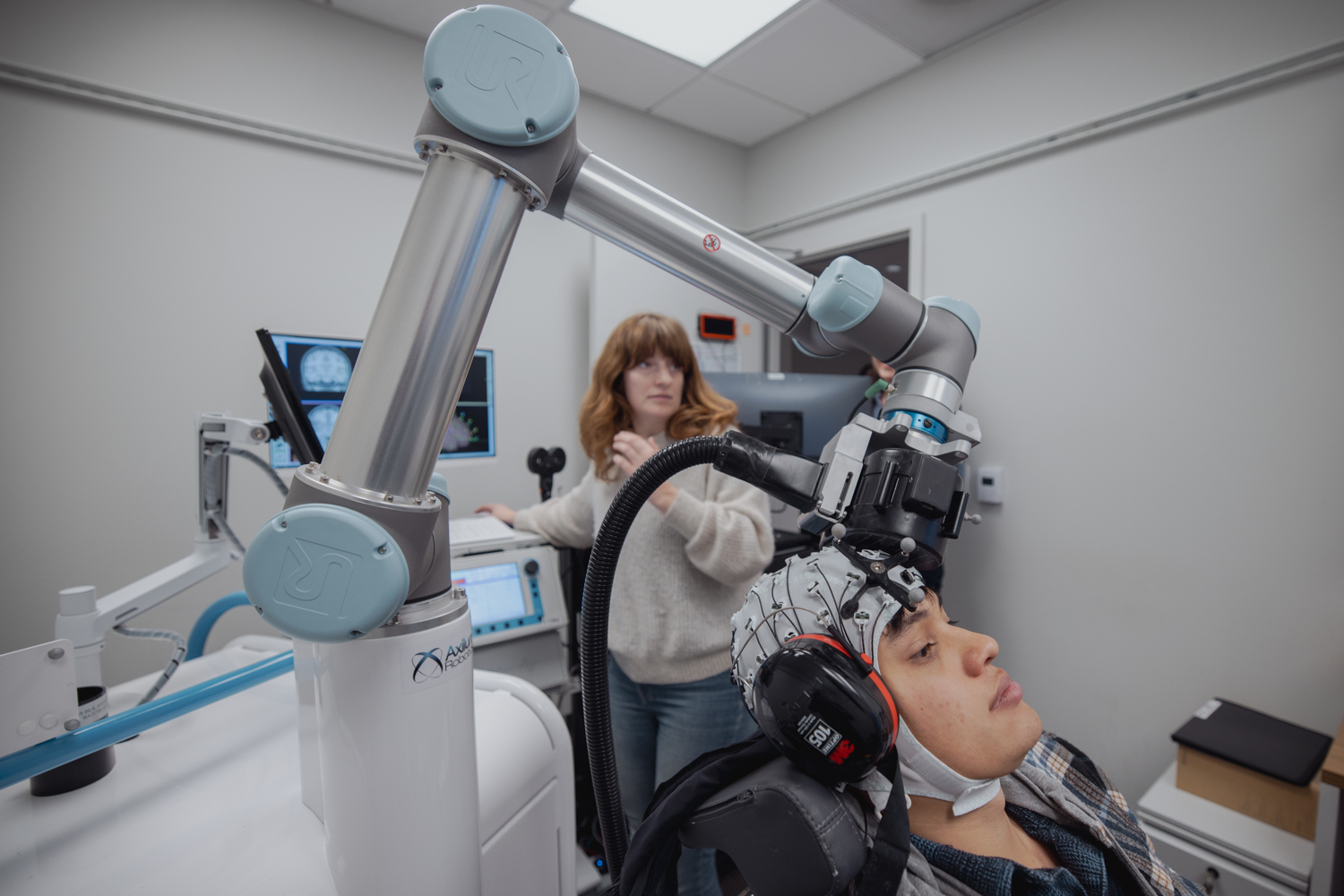
Scientists’ growing ability to observe—and shape—the flow of information through complex brain circuits is revolutionizing neuroscience, making it more practical than ever before to study how the human brain works and how to treat it when it goes wrong.
The Koret Human Neurosciences Community Laboratory at Stanford’s Wu Tsai Neurosciences Institute exists to make it easy for researchers across the university to take advantage of these cutting-edge technologies for non-invasive human brain research. As part of that mission, the lab has just announced their second round of pilot grants, which offer free training and support to researchers who are interested in adding to their personal toolkits.
One tool the Koret Lab specializes in, high-density electroencephalography (EEG), allows researchers to track the brain’s electrical activity with a swim cap-like device worn on the head. The other, transcranial magnetic stimulation (TMS), uses a magnetic coil to send pulses into the brain to stimulate activity or treat neurological conditions—notably, TMS has shown promise for alleviating treatment-resistant depression. Both techniques can be carried out in a more-or-less ordinary room, without the need for invasive electrode implants or gigantic machines with special safety requirements.
Two of this year’s grantees will explore potential ways to slow cognitive decline, one using TMS to boost the effects of cognitive training and another using EEG to better understand the brain’s ability to filter out distractions and potentially amplify that ability. Another grantee will investigate whether TMS targeting the cerebellum could shape social behavior and help people with autism. The fourth will use EEG to better understand the connection between exercise and the brain, laying the groundwork for new approaches to improve health and combat neurological disease.
The Koret Lab is uniquely positioned to bring together scientists from across campus and foster research that is transformative for the field and the researchers themselves, said Koret Lab Director Milena Kaestner.
“I’m really passionate about building community here, and the pilot awards are a key way in which we do that,” said Milena Kaestner, the lab’s director. “I am proud of the way the awards support early-career researchers or those looking to try something new. We take care to provide the training needed to get innovative projects going, connecting our awardees to each other, to experts in our community, and hopefully on to further funding opportunities.”

That’s something Ariel Chan, a former Stanford Provostial Fellow in linguistics and now an assistant professor at UC Santa Cruz, has direct experience with. Chan said that she had wanted to incorporate EEG into her work on speech processing in monolingual versus bilingual people, but she hadn’t had the opportunity until she received a Koret pilot grant last year.
The training and mentorship she received gave her enough confidence that she is starting her own EEG lab and making it a central part of her research, she said. With EEG, “you’re able to capture activity in your brain before your body even responds,” Chan said. “I’m interested in social factors influencing language processing, and that’s very nuanced, so you may not always see it in the behavioral evidence, but you can start to see how the brain responds.”
The Koret pilot grant taught her more than just the technical details of EEG, thanks to Kaestner’s experience and mentorship, Chan said. “What’s special about Koret is that you’re getting support on a deeper level. Milena trained me and my students to do the data collection, and she was always available to answer questions, but then I was also able to engage in deeper conversations in terms of research design,” she said.
One of this year’s grantees, Adam Turnbull, a lecturer in psychiatry and behavioral sciences who will work on the TMS cognitive training project as well as an ongoing EEG project, said he had little prior experience with EEG and TMS, and the Koret pilot grant was already helping him move his research forward.
“The Koret Lab pilot grants are perfect for us because we hadn’t done EEG, we hadn’t done TMS, and we can get the grants to run a small pilot study that gives us the feasibility data we need,” Turnbull said. “At the same time, we get much more hands-on training and support than you would usually get when venturing into a new technique,” he said.
John Hegarty, another of this year’s awardees and the director the Stanford Clinical Neuroscience Laboratory, will focus on TMS as a potential therapy for autism and identifying biomarkers that could help customize TMS treatments to individual patients. “We have been conducting EEG research out of the Koret Lab since its inception, but we're new to the field of TMS,” said Hegarty, a clinical assistant professor of psychiatry and behavioral sciences. "We’ve had a great experience so far, and we’re really looking forward to learning more from Milena and her team over the next year.”
Funded Projects
Spatial and Behavioral Characterization of Alpha Suppression and Broadband EEG Activity in Visual Attention
- Justin Gardner, Associate Professor, Psychology
- Qiyuan Feng, PhD student, Psychology
- Paying attention to where things are in space people notice important details, but it’s less clear exactly what’s going on inside the brain that helps focus spatial attention. In the past, researchers have used fMRI brain scans to investigate how attention works, but while fMRI can show where attention happens in the brain, it’s too slow to track when those changes unfold. With help from EEG, researchers have identified several intriguing patterns in the brain’s electrical activity—among other things, changes in “alpha waves” that are thought to reflect how the brain filters out distractions. With support from the pilot grant, Gardner and Feng will follow up on those findings with EEG and a related technique called magnetoencephalography. The team’s findings could help them develop neurofeedback methods to improve cognitive training and slow cognitive decline. “We need to collect a larger set of data, and the Koret Lab’s pilot grant will help us start to do that,” Gardner said.
Mapping Neurophysiological Responses to Exercise in Humans
- Christoph Thaiss, Assistant Professor, Pathology, School of Medicine
- Matthew Carter, Postdoctoral fellow in the Thaiss lab
- One of the best things people can do to protect against neurodegenerative disease is exercise—but while researchers have identified a variety of biological factors that contribute to that protection, not as much is known about how exercise reshapes neural circuits and activity for the better. To bridge that gap, Thaiss and postdoctoral fellow Matthew Carter will use EEG to track the brain’s electrical activity before, during, and after exercise to understand how the brain adapts to physical activity. They will also compare those findings to blood chemistry to link physiological and neurological reactions to exercise. Thaiss and his team hope to better understand the biology of exercise and its effects on the brain and lay the groundwork for new approaches to maintaining brain health and treating disease.
Modulation of cerebro-cerebellar circuits using transcranial magnetic stimulation
- John Hegarty, Clinical Assistant Professor, Psychiatry and Behavioral Sciences, School of Medicine
- Differences in the cerebellum can lead to well-known challenges in motor control but new research indicates it is also involved in other areas such as language and social processing. Alterations in the cerebellum during development have also been linked to autism spectrum disorder, but researchers don’t know why the cerebellum, which has typically been associated with what we commonly call “muscle memory”, would play a role in autism or other aspects of cognition and behavior. To address that, Hegarty and his team will first explore TMS targeting the cerebellum in healthy, neurotypical adults to identify the stimulation’s effects on brain activity, movement, sensory processing, and social functioning. The team will then build on their findings and explore whether TMS might have an effect on traits connected to autism, with the goal of conducting a clinical trial of TMS targeting the cerebellum in the future. “There are currently no biologically-based interventions for the core domains of autism and the cerebellum is implicated in many of them,” Hegarty said. “We hope to identify new treatments for improving the core symptoms.”
Establishing the feasibility of plasticity-guided rTMS with cognitive training in MCI
- Vankee Lin, Associate Professor, Psychiatry and Behavioral Sciences, School of Medicine
- Adam Turnbull, Instructor, Psychiatry and Behavioral Sciences, School of Medicine
- Cognitive training—memory games, puzzles, and other brain-exercising activities—can help older adults at risk of dementia stave off cognitive decline, but not as much as some had hoped (or claimed). Lin and Turnbull will study whether repetitive TMS might help boost the effects of cognitive training in people with mild cognitive impairment. In the future, they hope to track the brain’s responses to TMS—using EEG and other measures—to see if those responses might be predictive of cognitive function and decline. “It may be that the best approach is TMS with concurrent EEG that we can use to—ideally—update the TMS stimulation and the task people are doing” to maximize cognitive benefits, Turnbull said.