
Q&A: Could neuroscience help explain miscarriage?

Pregnancy risks suddenly spike after age 35, something doctors generally attribute to problems with the fertilized egg.
But Wu Tsai Neurosciences Institute postdoctoral scholar Blake Laham is not convinced that’s the whole story. For one thing, why does risk increase dramatically at an age when most other aspects of women’s health remain stable?
Laham spent his grad school years studying how mother-infant relationships impact brain plasticity and developmental transitions. This background led him to mull a very different possibility: What if the problem wasn’t entirely with the egg, but with neurons?
Researchers were aware of neural inputs to the uterus, but Laham wondered if they had overlooked the role these neurons play in coordinating pregnancy. He set out to study the complex ways neural signaling prepares the uterus for a fertilized egg to implant and grow, and how aging may hinder that process.
His plans would require bridging concepts across neuroscience, molecular biology, embryology, and artificial intelligence to understand the role of these neurons in reproductive aging. But while looking for a lab to conduct this research, his proposal to dive headfirst into interdisciplinary research in reproductive health—then outside of his area of expertise—was met with doubt. Some suggested taking a less ambitious route. At times he felt laughed out of the room.
Then he connected with Anne Brunet, the Michele and Timothy Barakett Endowed Professor of Genetics at Stanford Medicine. As a Wu Tsai Neuro faculty affiliate with a host of bold interdisciplinary projects under her belt, she had a different response: “She was in,” Laham said. His proposal, Brunet told Laham, was exactly the kind of daring project she strove to pursue in her lab.
“Her enthusiasm was incredibly validating,” Laham recalled.
We spoke with Laham about how he’s putting his boundary-defying ideas into action, working with Brunet as an Interdisciplinary Scholar in the Wu Tsai Neuro’s Neurosciences Postdoctoral Scholars Program.
What led you to study how aging affects pregnancy?
When I finished my PhD in 2023, I had become fascinated with both aging and reproductive function. What struck me was that by age 35, people are considered to be of advanced maternal age, a point at which pregnancy risk rises sharply even though many other aspects of health and physical vitality remain intact. Serena Williams, who many people would consider the greatest female tennis player of all time, was 35 in what was arguably the best year of her career.
This contrast made me wonder whether the central question was not simply why eggs age, but why the body’s ability to support pregnancy seems to change so abruptly. From there, I began thinking about whether my background in neuroscience could offer a different way into the problem—not just asking what is happening to the egg, but whether changes in the neural systems that help coordinate the body’s physiology might also contribute to the rapid decline in reproductive function.
The usual explanation for complications has to do with the mother’s eggs. Why are you looking elsewhere for an answer?
When thinking about miscarriage, the conventional explanation is that by age 35, the eggs carried since birth have declined in quality and are less able to support healthy fetal development. This is a significant part of the story, but to me it felt incomplete.
If the issue were only the egg, why would aged pregnancies also have higher rates of complications including diabetes and high blood pressure? This points to the possibility that aging affects how the maternal body adapts to pregnancy itself.
I would argue that pregnancy is the most profound transformation the adult body can undergo. The uterus, vasculature, circulation, immunity, and metabolism must all be extensively remodeled. When these transformations do not occur appropriately, the consequences can be severe.
Once I started thinking along those lines, it started to shine light on a lot of interesting questions about neurons and the uterus that I've been exploring.
When we’re thinking about neuroscience, we’re usually thinking about the brain. How does the uterus fit in neuroscience? Why hasn’t its connection to neuroscience been more thoroughly explored?
There’s a network of neurons that, instead of being in your brain, are located in your body itself. These neurons send long-range projections throughout the body to enable rapid information transfer between organs and the brain. The length of these neural projections can be extraordinary, with some neurons reaching well over one meter in length. If the cell body of the neuron were the size of a human, some of these projections would travel from Palo Alto to Nevada.
Over the last decade, we have learned a great deal about how these neurons influence organs such as the heart, lungs, and gut. One reason researchers have focused on those systems is that their function can be measured in relatively clear and immediate ways. If you perturb the neurons that regulate the heart, for example, you can observe outputs like heart rate, rhythm, and beat-to-beat variability. The physiological consequences of manipulation are easier to define.
The uterus exists on a very different spectrum. We know it is innervated, but the function of those nerves has been far less explored in part because the relevant outputs are much less obvious.
What, exactly, should be measured? Unlike the heart or lung, where function is more easily reduced to discrete physiological readouts, the uterus is dynamic, context-dependent, and deeply tied to pregnancy, remodeling, immune signaling, and endocrine state. That makes the consequences of neural manipulation harder to isolate, and therefore much harder to study.
Why study the neurons themselves, and what questions are you trying to address by studying them?
One thing that made me interested in this work is the question of what advantage there is to neurons connecting to the uterus.
Coordinated physiological tasks, such as those involved in a successful pregnancy, require the body to make changes in things like heart rate, breathing, energy mobilization, and digestion. But what is the best way to do that?
Cells could secrete hormones, but that's slower and a little messy, affecting many tissues at once.
Neurons, however, allow for extremely rapid and precise information transfer. Maybe that’s why these neurons exist in the body. They can send a targeted message to a specific place in the body rather than broadcasting the same signal everywhere.
We don’t really know what these long-range neurons in the uterus do or how they affect the transformations necessary to have a successful pregnancy. I want to know how we can visualize these transformations and how the neurons contribute: What are they monitoring, how are they communicating with the uterus, how do they coordinate these changes in the uterus? That's what I could be uncovering.
How do you answer these questions?
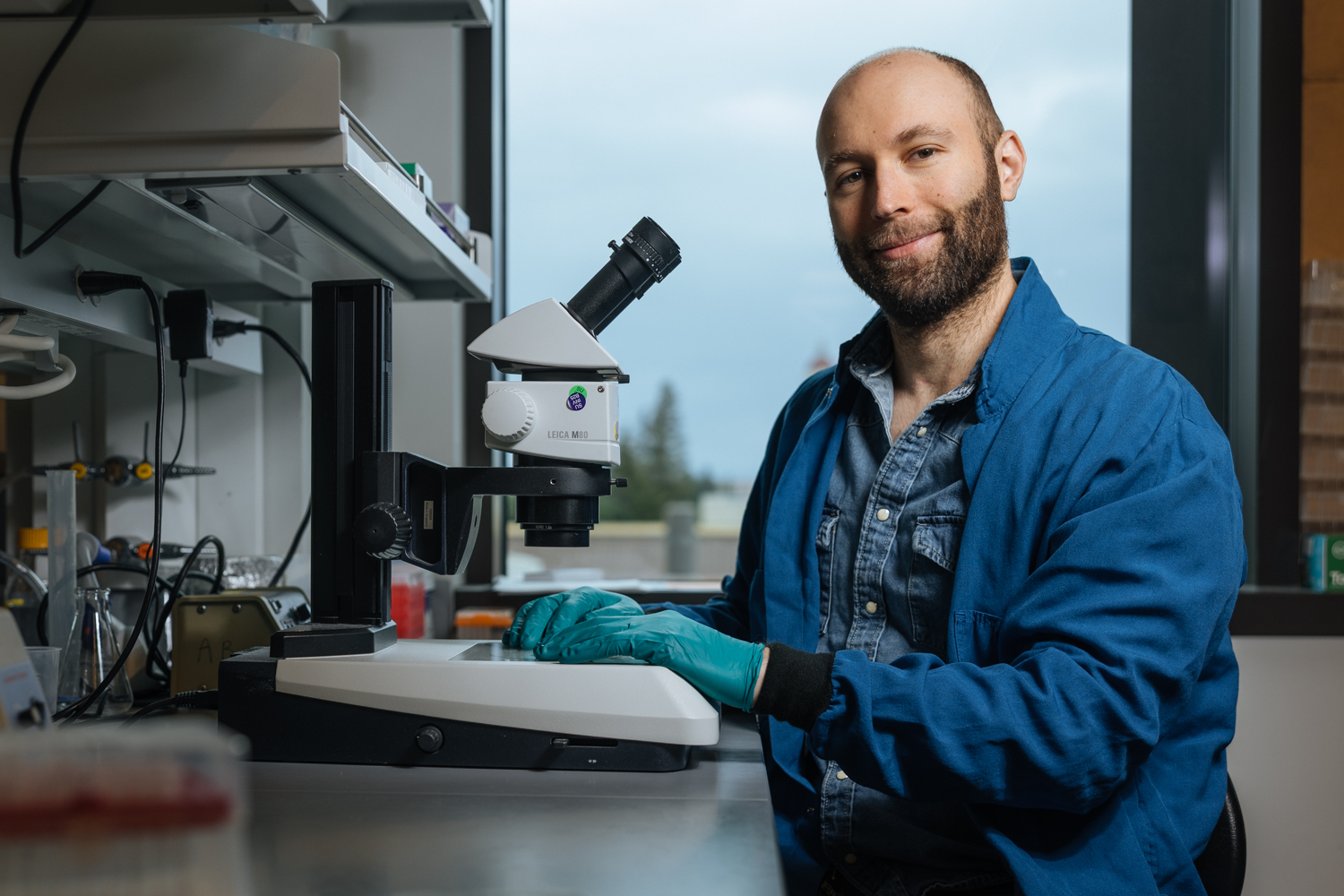
In my case, I work with mice. I manipulate neurons that travel to the uterus and then try to understand the consequences.
Imagine you have 100 different types of neurons that each serve a different function. It’s kind of like a piano where each key makes a sound, and those sounds work together to form music. Ultimately, what you'd want to understand is how you play this piano to make the most beautiful music.
I use targeted tools to eliminate a specific neuronal population, like removing a specific key on the piano. I can then look at what changes result in the uterus to answer questions about those neurons: Which types of neurons communicate with the uterus, how do they change across pregnancy, and what aspects of pregnancy do they help coordinate?
I think it would have been very difficult to pursue this work almost anywhere other than with Anne Brunet and the Wu Tsai Neurosciences Institute, because the project spans aging, embryology, neuroscience, molecular biology, and AI. It asks a question that is best understood in an environment that supports daring interdisciplinary science. Miriam Goodman and Liqun Luo, who lead the postdoctoral fellows program, actively seek out bold ideas and give students the space to grow into them.
What do you hope will come out of this work?
My hope is that this work reveals how neurons help orchestrate the profound physiological changes required for pregnancy, and how those signals may shape whether a pregnancy succeeds or fails.
I would love to say, “We’ll use these findings to prevent miscarriage.”, but it is a very complex phenomenon, and I would need many more years of work to get there. Hopefully, we will. The field is wide open, and there's so much room for discovery. It's a really exciting time to be studying reproductive health.
