
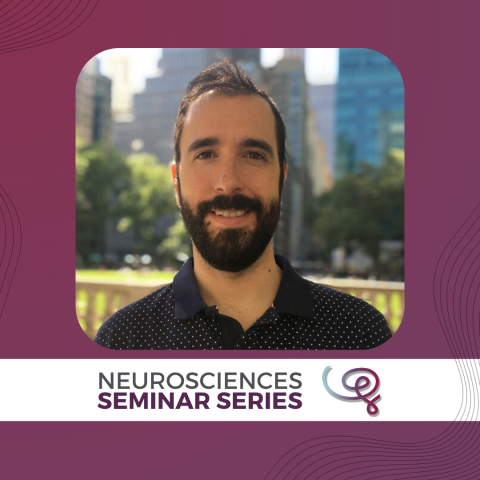
Neurosciences Seminar: Antonio Fernandez-Ruiz - Neural circuit mechanisms for memory and prediction
Join the speaker for coffee, cookies, and conversation before the talk, starting at 11:45am.
Neural circuit mechanisms for memory and prediction
Abstract
Episodic memory involves learning and recalling associations between items and their spatio-temporal context. Those memories can be further used to generate internal models of the world that enable making predictions. While the circuit mechanisms implementing those computations are not well understood, the hippocampo-cortical interactions have been implicated in both processes. Neural ensemble coordination across the hippocampus and associated cortical structures support learning and memory. Hippocampal ensemble reactivation broadcast memory representations to the rest of the brain, a process that supports memory consolidation, retrieval and planning. In this talk I will describe the neural circuit dynamics and plasticity mechanisms that support the formation and reactivation of internal models of the environment in behaving rodents. I will discuss our recent work showing how the sequential activation of cell assemblies is leveraged for planning upcoming spatial trajectories during memory-guided navigation and how their replay during sleep supports the selective consolidation of relevant memories, as well as the generalization of task structures. These findings contribute to a novel framework to understand the neural circuit dynamics that support the generation and use of internal models of the world to guide flexible behavior.
Antonio Fernandez-Ruiz, PhD
he/him | Assistant Professor, Nancy and Peter Meinig Family Investigator, Department of Neurobiology and Behavior, Cornell University
Antonio Fernandez-Ruiz is an Assistant Professor at Cornell University. He studied physics and biology at the Universities of Sevilla and Madrid, in Spain. He completed his PhD at the University of Madrid, where he developed machine learning methods to study the biophysical basis of brain dynamics. He then moved to New York University to work as a postdoctoral fellow in the laboratory of Gyorgy Buzsaki. His research focused on the neural circuit mechanisms of learning and memory in rodents. His work elucidated how the temporal coordination of excitatory and inhibitory inputs mediates communication between brain areas and supports learning. He developed a novel approach to causally probe the role of specific patterns of neural activity in behavior and used it to demonstrate the key function of neuronal sequence in memory formation.
Hosted by Yun Hwang (Haroush Lab)
Sign up for Speaker Meet-ups
Engagement with our seminar speakers extends beyond the lecture. On seminar days, invited speakers meet one-on-one with faculty members, have lunch with a small group of trainees, and enjoy dinner with a small group of faculty and the speaker's host.
If you’re a Stanford faculty member or trainee interested in participating in these Speaker Meet-up opportunities, click the button below to express your interest. Depending on availability, you may be invited to join the speaker for one of these enriching experiences.
Speaker Meet-ups Interest Form
About the Wu Tsai Neurosciences Seminar Series
The Wu Tsai Neurosciences Institute seminar series brings together the Stanford neuroscience community to discuss cutting-edge, cross-disciplinary brain research, from biochemistry to behavior and beyond.
Topics include new discoveries in fundamental neurobiology; advances in human and translational neuroscience; insights from computational and theoretical neuroscience; and the development of novel research technologies and neuro-engineering breakthroughs.
Unless otherwise noted, seminars are held Thursdays at 12:00 noon PT.