
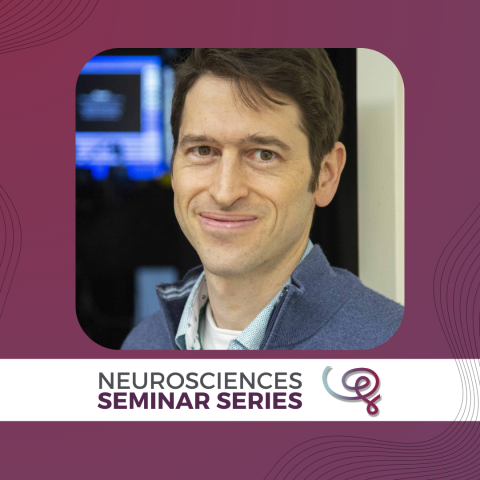
Neurosciences Seminar: Mark Andermann - Tracking offline cortical reactivations and biochemical signaling in the awake brain
Join the speaker for coffee, cookies, and conversation before the talk, starting at 11:45am.
Tracking offline cortical reactivations and biochemical signaling in the awake brain
Abstract
In my talk, I'll first describe our work on offline cortical reactivation of recent visual experiences, how these reactivations may guide visual response plasticity, and whether such reactivations are biased by pre-existing cortical ensembles. I'll then discuss our recent studies on the roles of cAMP signaling in regulating neural activity and plasticity across several hypothalamic and brainstem regions involved in mating, feeding, and pain. Finally, I’ll introduce a new optical method we developed to record up to ten neuromodulatory signals simultaneously in the awake mouse brain by embedding cells expressing different optical sensors in a hydrogel at the tip of a gradient index lens.
Mark Andermann, PhD
Professor of Medicine and Neurobiology, BIDMC / Harvard Medical School | he/him
Mark Andermann, Ph.D., opened his laboratory in the Division of Endocrinology, Diabetes, and Metabolism at Beth Israel Deaconess Medical Center (BIDMC) in 2012. He is a faculty member of the Harvard PhD Program in Neuroscience and Ph.D. Program in Biophysics and a Professor of Medicine and Neurobiology at Harvard Medical School. Dr. Andermann graduated from McGill University in 1999 with a joint honors degree in mathematics and physics, and received his Ph.D. in biophysics and neuroscience in 2005 from Harvard University, working with Chris Moore. Dr. Andermann completed his postdoctoral training with Clay Reid at Harvard Medical School, where he developed new tools for studying the neural basis of visual perception and attention, by tracking neural activity in the same individual brain cells across months in behaving mice. His lab seeks to understand how the needs of the body bias learning, attention, and imagery towards need-relevant objects. To achieve these goals, the lab employs cellular and subcellular imaging of brain cells in retina, thalamus, visual cortex, insular cortex, amygdala, hypothalamus, brainstem and choroid plexus across weeks as mice seek food, water, mates, or safety. This work has been supported, in part, by a Pew Scholars Award in the Biomedical Sciences, a Smith Family Foundation Award for Excellence in Medical Research, a McKnight Scholar Award, and a Director’s New Innovator Award and Pioneer Award from the National Institutes of Health.
Hosted by Rufei Li (Giocomo Laboratory)
Sign up for Speaker Meet-ups
Engagement with our seminar speakers extends beyond the lecture. On seminar days, invited speakers meet one-on-one with faculty members, have lunch with a small group of trainees, and enjoy dinner with a small group of faculty and the speaker's host.
If you’re a Stanford faculty member or trainee interested in participating in these Speaker Meet-up opportunities, click the button below to express your interest. Depending on availability, you may be invited to join the speaker for one of these enriching experiences.
Speaker Meet-ups Interest Form
About the Wu Tsai Neurosciences Seminar Series
The Wu Tsai Neurosciences Institute seminar series brings together the Stanford neuroscience community to discuss cutting-edge, cross-disciplinary brain research, from biochemistry to behavior and beyond.
Topics include new discoveries in fundamental neurobiology; advances in human and translational neuroscience; insights from computational and theoretical neuroscience; and the development of novel research technologies and neuro-engineering breakthroughs.
Unless otherwise noted, seminars are held Thursdays at 12:00 noon PT.