
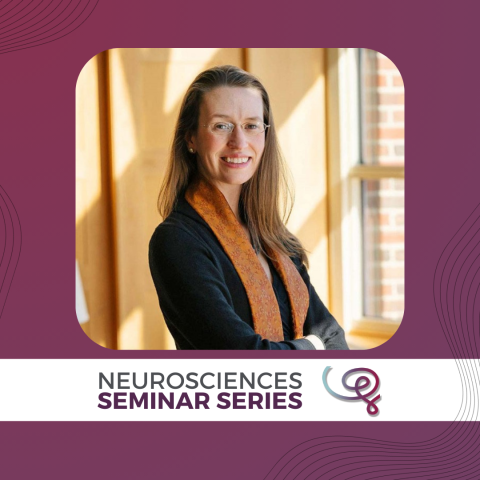
Neurosciences Seminar: Caroline Robertson - Seeing through memory systems
Join the speaker for coffee, cookies, and conversation before the talk, starting at 11:45am.
Seeing through memory systems
Abstract
How does memory shape our perception of the world around us? While the neural systems supporting high-level visual processing and memory are each relatively well understood, how they interact to give rise to memory-guided visual experience remains a fundamental question in cognitive neuroscience. In this talk, I will present a series of studies investigating how memory influences perception in the human brain and behavior, focusing on the process of naturalistic scene understanding. First, I will discuss recent behavioral work combining immersive virtual reality, in-headset eye-tracking, and computational modeling to reveal how memory shapes scene perception during active viewing in behavior and the brain (Mynick et al., 2024 Current Biology). Next, I will discuss recent fMRI work revealing a new computational interface for perceptual-mnemonic interactions at the anterior edge of high-level visual cortex (Steel et al., 2021, Nature Communications), as well as a retinotopically-grounded neural code that mediates perceptual-mnemonic interactions between the hippocampus and cortex (Steel, Silson, et al., Nature Neuroscience). Together, these studies challenge prevailing theories of memory’s role in high-level visual processing and offer new insights into the neural and cognitive mechanisms underpinning memory-guided perception in real-world contexts.
Caroline Robertson, PhD
Associate Professor of Psychological and Brain Sciences, Dartmouth College (she/her)
Caroline is an Associate Professor in the Department of Psychological and Brain Sciences at Dartmouth. Her research group uses cognitive and computational neuroscience approaches to investigate the neural mechanisms underlying memory, perception, and neurodiversity. She earned her PhD from the University of Cambridge as a Gates-Cambridge Scholar and NIH-Cambridge Fellow and continued her postdoctoral work at the McGovern Institute for Brain Research at MIT with a fellowship from the Harvard Society of Fellows. Caroline's contributions to cognitive neuroscience have been recognized by awards including the Society for Neuroscience’s Janett Trubatch Young Investigator Award, the NARSAD Young Investigator Award (2015), and the NSF CAREER Award (2022).
Hosted by Emily Chen (Scaffolding of Cognition Team)
Sign up for Speaker Meet-ups
Engagement with our seminar speakers extends beyond the lecture. On seminar days, invited speakers meet one-on-one with faculty members, have lunch with a small group of trainees, and enjoy dinner with a small group of faculty and the speaker's host.
If you’re a Stanford faculty member or trainee interested in participating in these Speaker Meet-up opportunities, click the button below to express your interest. Depending on availability, you may be invited to join the speaker for one of these enriching experiences.
Speaker Meet-ups Interest Form
About the Wu Tsai Neurosciences Seminar Series
The Wu Tsai Neurosciences Institute seminar series brings together the Stanford neuroscience community to discuss cutting-edge, cross-disciplinary brain research, from biochemistry to behavior and beyond.
Topics include new discoveries in fundamental neurobiology; advances in human and translational neuroscience; insights from computational and theoretical neuroscience; and the development of novel research technologies and neuro-engineering breakthroughs.
Unless otherwise noted, seminars are held Thursdays at 12:00 noon PT.