
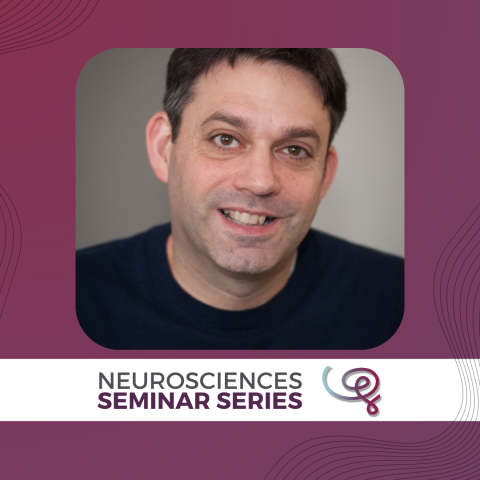
Neurosciences Seminar: Stephen Liberles - Mechanisms of body-brain communication
Join the speaker for coffee, cookies, and conversation before the talk, starting at 11:45am.
Mechanisms of body-brain communication
Abstract
The vagus nerve is a major body-brain communication highway that controls basic functions of the respiratory, cardiovascular, digestive, and immune systems. We charted vagal sensory neuron diversity, and used neurogenetic tools to reveal functions for vagal neurons throughout the body. We elucidated the workings of classical vagal reflexes and also discovered additional reflexes evoked by airway closure and blood volume changes, as well as underlying mechanisms of action. We also charted interoceptive circuits, revealing a brainstem topographic map for visceral senses. Identifying pathways that control autonomic physiology builds a foundation for mechanistic study and therapy design.
Stephen Liberles, PhD
Professor of Cell Biology, Harvard Medical School (he/him)
Dr. Liberles is a Professor and HHMI Investigator in the Cell Biology Department at Harvard Medical School who focuses on the molecular neuroscience of sensory systems. Dr. Liberles received an undergraduate degree in Chemistry from Harvard in 1994, and a Ph.D. in Chemistry and Chemical Biology from Harvard in 1999, working in the lab of Stuart Schreiber. He then performed post-doctoral work in the lab of Linda Buck, first at Harvard Medical School and then at the Fred Hutchinson Cancer Research Center in Seattle. He discovered non-classical families of olfactory receptors and charted how the vagus nerve controls physiology and behavior. His studies of sensory neurons in the airways, cardiovascular system, and gut led to the identification of novel body-brain reflexes, sensory receptors and mechanisms underlying classical reflexes, and key features of how inputs from the interoceptive nervous system are organized in the brain.
Hosted by Yingyue Zhou (Krasnow Lab)
Sign up for Speaker Meet-ups
Engagement with our seminar speakers extends beyond the lecture. On seminar days, invited speakers meet one-on-one with faculty members, have lunch with a small group of trainees, and enjoy dinner with a small group of faculty and the speaker's host.
If you’re a Stanford faculty member or trainee interested in participating in these Speaker Meet-up opportunities, click the button below to express your interest. Depending on availability, you may be invited to join the speaker for one of these enriching experiences.
Speaker Meet-ups Interest Form
About the Wu Tsai Neurosciences Seminar Series
The Wu Tsai Neurosciences Institute seminar series brings together the Stanford neuroscience community to discuss cutting-edge, cross-disciplinary brain research, from biochemistry to behavior and beyond.
Topics include new discoveries in fundamental neurobiology; advances in human and translational neuroscience; insights from computational and theoretical neuroscience; and the development of novel research technologies and neuro-engineering breakthroughs.
Unless otherwise noted, seminars are held Thursdays at 12:00 noon PT.