
Why do some animals live longer than others?
Today on the show, why do some of us age faster than others? Why do some of us grow old and die before our time while others seem to simply endure? And most of us have probably wondered at one point or another, which track am I on?
Turns out it might be possible to predict the whole trajectory of an animal's life at a surprisingly young age, just by looking closely at subtle patterns of behavior. That's the conclusion of a new study from researchers at the Knight Initiative for Brain Resilience here at Wu Tsai Neuro, out March 12, 2026 in the journal Science.
The study focused on the African turquoise killifish, a little fish that lives fast and dies young. This species has one of the shortest lifespans of any vertebrate, which makes it ideal for studying the entire arc of a life in the laboratory setting.
The important point here is that even short-lived killifish are dealt different lots by the fates. Even when you control for genetics and the environment, some killifish only live a month or two, while others can live as long as a year. So the big question is, what drives this difference in longevity?
To learn more, we're joined today by the study's two lead researchers, Wu Tsai Neurosciences Institute Postdoctoral Scholars, Claire Bedbrook and Ravi Nath, who performed the research in the labs of Anne Brunet and Karl Deisseroth here at Stanford.
SUBSCRIBE on Apple Podcasts, Spotify, Amazon Music and more.
Learn More
- To study aging, researchers give killifish the CRISPR treatment (Knight Initiative for Brain Resilience, 2023)
- Study pinpoints key mechanism of brain aging (Stanford Report, 2025)
- Killifish project explores the genetic foundation of longevity (Stanford Medicine 2015)
Multi-tissue transcriptomic aging atlas reveals predictive aging biomarkers in the killifish (Nature, 2026)
Episode credits
This episode was produced by Michael Osborne at 14th Street Studios, with sound design by Mark Bell . Social media strategy is by Julia Diaz, and additional editing by Nathan Collins. Our logo is by Aimee Garza. The show is hosted by Nicholas Weiler at Stanford's Wu Tsai Neurosciences Institute and supported in part by the Knight Initiative for Brain Resilience.
Share the show:
If you're enjoying our show, please take a moment to give us a review on your podcast app of choice and share this episode with your friends. That's how we grow as a show and bring the stories of the frontiers of neuroscience to a wider audience.
Get in touch:
We want to hear from YOUR neurons! Email us if you'd be willing to help out with some listener research, and we'll be in touch with some follow-up questions.
Transcript
Nicholas Weiler (00:10):
This is from Our Neurons to Yours, a podcast from the Wu Tsai Neurosciences Institute at Stanford University, bringing you to the frontiers of brain science. I'm Nicholas Weiler.
Today on the show, why do some of us age faster than others? Why do some of us grow old and die before our time while others seem to simply endure? And most of us have probably wondered at one point or another, which track am I on?
Turns out it might be possible to predict the whole trajectory of an animal's life at a surprisingly young age, just by looking closely at subtle patterns of behavior.
That's the conclusion of a new study from researchers at the Knight Initiative for Brain Resilience here at Wu Tsai Neuro out this week in the Journal Science. The study focused on the African turquoise killifish, a little fish that lives fast and dies young. This species has one of the shortest lifespans of any vertebrate, which makes it ideal for studying the entire arc of a life in the laboratory setting.
(01:14):
The important point here is that even short-lived killifish are dealt different lots by the fates. Even when you control for genetics and the environment, some killifish only live a month or two, while others can live as long as a year.
So the big question is, what drives this difference in longevity? To learn more, we're joined today by the study's two lead researchers, postdoctoral scholars, Claire Bedbrook and Ravi Nath, who did this research in the labs of Anne Brunet and Carl Deisseroth here at Stanford. I started by asking them how they set up this experiment.
Claire Bedbrook (01:47):
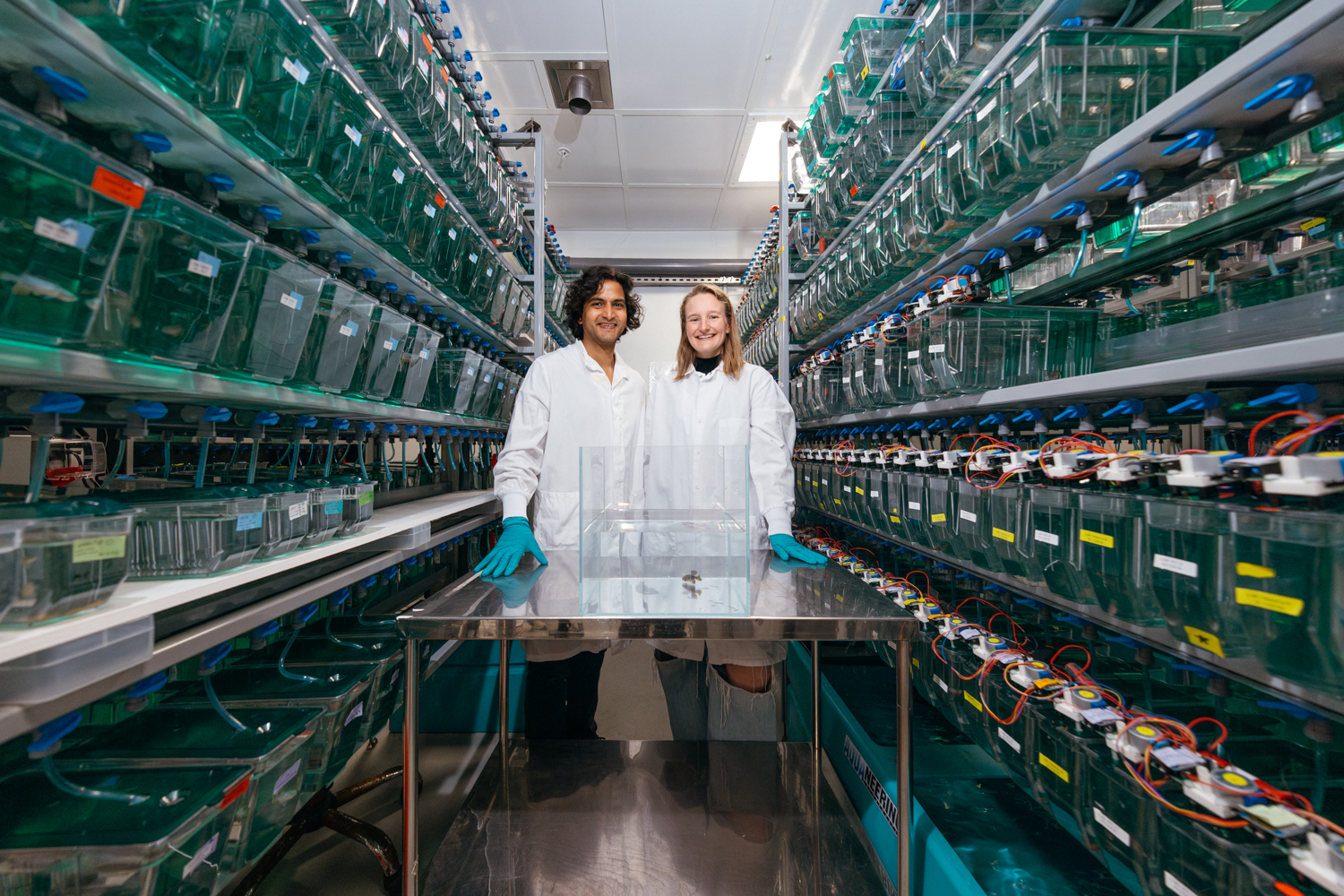
Yeah. So we built a system where we have cameras that are mounted on the ceiling, looking down with a bird's eye view on individual tanks that have these killifish individually housed within them. And we place the killifish in these tanks at adolescents. So for us, that's about one month of age. And then they remain in the same tank until their natural death and we record the entire process continuously at 20 frames per second, so a pretty high resolution. So this is really to just give us a view of the aging process from adolescence all the way until death.
Nicholas Weiler (02:31):
So the image I always get is a little bit like the Truman Show vibe where someone is under surveillance basically for their entire life, except you've done this for scores and scores of these killifish.
Claire Bedbrook (02:42):
Exactly.
Nicholas Weiler (02:44):
Okay. So you've got these fish under surveillance. You've got a fishy panopticon going on. And I guess the question is, why did you do this? What was the idea behind following on video these fish over their whole lives?
Claire Bedbrook (02:59):
Yeah, I think honestly, I was really kind of curiosity driven. What could we learn? What would we see if we just, like you said, did the Truman Show of fish, if we continuously observed animals across the aging process? Of course, we were really interested in more specific questions such as how much we sleep early on in life have any linked to how long we live.
Nicholas Weiler (03:26):
I'm interested in why you were interested in recording behavior specifically. And Ravi, maybe you can tell us a little bit about the genesis of this experimental setup. We've seen a number of papers come out looking at molecular aging clocks, like what's going on in the blood or in brain cells or what have you, that we can see differences in the course of aging. But you were interested in looking at behavior. Was there something in the field that made you think that might reveal something that we hadn't seen before?
Ravi Nath (03:57):
Yeah, I guess it's known that as we age, our behaviors do change. And then really from the experimental side, there's beautiful work done in invertebrate species like sea elegans, which is very genetically tractable roundworm that's often used in experiments. And people have monitored sea elegans behavior as they age and found that behavior is important in the aging process. And we were really excited to do this in a vertebrate animal for the first time and really look at vertebrate behaviors and how they're changing with age. And I should also mention that there's also evidence that behavior's changing in humans and looking at things like gait speed or other metrics that have been linked to the aging process.
Nicholas Weiler (04:44):
This is suddenly reminding me of JQE's speech from Shakespeare talking about the ages of man, like from crawling to standing and then bending over in old age. You can instantly recognize something about someone's age based on how they move, how they talk. So I guess it's not that surprising. When we talk about age, maybe what we're usually mostly talking about is behavioral age. Science is now trying to understand what is age at a molecular level? Why do we age? But yeah, when we colloquially talk about age, a lot of it is how is someone behaving? And you might say they seem older than they should, or someone is 70, but they act very youthful. And maybe that's the holy grail, right? I'd like to be behaving like a young person when I'm 80 or 90.
Claire Bedbrook (05:31):
Yes.
Nicholas Weiler (05:32):
So you mentioned that one of the motivations here is people have done things like this in sea elegans, which is this worm that scientists use to study neuroscience and study aging, but this is one of the first times or the first time that this has been done in a vertebrate.
(05:47):
Ravi, I wonder if you could give me just a little backstory. What is the killifish and why did you pick this animal for this experiment?
Ravi Nath (05:53):
Yeah, ecology is actually quite fascinating. It's originally from ephemeral ponds in Zimbabwe and Mozambique in Africa. In this region, there are these dry periods where the land is arid and the fish lay their eggs in the dirt. And then when it rains, they create these rather large ponds where the fish kind of hatch and live their life. And because of this environment, they've developed a short lifespan and scientists have brought these fish into the laboratory to study. And with the advent of CRISPR, they've also become a genetically tractable model organism, meaning we can manipulate their genes and perform molecular biology experiments. And so scientists in the field want to use this model to really study aging. And because they have a compressed median lifespan of 48 months, we can perform experiments and test how interventions and genes really change a vertebrate animal's life. And hopefully this could one day, the findings we make could one day be translated to humans.
Nicholas Weiler (07:00):
That makes so much sense because in studying aging, in humans, one of the biggest challenges is it takes a really long time. Humans live to age 80 or beyond. So trying to study all the different stages of that would be a very big time commitment. And even a mouse lives two or three years.
(07:19):
Studying a whole lot of mice over that period of time, it's going to take a really, really long time in the lab. So this is a very cool experimental system where you can track over a hundred animals over the course of the few years that you spent on this project and try to say, well, what does a life look like? What's the arc of a life for the killifish? And they go through most of the same phases that human or other vertebrates go through. There's sort of like adolescence, young adulthood, middle age, older age.
Claire Bedbrook (07:47):
Yeah. I think you're bringing up a great point that they have really shared hallmarks of aging with humans. So it's not just that they live short within their compressed lifespan. They really do show a natural aging progression and phenotypes that we can really relate to as humans start loss in pigmentation, spine curvature, neuro degeneration, loss in vigor.
Nicholas Weiler (08:11):
So let's talk about what you found. So you've got all of these killifish. They're in tanks. As you said, they have video cameras, you're watching their behavior from adolescence until their natural death. And these are all sort of clones of one another, right? They're genetically pretty identical. They're in identical environments.
Claire Bedbrook (08:30):
Yeah. So it's an inbred line that we're working with. There's still some diversity, genetic diversity within the line, but yeah, pretty homogeneous.
Nicholas Weiler (08:39):
So let's talk about your top line findings. I mean, you had some short-lived animals and some longer lived animals. How early could you see differences between those animals start to emerge?
Claire Bedbrook (08:50):
Yeah. So we were really excited that if you look at the behavior of these short-lived animals versus the long-lived animals.
Nicholas Weiler (08:59):
And we're talking like a couple of months versus up to a year for the longest lived animals.
Claire Bedbrook (09:03):
Yeah. That's a pretty big difference. For the really, really long-lived ones. You can see behaviors actually quite early on in life that are different between those populations. So before middle age, I would say 30, 40 in human years, it's hard to do a direct conversion from fish to human years. But I'd say middle age, we start to see a deviation in the behavior of animals that are destined for a short lifespan compared to those that are going to live for a really long time.
Nicholas Weiler (09:39):
And just to be clear, I remember it took me a minute to figure this out when I was looking through the study. When you say destined to live, what you're doing is you're taking the animals that lived a short time and a long time, and then going back through this lifetime of video that you have using machine learning and saying, "What are patterns that distinguish the ones that lived a short time and a long time?" So you know which ones died early and which ones lived a long life, and now you're going back and saying, "When could we first see the difference?"
Claire Bedbrook (10:06):
Yeah, so they're all living in parallel with one another and living out their life. We record their entire lifespan and post hoc go back and say, "What was different between these animals behaviorally?"
Nicholas Weiler (10:17):
And what were some of the behaviors you saw that were different in the short and long-lived fish?
Claire Bedbrook (10:22):
Yeah, so some striking differences were that animals, and again, this is at that middle-aged time point. So this is still a long way away from them actually dying. The differences we see are the animals destined for a long lifespan, they show higher movement velocity and much higher peak movement velocity. So their sort of darting or sprint speed is higher than those that are destined for a short lifespan. Another characteristic that we look at is sleep behavior and also the timing of when sleep happens. So does it happen during the day or the night? We see that animals destined for a long lifespan, they seem to sleep more. They have elevated levels of sleep, but that sleep is really concentrated mostly to in their night or dark cycle. Whereas the animals destined for a shorter lifespan show more sort of distributed sleep throughout both the day and the night.
Nicholas Weiler (11:22):
Interesting. And I think it's really cool that you did this in a kind of unbiased way where you took their whole behavior, these billions of frames of video over the course of their lives and basically cataloged it into, you called it syllables of behavior, like turning around, swimming forward, scooting along the glass. And so you have each frame essentially labeled as to what the fish was doing at that time. And so these conclusions about faster swimming, vigor, sleep, and so on, those are the ones out of all the different things you looked at that popped out as different between these two groups. So I just wanted to clarify that, that there's a lot of other stuff that fish were doing. These were the things that seemed like they predict whether a fish was going to live a long or short life. And in fact, you could use them to predict, right?
(12:07):
You could just look at the behavior and tell how much longer a fish had to live. Am I taking that too far or is that accurate?
Claire Bedbrook (12:13):
No, that's true. I think I should be clear that you describe explicitly exactly what we've done. We sort of cataloged the different types of behaviors that an animal can do at any given time. I am highlighting behaviors that were really different between those two groups. I should say that there are also other behaviors amongst all of the different behaviors we characterize that are different. It's not only the sleep and velocity. So there are many differences between the animals that are destined for a short lifespan versus long lifespan. And exactly because there are so many, they are behaviorally really distinct from one another, we are able to, at that middle-aged time point, accurately predict or classify that animal as destined for a short lifespan versus long lifespan.
Nicholas Weiler (13:01):
It's so wild that you could see that early. On the other hand, I mean, the idea that youthful, this sort of idea of vigor, of circadian regulation, like getting good sleep at night and not napping during the day and things, these are things that have been tied to aging in humans as well. And so while it's amazing that you can see them that early, it's not entirely surprising that those would be the things you would see, particularly given that these are genetically very similar animals and they're existing in identical, as best you could make them, environments. To me, the question this raises, and this is something that you got into, is, well, why? Why are some animals more vigorous? Why do some animals have better circadian regulation given how similar the animals are? I mean, these animals are very similar and some of them are only living a couple of months and some of them are living 12 months.
(13:52):
So what answers did you extract from studying these animals? Could you see at a biological level any hints as to why some of these animals seem to be on a long-lived trajectory and others were on a short-lived trajectory?
Claire Bedbrook (14:08):
Yeah, I would say that we looked at sort of a molecular level using transcriptomics to compare animals at a young age that are destined for a long lifespan or destined for a short lifespan based on their behavior. And we do see clear differences in a lot of metabolic terms. Sort of ribosome biogenesis seems to be different between the two groups, maybe protein synthesis. It's still, I would say, just a first kind of snapshot of what could be different between these two groups. But what I think is still a really open question that we haven't answered is what is actually driving these differences that we're seeing. As you've said, could it be some underlying genetic difference? We are looking at a relatively homogeneous population, but there are still some genetic differences between these animals. Is it in a slight difference in environment even though we think their environment's highly controlled or is it some stochastic difference that happens throughout development?
(15:14):
We don't know. Those I would say are still really open questions, but what is exciting is that the differences that we see in these young versus long destined populations, we see both at a behavioral level and at a molecular level.
Nicholas Weiler (15:30):
So the way that I read this, you mentioned things like ribosome biogenesis and protein synthesis and things, and this is like some hairy cell biology business. I think if I remember correctly, this was especially true in certain organs like the liver where there's a lot of metabolic activity going on. So it's cool that you can see some of these molecular differences in the short-lived and the long-lived fish are happening in different tissues. You can identify some of the cellular processes that are different. It sounded like there were just differences in how much work the cells were doing. How hard are these cells working either to replicate themselves or to maintain themselves in some sort of metabolic equilibrium? In the short-lived fish, it seemed like those cells were working harder. They were making more proteins perhaps. Maybe they were engaging in more cell division. I'm not sure if that is totally borne out in the data, but is that sort of a big picture what it kind of looks like to you?
Claire Bedbrook (16:26):
Yeah. I want to be careful not to overstate because we aren't actually specifically measuring protein synthesis, but those are kind of the signatures that we're seeing that are changing. And those are also signatures that in mammalian systems and in human cells, for example, there are links to either interventions that are known to extend lifespan or genetic perturbations that shorten lifespan. So it is aligned with what has been observed in other systems.
Nicholas Weiler (17:01):
Ravi, I'd love to hear from you as well on this sort of how do we connect some of these aging biology findings to what else has been known in the field. Do we see things like this with just general cellular processes revving a little higher? How do we make sense of that, I guess, is my question.
Ravi Nath (17:20):
I think some of the pathways that we found weren't necessarily unexpected from the literature that people have found these pathways involved in the process of aging before. I think what was really remarkable is how early we could distinguish these trajectories. And I hope longer term with studies, we could possibly have interventions and manipulations at the time when these pathways are changing to see if we could change an animal's trajectory.
Nicholas Weiler (17:52):
That was one of the things I thought was so cool. And you actually did an intervention, this dietary restriction, caloric restriction, which as we've said, common in many aging researchers I've talked to, maybe we eat too many times a day. Ravi, can you give me a little background on that? What is the literature on caloric restriction and how did you apply that here?
Ravi Nath (18:15):
Yeah. So dietary restriction and kind of restricting calories is probably one of the strongest longevity interventions across various species. General explanation is it's thought to basically put an organism and cells into a state of self-preservation. So the cell turns on pathways that are involved in cleanup, so like autophagy to clean up cellular debris and put on pathways that kind of promote preservation. And so-
Nicholas Weiler (18:48):
Kind of puts all your cells on notice.
Ravi Nath (18:50):
Yeah. And there's lots of interesting evolutionary theories about why this is, but we basically just applied two different dietary regimens to the killifish. We saw that calorie restricted or dietary restricted animals live longer.
Nicholas Weiler (19:04):
How much longer?
Ravi Nath (19:06):
I think it's about 20% increase in lifespan, but I don't remember the exact number.
Nicholas Weiler (19:10):
Pretty decent. Okay.
Ravi Nath (19:12):
Yeah. A decent percentage. And then so we applied a very similar paradigm. So the fish during the day were normally fed ad libitum. They were fed seven times throughout the day.
Nicholas Weiler (19:22):
Ad libitum meaning whenever they wanted.
Ravi Nath (19:24):
Yeah, it's not totally whenever they wanted, but they have access to food seven times a day, whereas the dietary restricted fish had access to food three times a day only in the morning. So it was both calorie restricted and time restricted feeding. And then we applied the paradigm to the killifish and then looked at their behavior. And it was really remarkable. There were dramatic differences in the behavior of the animals when they had calories restricted.
Nicholas Weiler (19:50):
I mean, were you basically seeing that this reversed some of the... Could this move the animals from the short-lived trajectory towards the long-lived trajectory? Is that what you were seeing in the behavior?
Ravi Nath (20:03):
We didn't perform that experiment yet. That's something we were really excited to do in the future. Taking animals when they're already on a trajectory and then changing something to see if you could modify their trajectory, that's I think a really excellent future direction that we hope to pursue. The thing that we observed is that they were just actually just aging more slowly. So these animals were dietary restricted post-sexual maturity, and we saw that they were progressing through their aging trajectory at a much slower rate than those animals that were fed normally.
Nicholas Weiler (20:39):
I mean, that's why I thought that the sort of cell biology and things as well as the behavior were so interesting because I think we think of aging as something that happens later in life, but this whole set of experiments is suggesting that aging is something that happens throughout life and that perhaps there are things you can do to adjust the speed of aging even when it's not necessarily yet apparent. Claire, what's your takeaway from the dietary restriction experiments? What do you think it was changing in the fish's aging process?
Claire Bedbrook (21:10):
Yeah. So behaviorally, animals under dietary restriction showed more sleep again at night. So this tighter regulation of when animals were sleeping, that was a big difference. I think the dream experiment now is to see if when we apply dietary restriction on an animal that's on a short lifespan trajectory, would this sort of revive that and shift them over to a longer lifespan trajectory? Something we don't know yet, but I do think it's really interesting that we're seeing this kind of slower rate of aging in the animals that have gone through dietary restriction.
Nicholas Weiler (21:54):
But what you did see, if I understand correctly, is when you put animals on dietary restriction, more of them seemed to be on a trajectory that looked like the longer lived trajectory. Is that right? It pushed the distribution.
Claire Bedbrook (22:06):
Yeah. It really shifted them to look younger. The entire population looked younger.
Nicholas Weiler (22:11):
Right. So you weren't able to show that you could take an animal that was destined for a short life and make it long-lived, but when the animals were under dietary restriction, all of them looked like they were on a more long-lived trajectory.
Claire Bedbrook (22:22):
Yes. I should say though that there was still diversity within that population of animals. So it's not making every single animal all have the most long-lived behavior, but it is really shifting the population quite a large amount. So I don't know the conversion to sort of human years, but they looked sort of a month younger than their true age.
Nicholas Weiler (23:12):
So I really want to get... We've been talking a lot about fish and the fish are fascinating, but I want to get to humans soon. The one last thing I want to touch on about the experiment before we dive into what does this mean for us was that you also saw this thing in the fish that has kind of been noted in humans, which is that there seemed to be phases of aging, that it wasn't actually that aging was happening continuously or in the behavior, but there would be these sudden shifts where at some point each fish would go from looking like a young adult to looking like a middle-aged adult or looking like a middle-aged adult to looking like an older adult. Can you describe these different sort of life phases that you saw in the behavior?
Claire Bedbrook (23:54):
Yeah, so we didn't expect this. I think probably my hypothesis going in would have been that it is a more gradual process, but when we just looked at whole lifespan behavior for individual animals, we would see these really abrupt transitions where they would go from every day to the next looking pretty similar across periods of aging, followed by these kind of abrupt transitions where they seem to enter a new and distinct behavioral life stage. We really observe this across the population, and we think that these stages are relatively stereotyped.
Nicholas Weiler (24:34):
Meaning all the animals go through similar transitions just at different times.
Claire Bedbrook (24:38):
Exactly. They don't all go through exactly the same stages, but there are overlapping kind of behavioral life stages that they seem to have and they progress through them in a very similar manner. But the timing of when they transition from one to the next varies a lot depending on which animal you're looking at.
Nicholas Weiler (24:56):
And would it be accurate to say that one interpretation of this is the short-lived animals are just moving through these phases more quickly?
Claire Bedbrook (25:03):
Yes, that is what we largely see.
Nicholas Weiler (25:06):
Interesting. And so you could theoretically think about extending any of these phases and extending the overall life expectancy.
Claire Bedbrook (25:14):
Yeah. And I think that's something really exciting to me about behavior because not all stages are probably equivalent in terms of the health of the animal and the experience of the animal. So being able to extend these youthful and what are typically early in life stages, I think would be really beneficial instead of extending the later life stages where animals are eating less and showing less vigor, just drifting around the tank, looking less motivated. I'm just giving my own interpretation of how-
Nicholas Weiler (25:52):
We can anthropomorphize the fish a little bit.
Claire Bedbrook (25:58):
Yeah. Yeah. So this kind of gives us the ability using behavior to identify when these transitions are happening. Can we modulate some transitions or when we extend animal lifespan with an intervention like dietary restriction, does that just extend all of them or does that preserve certain stages while not lengthening others? This is still an open question.
Nicholas Weiler (26:19):
Right. But now we have, I mean, you've created this model where you can test some of these things, right? You can see these differences.
Claire Bedbrook (26:26):
Yeah.
Nicholas Weiler (26:26):
You can identify which fish are on one trajectory or another based on their behavior and you can start to say like, "Well, what does this intervention do? Does it affect one phase over another? How does it actually extend lifespan?" I wanted to just stick on this question of the life phases, because I thought your interpretation of this was actually really interesting, which is it seems like maybe there is some underlying process of aging that builds up to a point where the animal can no longer adapt or cover for it, and that the cells then need to sort of switch gears, you use this sort of gear switching metaphor, to switch gears into a new, maybe less optimal but stable metabolic state that the animal could then live in for another long time before whatever is going on with aging builds up to a intolerable level again.
(27:21):
Am I explaining this in a way that's consistent with your data?
Claire Bedbrook (27:24):
Yeah, that's exactly how we think about it. That's another thing I want to work on. Is it a genetic driver? Is it gradual at the molecular level, but behaviorally it's a really abrupt transition, they just can't take enough and then they have to transition. And that's something behaviorally we see as this sort of stark transition, but yeah, still open.
Nicholas Weiler (27:48):
Right. The muscles are no longer quite as strong as they were, and so now we're hobbling around, right? Something suddenly you just have to change how you're working through life. So yeah, I mean, this is obviously an experiment you can't do with humans easily and ethically. I mean, we don't have a Truman Show model for human subjects. I don't think that would get past the human subjects panels. So how do we start to extrapolate some of these findings to our species? To be honest, I mean, the whole thing makes me a little bit anxious because is our lifespan predicted by random variation. Like I'm in my 40s now. Am I already on one trajectory or another? How do we think about this?
Claire Bedbrook (28:30):
Yeah. I mean, while we haven't done the explicit experiment here, I think we have shown that with an intervention, the entire population was shifted to look healthy and more youthful. So I absolutely believe changes in feeding behavior, things like that can really shift us to a different trajectory. Though again, we haven't done the explicit experiment.
Ravi Nath (28:52):
I guess if we could generate similar models in humans and you could have a quantified value that told you what trajectory you were on, it might motivate someone to change their behavior more proactively.
Nicholas Weiler (29:09):
Do we have anything like that in humans? I mean, so the idea of these aging phases reminded me immediately of Mike Snyder's work at Stanford showing more at a molecular level that you can see these sharp transitions in the, I think early 40s and around age 60 that you can see suddenly at a molecular level, people tend to make these jumps in aging. Do we know anything else about how you could figure out what aging trajectory you're on and whether there are things we can do about that?
Claire Bedbrook (29:42):
Yeah, I think there're exciting epigenetic clocks. There are in the field methods where you might be able to predict your age and maybe you'd be able as a human to see what aging trajectory you're going on. What would really excite me is, I mean, many of us are wearing watches that measure our activity or we do have some readout of our activity levels, our maybe circadian behaviors. What I am excited about from this study is it does seem that behavior is really informative about our aging trajectory, where we are in the aging process. I think it would be really exciting if that could be expanded to humans using not continuous recordings of humans across life, but I can imagine just using our actigraphy data from Apple Watch or whatever your favorite wearable is. And maybe that would be really informative because at least in the fish, it is. Behavior is very informative.
Ravi Nath (30:49):
Yeah. And also to add on that, it's non-invasive. A lot of the metrics that people would guess, like doing a blood test, it's not super thrilling to have to do that, to get information about yourself. So you can do this non-invasive measurement and just have a real readout. I mean, that's what we saw in the fish. It might also be true in humans. And I think, like Claire said, I think the work kind of motivates that direction.
Nicholas Weiler (31:14):
So one of the things that I was thinking about a lot as I was looking at your paper and thinking about this conversation is in health circles, there can be a tendency for putting a lot of blame on the individual. We know that exercise is good for aging, so get up off the couch and go work out. We know that circadian rhythms are really important and having solid sleep at night and not napping during the day. It's easy to interpret that as don't take naps. But really, I mean, one of the things we're seeing here is there's some fundamental biology going on that is putting these fish on different trajectories. Although at one point in the paper you wrote that, I'm going to quote this because I think I misread this and thought it was funny. You said vigorous activity patterns which are associated with long lifespans could be linked to individual energy conservation decisions and actions that have been associated with fitness outcomes, which did sort of sound like you were blaming these fish for being short-lived or long-lived. I'm not sure if that's what you intended.
Claire Bedbrook (32:15):
I think innate decision.
Nicholas Weiler (32:19):
Maybe energy regulation decisions at the cellular level was how I reframed this for myself. But I mean, how do we take this... Again, taking this up to ourselves, this is obviously research in fish and we want to understand how does this inform us about the fundamental biology of aging? Does this take us to a biology is fate? Does this take us to a, you need to focus on these things in your life to advance healthy aging? Maybe how do you as people think about this? Does this change the way you think about your behavior, about the aging process and so on?
Claire Bedbrook (32:58):
I think, I mean, this is just such a fascinating subject area. I think that we don't have a good answer here on what's really driving the differences. We are just observing the differences right now. But I do feel really confident from this study that when you do an intervention, it does have dramatic effects independent of what would have been the animal's fate if they didn't go through an intervention. So I feel optimistic that it isn't sort of predetermined and you can change your trajectory.
Nicholas Weiler (33:38):
But first we have to understand what causes the trajectory.
Claire Bedbrook (33:40):
Exactly. Exactly. So I think that's still really an open question and something that I'm excited that we could start to get at with this system, but not something that we know yet.
Nicholas Weiler (33:50):
And so you guys are both moving to professorships at Princeton, which is exciting. Congratulations on opening the new labs. What are some of the questions you want to ask next?
Claire Bedbrook (34:00):
Yeah, I think we actually started touching on some of the next things I really would love to do with this system. So can we start adding interventions later on in life and seeing if we can shift an animal's trajectory to a different place? Sort of more explicitly trying to get at the questions you're asking. Are these just predetermined? Can we change and reshape the trajectories animals go on as they age? When should we do that and how? So what are different types of interventions that we can use to make a positive impact on not just how long an animal lives, but preserving those sort of youthful, healthy stages of life.
Nicholas Weiler (34:46):
And how about you, Ravi?
Ravi Nath (34:47):
Yeah, so I'm really interested in the genetic tractability of the model and in an unbiased way, screening different factors in genes to see if we can manipulate the genetics kind of explicitly making these animals not the same genetic background, but changing individual genes or different proteins and looking at how manipulating them can impact these trajectories. And using this quantitative approach that's noninvasive with behavioral tracking, we can not just have this endpoint that is like the lifespan of a population, but really quantify how these genetically manipulated animals are actually different from the wild type or control population. And I also think another direction that's kind of exciting is to start to create human disease models in the fish. So modeling elements of Alzheimer's disease or specific aspects focusing on disease proteins, and then seeing do we see that they have different life stages or do interventions change the rate that the disease progresses?
Nicholas Weiler (35:55):
Yeah, that's such a great point. I mean, very central to the mission of the Knight Initiative for Brain Resilience, which in part supported this work is like, seems like aging is really a common factor across all kinds of different diseases, just aging itself. And so this effort to understand what is aging, what is the biology here, understanding that could lead to benefits across all kinds of different disorders, which are made much more likely by the process of aging. Well, I am going to thank you both for joining us to talk about this fascinating paper. I really appreciate you coming on the show.
Claire Bedbrook (36:30):
Thank you so much. It has been really fun.
Ravi Nath (36:32):
Yeah, this was awesome.
Nicholas Weiler (36:34):
Thanks again so much to our guests, Claire Bedbrook and Ravi Nath. They're both Wu Tsai Neurosciences Institute postdoctoral scholars and are about to start new labs as assistant professors at Princeton University. To read more about their work, check out the links in the show notes. And if you enjoyed this episode, please be sure to subscribe for more conversations from the frontiers of brain science. We also love hearing from listeners. If you have thoughts about the show or questions about the brain you'd like to hear us discuss in a future episode, send us an email at neuronspodcast@stanford.edu, or leave us a comment on your favorite podcast platform. While you're at it, please give us a rating and share the show with your friends. It might seem like a small thing, but it is tremendously valuable for us to be able to bring more listeners to the frontiers of neuroscience.
(37:24):
Next time on From Our Neurons to Yours.
Neir Eshel (37:29):
When people think about dopamine as a happy or a reward molecule, that's partly right, but it's more complicated than that because what it seems to be more capable of doing is regardless of whether the thing that you're getting is actually pleasurable or not, it makes you want more of it.
Nicholas Weiler (37:48):
From Our Neurons to Yours is produced by Michael Osborne at 14th Street Studios, with sound designed by Mark Bell. Our social media strategy is by Julia Diaz, additional editing by Nathan Collins. Our logo was designed by Amy Garza. I'm Nicholas Weiler. Until next time.

