
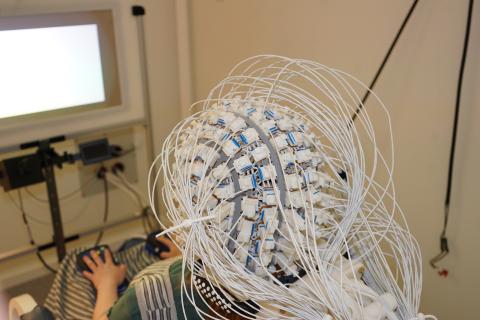
Magnetoencephalography (MEG) is a non-invasive technique to measure tiny magnetic fields caused by the electrical activity neurons in the brain. A new generation of MEG sensors, called Optically Pumped Magnetometers (OPMs), can be placed directly on the scalp and thus promise improvements in signal strength over classical MEG systems.
The Koret Human Neuroscience Community Lab houses one of the very first, high-density OPM-MEG systems on the West Coast. Our system is housed in a custom-built magnetically shielded room with active and passive shielding capabilities, which provides an optimal environment in which to measure these neural signals.
The facility provides investigators across the Stanford campus with access to OPM-MEG technology that can be combined with a variety of sensory stimulation protocols. We offer a welcoming, supportive and comfortable environment for research participants and their caregivers.
We provide:
- The first and only MEG system on Stanford campus
- Equipment specifically designed for visual and auditory stimulation, recording participant responses, and eye tracking within the magnetically sensitive environment
- Technical staff to train and assist new researchers in data collection and analysis
- Equipment for co-registration of OPM-MEG sensors with MRI data for source localization