
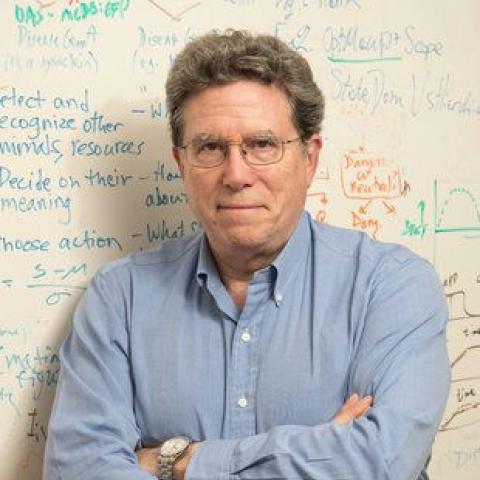
David Anderson - Neural Coding of Affective Internal States Underlying Innate Behaviors
Join the speaker for coffee, cookies, and conversation before the talk, starting at 11:45am.
Neural Coding of Affective Internal States Underlying Innate Behaviors
Abstract
Innate survival behaviors such as fighting, mating and predator defense are associated with affective or emotion states. Finding neural representations of such states using supervised analyses is challenging due to a lack of direct state measures. To overcome this limitations, we have performed unsupervised modeling of single-trial neural data acquired during naturalistic social behaviors, using recurrent Switching Linear Dynamical Systems (rSLDS). rSLDS learns a dynamics matrix based on latent factor activity in a state-space approximated by a set of linear substates, yielding a probabilistic model of neural dynamics. When used to model single-trial calcium imaging data recorded from hypothalamic “attack” neurons during aggressive encounters, rSLDS discovered an approximate line attractor that represents the intensity and duration of a scalable and persistent state of aggressiveness. I will discuss features of this representation, evidence for its local instantiation in the hypothalamus, mechanistic implementation and generalization to other social behaviors. Together, these results extend the potential role of line attractor dynamics beyond the representation of cognitive variables, to the representation of affective internal states. They also identify a tractable experimental platform to investigate how circuit-level mechanisms give rise to emergent network dynamics at the manifold level in the mammalian brain.
David Anderson
Professor of Biology, TianQiao and Chrissy Chen Leadership Chair, HHMI Investigator, California Institute of Technology
David J. Anderson received his AB in Biochemical Sciences, Summa Cum Laude, from Harvard College in 1978. He received his Ph.D. in Cell Biology with Dr. Günter Blobel at The Rockefeller University in 1982 and did postdoctoral work with Dr. Richard Axel at Columbia University from 1983-1986. He joined the faculty of Caltech as an Assistant Professor of Biology in 1986 and has remained there ever since. In 1989 he was appointed an Assistant Investigator of the Howard Hughes Medical Institute. In 1992 he was promoted to Associate Professor (with tenure) at Caltech and Associate Investigator at HHMI and in 1996 promoted to Full Professor and HHMI Investigator. He is currently the Seymour Benzer Professor of Biology and has been the Tianqiao and Chrissy Chen Leadership Chair and Director of the Tianqiao and Chrissy Chen Institute for Neuroscience at Caltech since 2017. He has received the 1999 Alden Spencer Award in Neurobiology from Columbia University, the 2017 Perl-UNC Neuroscience Prize, the 2017 Thomas Salmon Award from the New York Academy of Medicine and the 2018 Edward M. Scolnick Prize in Neuroscience from MIT. In 2002 he was elected a fellow of the American Academy of Arts and Sciences and of the American Association for the Advancement of Science. In 2007 he was elected as a member of the US National Academy of Sciences. Dr. Anderson was a founding scientific advisor of the Allen Institute for Brain Science and proposed the Institute’s inaugural project, a complete map of gene expression in the murine brain. Dr. Anderson has authored over 250 research articles and has published two books: The Neuroscience of Emotion: A New Synthesis (co-authored with Ralph Adolphs) (2018, Princeton University Press) and The Nature of the Beast: How Emotions Guide Us (2022, Basic Books). He resides in Altadena, California.
Hosted by Linderman Lab
This seminar is co-presented by Psychiatry Grand Rounds | Department of Psychiatry and Behavioral Sciences
Sign up for Speaker Meet-ups
Engagement with our seminar speakers extends beyond the lecture. On seminar days, invited speakers meet one-on-one with faculty members, have lunch with a small group of trainees, and enjoy dinner with a small group of faculty and the speaker's host.
If you’re a Stanford faculty member or trainee interested in participating in these Speaker Meet-up opportunities, click the button below to express your interest. Depending on availability, you may be invited to join the speaker for one of these enriching experiences.
Speaker Meet-ups Interest Form
About the Wu Tsai Neurosciences Seminar Series
The Wu Tsai Neurosciences Institute seminar series brings together the Stanford neuroscience community to discuss cutting-edge, cross-disciplinary brain research, from biochemistry to behavior and beyond.
Topics include new discoveries in fundamental neurobiology; advances in human and translational neuroscience; insights from computational and theoretical neuroscience; and the development of novel research technologies and neuro-engineering breakthroughs.
Unless otherwise noted, seminars are held Thursdays at 12:00 noon PT.