
The Stanford Digital Brain Project
Building a predictive model of the human brain
Who We Are
An interdisciplinary consortium of Stanford neuroscientists, computer scientists, and clinicians working towards a holistic computational model of the human brain.
Our Mission
We're leveraging advances in neuroscience and machine learning to create a uniquely rich and holistic portrait of the human brain in action: data which will form the backbone for the world’s most detailed, high-resolution digital model of the human brain.
Our Goal
The data we gather and the models we build will accelerate neuroscience research and clinical care; deepening our fundamental understanding of the human brain and guiding personalized interventions for brain disorders.
The Project
Ten research campaigns. One integrated model.
Our Approach
Naturalistic human brain imaging and modeling at scale
A series of large-scale experimental campaigns leveraging next generation brain imaging technologies will produce a rich and unprecedented portrait of how our brains’ many functional networks work together in everyday life.
Each campaign will add a new domain of mental function to a holistic digital model of how our brains allow us to perceive and act in the world.
Campaign 01
Audio-Visual Scene Descriptions
The first experimental campaign combines natural audiovisual scenes with tasks involving attention, memory, and language. Participants watch and listen, direct their attention, make memory judgments, and describe what they experienced, while neural activity is recorded sequentially by 7T MRI and OPM-MEG.
Enabling technologies
Seeing the brain across space and time
Cutting-edge non-invasive brain imaging techniques — available at only a few institutions in the world — record both where activity occurs in the brain and how it unfolds over time, resulting in a uniquely rich portrait of the brain activity underlying human cognition and behavior.


The model
A digital observatory for the human brain
We propose to create the most detailed and accurate foundation models of the human brain ever attempted: trained on large-scale neural and behavioral datasets, and capable of extrapolating to reverse engineer fundamental principles of neural circuit connectivity and function.
Step 01
Design
Combine several interacting cognitive and behavioral capacities in carefully designed experimental task structure.
Step 02
Measure
Record spatial, temporal, and behavioral signals associated with experimental tasks.
Step 03
Model
Determine scaling curves and progressively train a predictive model across multiple subjects, instruments, and experimental tasks.
Step 04
Validate
Evaluate model performance against held-out conditions, third-party datasets, and simpler baselines.
Step 05
Refine
Results refine the model and inform the next experiments.
Open Science
Our commitment to the research community
In keeping with Stanford's commitment to open science, the datasets and models developed by the project will be made freely available to researchers worldwide.
Validated datasets
Data products with appropriate public or controlled access.
Shared tasks and protocols
Experimental designs and implementations that other groups can use and extend.
Open-source models and code
Reusable model releases, training tools, and documented software.
Benchmarks
Common tests for comparing predictions across models and datasets.
Impact
A transformative tool for neuroscience and brain health
Today, it is impossible to predict in detail how the human brain will respond to any given sensory input, cognitive task, disease state or clinical intervention. We aim to change that.
A new model for neuroscience research
In the near term, we are building a predictive model of brain function that can be tested, challenged, and improved in order to advance our fundamental understanding of our brains and ourselves.
A foundation for future clinical research
Longer term, the same foundation model could help researchers better understand brain disorders, identify meaningful differences between patients, and test targeted interventions to improve brain health.
The Team
Stanford Digital Brain Project Consortium


External collaborators and advisors


Tomas Knapen
Assistant Professor, Faculty of Behavioural and Movement Sciences, Cognitive Psychology and IBBA, Vrije U Amsterdam
Greta Tuckute
Kempner Research Fellow, The Kempner Institute for the Study of Natural and Artificial Intelligence at Harvard University
Project Updates
Follow our ongoing work


Acknowledgements
Made possible through generosity and collaboration
This project was made possible by foundational philanthropic support, Stanford’s long-standing investments in interdisciplinary science and shared research infrastructure, and critical strategic partnerships.
Benefactors
We are grateful for lead support from philanthropists Mark and Mary Stevens and additional support from Clara Wu Tsai, which made possible the launch of this ambitious initiative.
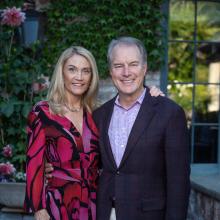
Mark & Mary Stevens
Mark and Mary Stevens have been core supporters of the Wu Tsai Neurosciences Institute since its inception. Mark is a venture capitalist and managing partner of S-Cubed Capital, as well as a board member of Nvidia and member of the Board of Trustees of University of Southern California. At Stanford he has served on the Interdisciplinary Life Sciences Council and the Hoover Board of Overseers. Mary is a member of the Board of Trustees at Santa Clara University. The couple serve on the U.S. Olympic & Paralympic Foundation Board of Directors and are parents of a Stanford student who graduated in 2020.

Clara Wu Tsai
Clara Wu Tsai was the foundational supporter of the Wu Tsai Neurosciences Institute and the Wu Tsai Human Performance Alliance at Stanford, both designed to operate at interfaces of diverse fields to create transformational advances in human health and cognitive and physical performance. She is a member of the Stanford Board of Trustees, governor of the WNBA’s New York Liberty, owner of the NBA’s Brooklyn Nets, vice chair of Brooklyn Sports and Entertainment, and a trustee of Lincoln Center for the Performing Arts.
Stanford Institutes, Shared Facilities, and Research Partners
This project is anchored at the Wu Tsai Neurosciences Institute, an interdisciplinary life-sciences institute under the auspices of Stanford's Vice Provost & Dean of Research, and builds on the university's long-standing strategic investments in shared research infrastructure and data.
- The Wu Tsai Neurosciences Institute
- Koret Human Neurosciences Community Laboratory, Wu Tsai Neurosciences Institute
- LUCAS Center for Imaging, Stanford Medicine
- Stanford Center for Shared Research Platforms (C-ShaRP)
- Marlowe High Performance Computing Cluster, Stanford HAI & Vice Provost and Dean of Research