
Special MBCT Seminar: Xiao-Jing Wang - Baby steps towards a (new kind of) foundation model of intelligence
Continue the conversation: Join the speaker for a complimentary dinner in the Theory Center (second floor of the neurosciences building) after the seminar
Baby steps towards a (new kind of) foundation model of intelligence
In this talk I will eschew the conventional format of a research talk. Instead, to stimulate brainstorming, I’ll ask questions and identify challenges in our efforts to develop a new kind of foundation model for intelligence, namely connectome-based large-scale brain circuit modeling instead of large language models (LLMs). First, I will highlight the prefrontal cortex (PFC) as a quintessential example of “cognitive-type” neural systems in contrast to sensory or motor systems. Second, I will discuss training recurrent neural networks (RNNs) for PFC-dependent cognitive processes such as multitasking and learning-to-learn. Third, I will summarize a parallel line of research on the development of connectome-based multiregional modeling of the neocortex. Finally, I will speculate how an integration of connectome-based modeling and training RNNs would yield a connectome-based foundation model of the primate brain capable of fluid intelligence, which represents a central goal of NeuroAI.
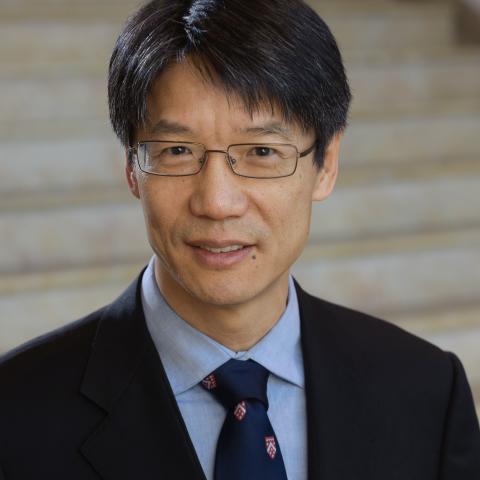
Xiao-Jing Wang
New York University
Xiao-Jing Wang is Distinguished Global Professor of Neural Science at New York University, with a PhD in Theoretical Physics. Previously he was Professor at Yale University School of Medicine. Using theory and computational modeling, Dr. Wang’s research focuses on neural circuit mechanisms of cognitive functions such as decision-making, with a special interest in the prefrontal cortex which plays a central role in intelligence and executive control of behavior. He is one of the founders of the nascent field of Computational Psychiatry. More recently, his group developed connectome-based modeling of large-scale brain circuits to investigate whole-brain dynamics and distributed cognition. His research bridges neuroscience, artificial intelligence and psychiatry. Dr. Wang is a recipient of Alfred P. Sloan Research Fellowship, Guggenheim Fellowship, Swartz Prize for Theoretical and Computational Neuroscience, Goldman-Rakic Prize for Outstanding Achievement in Cognitive Neuroscience, and he was elected to the Royal Academy of Belgium. Dr. Wang was recognized as Highly Cited Researcher by Clarivate Analytics, Web of Science Group in 2021 and 2024. He is the author of “Theoretical Neuroscience: Understanding Cognition” published by CRC/Taylor & Francis (2025), 561 pages..
Note: Dr. Wang is currently a visiting professor in the Stanford Department of Neurobiology, hosted by the Baccus Lab and based out of the Neurosciences Theory Center.
About the Center for Mind, Brain, Computation, and Technology (MBCT)
The Stanford Center for Mind, Brain, Computation and Technology (MBCT) Seminars explore ways in which computational and technical approaches are being used to advance the frontiers of neuroscience.
Questions? Contact neuroscience@stanford.edu
Sign up to hear about all our upcoming events
Hosted by Youssef Faragalla (Baccus Lab)
