
An advanced gene editing tool suggests new ways to study and treat disease
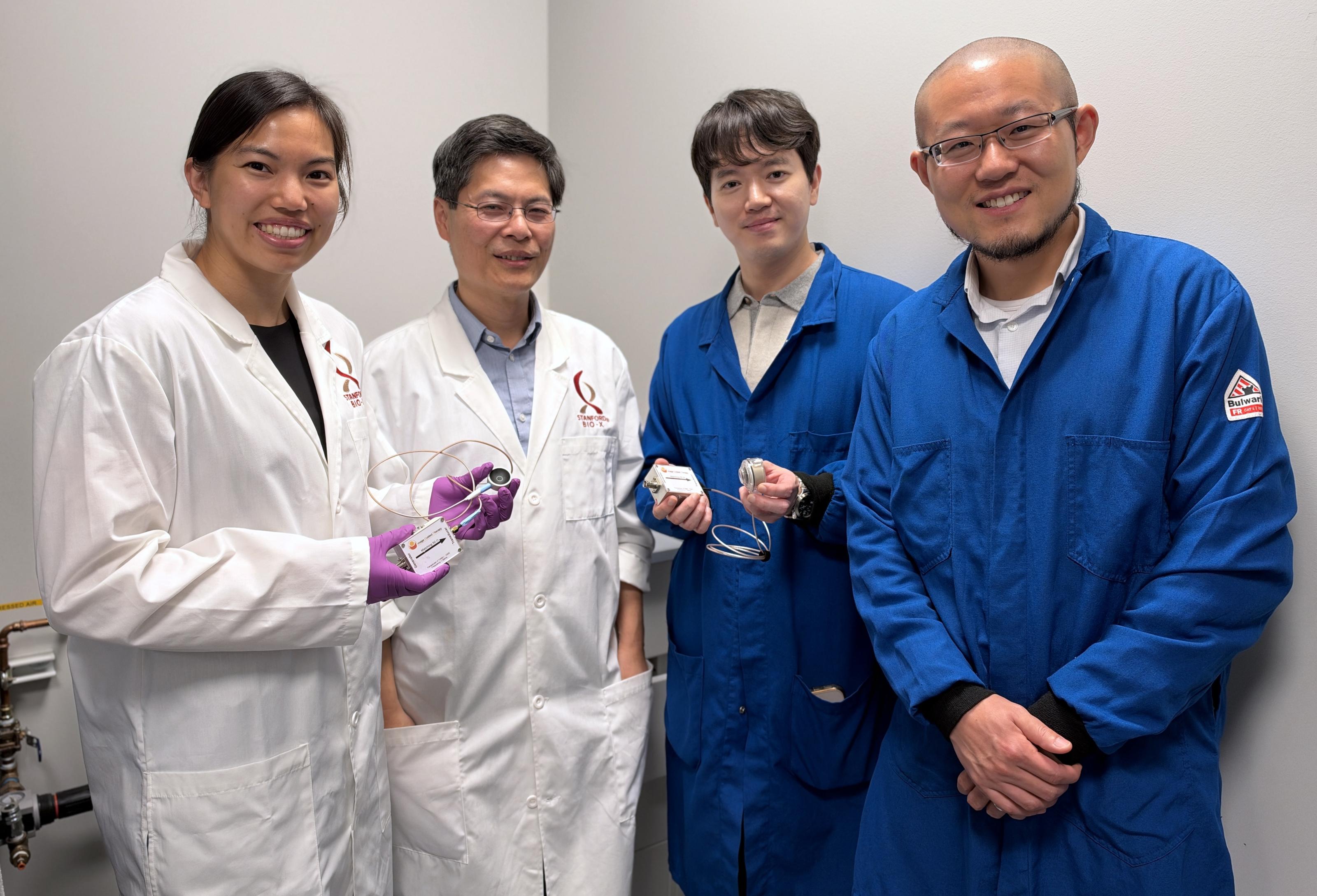
Scientists can now edit genes in precise locations deep in the brain and body without the use of invasive surgery or implants, thanks to new work from researchers at the Wu Tsai Neurosciences Institute. The team demonstrated their technique, which uses a combination of ultrasound, light-emitting nanoparticles, and photo-controllable gene-editing proteins, by successfully altering genes in mouse brains at selected locations.
The work – the latest advance in controlling the ever-expanding universe of CRISPR-family gene editors – was published September 28, 2026 in Cell and led by Wu Tsai Neuro Faculty Scholar Guosong Hong, an associate professor of materials science and engineering at Stanford Engineering, and Michael Lin, a professor of neurobiology and bioengineering at Stanford Medicine and Stanford Engineering.
Widely used gene-editing technologies such as CRISPR, the topic of the 2020 Nobel Prize in Chemistry, have given researchers remarkable tools for gene editing, but they have important limitations. Notably, targeting a gene with CRISPR typically means targeting it throughout the whole body – a problem if, for example, doctors want to treat chronic pain in one area without affecting others. While targeting specific areas of the body is possible, it requires invasive techniques – for example, implanted nanoscaffolds that release CRISPR tools and affect just a handful of cells.
“Biologists have figured out a way of controlling whether any given gene can be edited,” said Lin. “But we wanted to extend the question not just of which gene you can inactivate, but where you can edit it.”
Light offers an extraordinarily powerful way to manipulate and study biological activity. Over the past decade or so, scientists have figured out how to engineer proteins and cellular processes that can be switched on and off with illumination. The development of one such technique, optogenetics, earned Lin and Hong’s Stanford colleague Karl Deisseroth the 2026 Nobel Prize in Physiology or Medicine.
But there’s a challenge, whether researchers are deploying optogenetics or editing genes: Light doesn’t travel far through biological tissue, making it difficult to reach deep targets without surgical implants or other invasive methods, which the researchers were keen to avoid.
Hong had some ideas about how to overcome that limitation. His group developed nanoparticles that can circulate in the bloodstream and light up when struck by focused ultrasound, which penetrates tissue much more deeply than light. Meanwhile, Lin’s lab had been engineering a CRISPR-Cas9 gene editor that could be switched on with light.
About six years ago, Hong and a graduate student approached Lin looking for ways to put their remotely controlled light source to work in genetics. The researchers realized that combining their technologies could give them precise control over where gene-editing occurred. But neither technology alone was quite up to the task. Lin’s existing light-sensitive editor was too large to fit into a single viral delivery vehicle – the usual method of getting CRISPR gene-editing molecules into cells – while Hong’s nanoparticles needed to generate enough light to activate the editor without requiring ultrasound at intensities that could damage tissue.
The researchers dealt with those challenges using a multipronged approach. Postdoctoral scholar Daesun Song in Lin’s group developed a much smaller light-sensitive gene editor, Cas12f, which they also engineered to respond more efficiently to light. Hong’s group made their nanoparticles brighter, reducing the ultrasound power needed to activate the gene editor.
In the new paper, the researchers first showed they could deliver a Cas12f editor designed to target a particular gene. Then, they could focus ultrasound at a particular location in the body, where the sound waves would cause nearby nanoparticles to emit light. The light switches on the Cas12f editor so that it can act on the targeted gene.
To test the spatial precision of their new tool, the team studied a mouse that had already been genetically modified in two ways. One change made tissues glow, while a second stopped that from happening. As a result, successful disruption of the “stop” signal alone would cause the mouse to glow. When the researchers directed ultrasound at one side of the brain, that side began to glow, while the other remained dark, showing that they could control where in the brain they had edited a gene.
One potential clinical application, Lin said, concerns neuropathic pain, which research in mice suggests can be controlled by silencing genes associated with sodium ion channels using CRISPR techniques. However, this approach tends to numb the entire body. By silencing those genes only in the part of the nervous system associated with the pain, researchers might one day be able to bring more targeted relief to patients. Spatial control could also help researchers study how genes function in different brain regions.
“By putting these two very different, interdisciplinary technologies together, this is really one plus one much greater than two,” said Hong.
Lin’s group is now working toward a variation of the method that temporarily activates or represses genes without actually altering the underlying DNA. At the same time, Hong’s group is developing a wearable ultrasound device that could allow researchers to control genes while an animal moves around, and observe the effects on their behavior.
“I’m excited by the possibility that researchers – and hopefully future clinicians – can control gene activity at different locations in vivo,” Lin says. “I think that gives us the four-dimensional control that previously was not there.”


