
Student researchers probe the mysteries of the brain
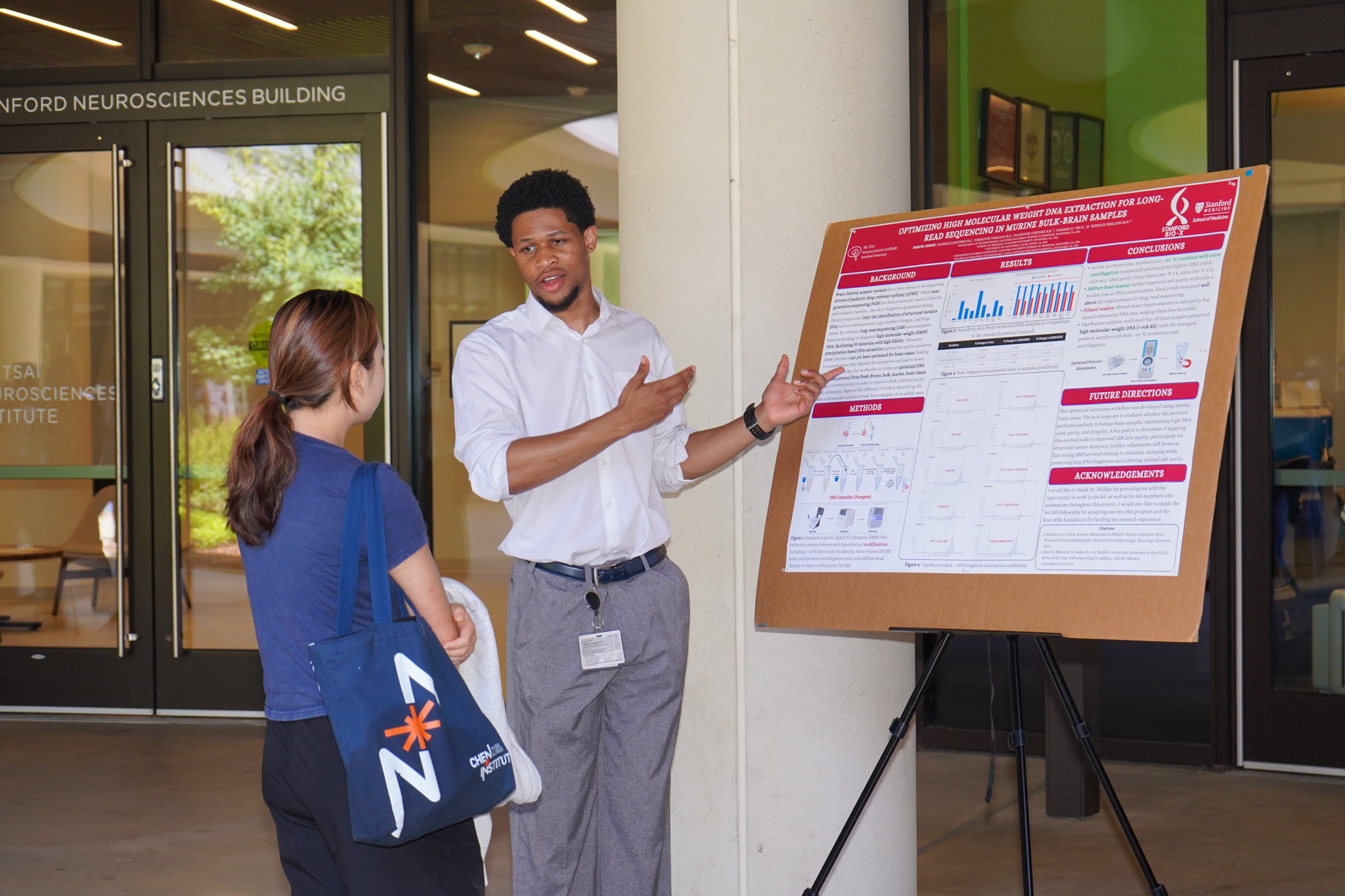
Arrayed around the courtyard of the Stanford Neurosciences Building one recent summer morning were 20-some young scientists. Each of them stood next to a poster describing their research, ready to go in depth on their hard-won results.
But unlike many poster sessions featuring seasoned grad students and postdocs discussing years of experiments, these young scientists had been working on their projects for just a few months.
Not that you could easily tell the difference. The event, held August 21, was the culmination of the Wu Tsai Neurosciences Institute’s Neuroscience Undergraduate Research Opportunity (NeURO) and NeURO-Community College (NeURO-CC) programs. Over the course of five months in the spring and summer quarters, Stanford undergraduates in the NeURO program develop research projects in collaboration with their Wu Tsai Neuro mentors, take part in scientific and professional development workshops, and eventually present their research. The NeURO-CC fellowship, aimed at students from De Anza, Foothill, and Mission Colleges, does much the same thing over just eight weeks in the summer. Both programs are aimed at students with little to no experience in a research lab.
“This is one of my favorite scientific poster sessions on campus. It's amazing to see the variety and quality of the work,” said Ted Wilson, an instructor in the Department of Neurology and Neurological Sciences at Stanford Medicine and Wu Tsai Neuro affiliated researcher who has served as a NeURO mentor for the past two years. “The NeuRO-CC students especially deserve to be congratulated. For many, this is their first experience working in a research laboratory, and it really is remarkable how far they've come in just 8 weeks. This is what it's all about—empowering a future generation of scientists.”
Valerie Vargas-Zapata, community engagement program coordinator at the Wu Tsai Neurosciences Institute, agreed. “It's exciting to see the impact of our undergraduate programs in students' professional development,” she said. “NeURO-CC in particular is a very transformative experience for students.”
There’s always a way
Stanford undergrad Isabella Russo got interested in neuroscience after her mother was diagnosed with Alzheimer's. Now, she’s studying the disease in Wilson’s lab.
“Despite there being so much research on it, it's still an enigma,” she said. “One aspect that's critical is diagnosis. We're looking to find a way to diagnose Alzheimer's disease purely from a blood test,” which could be more reliable and less invasive than other means.
Russo narrowed in on a protein called complexin-2, which modulates signaling between neurons. She found a strong correlation between Alzheimer's disease and complexin-2 in the blood, a fact that could lead to new diagnostic tests.
“It's been a great experience,” Russo said. “I've learned so much about the disease, the brain in general, finding data, and probably most importantly, coming up with solutions to problems. When you think you're stumped, there's always a way around it.”

Making connections
“I never really thought about neuroscience as something I wanted to learn about,” said Jillian Quach, a NeURO-CC fellow and a human biology major at Mission College—but her experience this summer may have her hooked.
Quach spent her summer in the lab of Frank Longo, a Wu Tsai Neuro affiliate and professor of neurology and neurological sciences at Stanford Medicine. She studied Alzheimer's disease with a focus on synapses, the communication links between neurons. Synapses degrade and are ultimately lost in Alzheimer's, so Quach tested a small-molecule drug that targeted one of the chemical pathways that can damage synapses. The drug, called C31, proved successful in mouse neurons, and Quach hopes that one day it might be used to slow the progress of Alzheimer's.
Now, Quach is building on her experience, connecting with other Stanford labs, and looking for her next research opportunity. “I do want to go to grad school, and I could see neurology as a future career,” she said.
Finding opportunities
Unlike Russo and Quach, Ladan Abdi doesn't have much background in biology or neuroscience. Instead, the NeURO-CC fellow and Mission College student is studying computer engineering.
“Coming from a computational background I wanted to try and see if there was any way I could contribute to a lab,” Abdi said.
She soon found an opportunity with Nirao Shah, a professor of psychiatry and behavioral sciences at Stanford Medicine who studies mouse behavior. Abdi noticed how hard it was to gather behavioral data from videos of mouse studies, a task that involves manually labeling every sniff, twitch, and touch in sessions that can last up to an hour.
“It is a very time-consuming and labor-intensive task,” Abdi said.
To address that issue, she trained a machine learning model to pick out fine details of mice's social interactions in three-minute snippets of video. “The model was able to accurately describe behavior down to the second,” Abdi said. “We need a lot more model work for it to be a viable alternative to manual labeling in longer videos, but this is definitely promising.”
She hopes to continue this kind of work. “I've always loved the interdisciplinarity of engineering, and I thought I'd love to try working in biology or chemistry—these other fields that I also love but don't intersect with my major as much,” Abdi said. “I saw this opportunity and I decided to take it.”

