
Brain development in the clinic and classroom (with The Future of Everything)
On today’s show, something special: a conversation we recorded live at our 13th Annual Symposium on “Building the Brain”.
The event featured experts at the frontiers of brain development research asking questions like how much of our brain wiring is driven by genetics versus experience and whether we could use AI to understand the way infants naturally learn about the world around them. You can see some of these talks on our YouTube channel.
Each year at the Symposium we also host a fireside chat where leading Stanford researchers help us take a step back and look at the state of the field as a whole.
This year, we collaborated with The Future of Everything podcast and its host, bioengineer Russ Altman, to bring that conversation to you.
Russ spoke onstage with Karen Parker, who studies how our brains – and those of other primates – develop socially. She’s been studying how hormones like oxytocin and vasopressin are linked to differences in social cognition and the implications for children with autism, and she’s been working to translate these basic science findings to clinical trials.
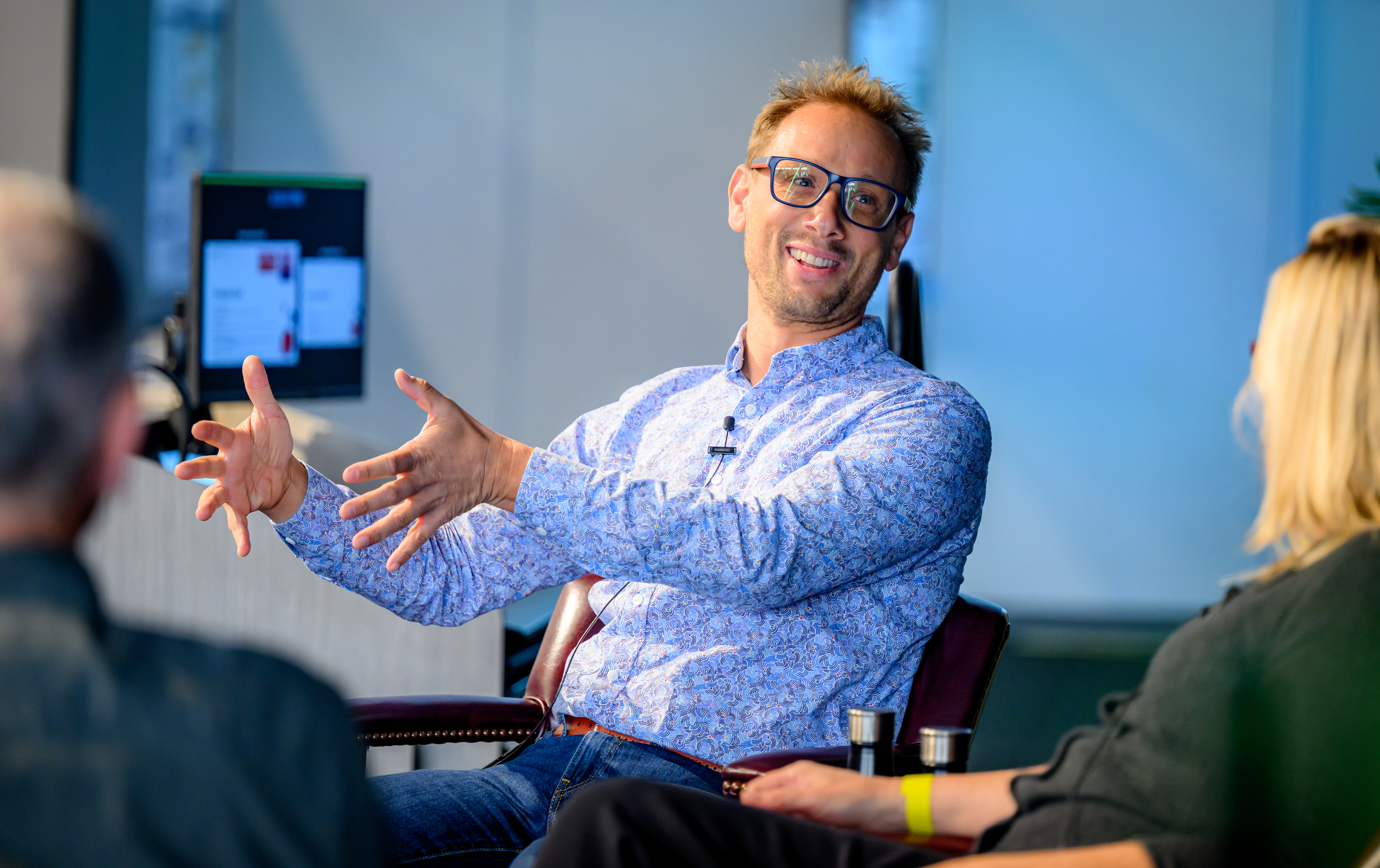
Also on stage was Jason Yeatman, who studies how children learn to read and the challenges faced by kids with dyslexia. He’s developed online reading assessment tools and brought them to 1.2 million students at nearly 3,000 schools.
While their individual work is different in approach, the conversation sheds light on the opportunities and obstacles researchers face in turning scientific discovery into real-world impact, whether in the clinic or the classroom.
SUBSCRIBE on Apple Podcasts, Spotify, Amazon Music and more.
Learn More
- 2026 Wu Tsai Neuro Symposium: Building the Brain
- Parker Lab Social Neurosciences Research Program
- Yeatman’s Brain Development and Education Lab
- Rapid Online Assessment of Reading
- The Future of Everything
- Russ Altman
- ‘Our goal is to build bridges between the lab and the classroom’ | Stanford Report
- Reading-specific region differs in the dyslexic brain (Stanford Medicine, 2026)
- Potential autism biomarker found in babies (Stanford Medicine, 2020)
- Autism May Have ‘Unnoticed’ Driver, Say Stanford Neuroscientists (Newsweek, 2024)
Episode credits
This episode was produced by Michael Osborne at 14th Street Studios, with sound design by Mark Bell. Social media strategy is by Julia Diaz, and additional editing by Nathan Collins. Our logo is by Aimee Garza. The show is hosted by Nicholas Weiler at Stanford's Wu Tsai Neurosciences Institute and supported in part by the Knight Initiative for Brain Resilience.
Share the show:
If you're enjoying our show, please take a moment to give us a review on your podcast app of choice and share this episode with your friends. That's how we grow as a show and bring the stories of the frontiers of neuroscience to a wider audience.
Get in touch:
We want to hear from YOUR neurons! Email us if you'd be willing to help out with some listener research, and we'll be in touch with some follow-up questions.
Transcript
Nicholas Weiler (0:10):
This is From Our Neurons to Yours, a podcast from the Wu Tsai Neurosciences Institute at Stanford University, bringing you to the frontiers of brain science. I'm your host, Nicholas Weiler. Today on the show, we're bringing you a special episode, a live recording from our recent annual symposium on Building the Brain. We had a lot of great talks from experts at the frontiers of the field of brain development, asking questions like how much of our brain wiring is driven by genetics versus experience, and what can we learn about the way that infants naturally learn about the world through the lens of modern AI systems? You can see some of those talks on our YouTube channel.
(0:50):
And each year at the symposium, we also host a fireside chat where we have leading Stanford researchers join us to help take a step back and look at big picture questions in the field. This year, our fireside chat was hosted by bioengineer Russ Altman. Now, Russ also has a podcast called The Future of Everything. So Russ and I decided to do a live podcast recording that we could share on both of our shows. Russ interviewed two of our faculty members on stage about how we can take what we're learning about the developing brain and turn it into real world impact for developing humans, also known as children. Russ spoke with Karen Parker,who studies how our brains and those of other primates develop socially, how hormones like oxytocin and vasopressin are linked to differences in social cognition and the implications of that for children with autism. And she's been working to translate these basic science findings to clinical trials.
(1:46):
Also on stage was Jason Yeatman, who studies how children learn to read and the challenges faced by kids with dyslexia. He's developed online reading assessment tools that are being used by over a million students at nearly 3,000 schools. So while their individual work is quite different in approach, the conversation hopefully sheds some light on the opportunities and the obstacles researchers face in turning scientific discovery into real world impact, whether in the clinic or in the classroom. So without further ado, I'll let Russ take it away. Here's our fireside chat on building the brain.
Russ Altman (0:26):
This is the future of everything with Russ Altman. Thank you very much for tuning in. Today we're at the Wu Tsai Neuroscience Institute at Stanford University at the Symposium on Building the Brain. My guests are Karen Parker and Jason Yeatman. We're doing this special episode in collaboration with the podcast From Our Neurons to Yours, which is hosted by Nick Weiler. Please remember to rate and review, follow the podcast and share with your friends, neighbors, anybody you like. And if we deserve a 5.0, please give it to us. At the end of our discussion, we're going to have a little segment that we call future in a minute. I will ask both Jason and Karen some rapid fire questions and they'll give us some rapid fire answers to these questions. So with that introduction, let's try to understand building the brain.
(3:15):
So Karen, to start out, thanks so much for being here today. What are the challenges we should think about going forward with integrating molecular level insights with systems and behavioral phenotypes of interest? That's a big gap to jump. And how do you think about that and where do we need to get better and where are we doing well?
Karen Parker (3:35):
Great. It's a pleasure to be here with you, Russ. I think that because it's such a large problem to tackle, it's going to take large teams of people. And so I think we need people that are experts in all of those areas and we need to work together as teams and it's going to require research and models that are tractable like animals up to doing human work and clinical work as well as educational work.
Russ Altman (3:59):
Are things in place to do that or do there needs to be some innovation? Does somebody need to come up with a good idea or is the path for doing that pretty clear?
Karen Parker (4:10):
There's some larger grants that NIH offers, but I think we have a blueprint here at Stanford with the Knight Initiative. And so what they've done for neurodegeneration and resilience would be wonderful if we had large scale philanthropy to do the same thing for neurodevelopment.
Russ Altman (4:26):
So Jason, on that issue, you're facing a little bit of a different issue because I know you're an education professor. You don't think about molecules that much, but you think about these phenotypes, these behaviors very deeply. And there are people in neuroscience who do think about the circuits that underlie this. How do you imagine these coming together eventually?
Jason Yeatman (4:45):
Well, when I look at work like Karen's, one of the things that I'm always in awe of is the system going from molecules to humans in the clinic and back, that a lot of the foundational science that's being done in school of psychiatry, for example, is driven by challenges that are being brought up in real clinical practice. The work of the clinicians with patients is driving the next generation of science that's being done. And when I look at education, I think one of the challenges that we can zoom out and look at is we don't have a system built to go from basic science research to clinical trials or randomized control trials in our education system to standard of practice in schools. And also to make sure that challenges that educators face in schools are going back and shaping the underlying research that labs are doing. So I a lot of times think that the model of academic medicine could inform many ways that we think about going forward in educational research.
Russ Altman (5:45):
Yeah. We were talking a little bit about this before the panel. What are the prospects for actually creating the ethos and the ecosystem for doing randomized controlled trials of educational interventions and then picking the best ones?
Jason Yeatman (6:00):
Yeah. You got to step back. There's so many challenges even to get there. I look out often and talk like this and ask how many people have kids in schools around here, but the products that are brought to your classrooms are mainly brought by sales reps and they don't go through necessarily any testing. There's no regulation that requires them to be effective. It's not that schools aren't trying to do their best, but there aren't systems in place to make sure that of the many, for example, in my case, ways to teach reading that we're systematically choosing the next best one and the next best one improving on it. A lot of it's driven by what can a company create a compelling narrative about that resonates with teachers or district leaders that are going to be buying the product that's in no way saying that the schools are at fault there. It's all of us, I would say, for not creating a system that has ways to bring in scientific evidence at the various stages of it. So even when you think about running an RCT, it's a great idea. So Russ asked the question of how can we think about running more randomized control trials to see what works?
Russ Altman (7:13):
Which are very expensive.
Jason Yeatman(7:14):
Which are very expensive. Why would you run a large RCT to show something is better if that's not going to drive profit? I think that's one of the big challenges in education because it's not that we don't have evidence for what works often, it's that we don't have a system to ensure that what there's evidence for is the product or tool or approach that is used.
Russ Altman (7:39):
Yeah. So that's a really important thing that you just said because although we're happy that in the medical context, in the clinical context, there are these checks and balances where you can count on a certain level of vetting, there's lots of very important neuroscience that happens outside of the clinic. And the fact that we haven't figured out how to bring those same standards of evidence outside of the clinic sounds like a big challenge. So I'm glad you brought it up. Speaking of big challenges, I wanted to ask about the neuroscience of learning and education, something that you think about all the time, and you both do actually, in the context of brain development and psychological development. So brain development is a field, psychology is a field. How good are we at connecting these and what needs to happen to improve our ability to connect the discoveries in those two fields?
Jason Yeatman (8:30):
Infrastructure is a lot of it. Labs often operate in their own silos, brain imaging labs studying at the resolution that we think about brain development and even communicating from there to other scales within the neurosciences can be a challenge, but institutes like Wu Tsai try to build connections across them. And you'll bring up the brain resilience initiative of building systematic infrastructure to allow discoveries to go across different levels of analysis. So I think one of the big challenges is figuring out how to build that infrastructure. And more and more my lab has transitioned from ... We still do ask a lot of basic scientific questions, but more and more are building tools and collaboration with schools, doing work that's taking scientific discoveries, building tools around them and doing that in collaboration now with thousands of schools around the country. For me, a lot of the challenge was creating that infrastructure to make that possible. And so that's a model I would like to see grow other places.
Russ Altman (9:38):
Karen, your thoughts about linking psychology, basic neuroscience, especially when they're asking extremely similar questions, but taking very different experimental approaches.
Karen Parker (9:47):
I completely agree with Jason. It's all about the infrastructure and it's about the dialogue and it's creating spaces for people to come together to even learn about other people at the same university.
Russ Altman (9:59):
So that leads me to my next question, which is about collaboration. So implicit in many of your answers already has been the idea that one group, one investigator can't do it all and we have this very rich system of investigators, but collaboration between academics is hard. We know that. And now we hear about collaborating with a school or collaborating with a clinic. I guess starting with Karen, tell me about what are the challenges to putting together the best collaborations?
Karen Parker (10:30):
I think part of it is aligning incentives. And so if you think about what the academics care about versus parents who have a child with a disorder, the incentives may be different. The academics are thinking about being first, they're thinking about getting the papers published, and of course they care about the clinical impact and they care about all the kids in a trial. A parent, of course, as a parent myself, you care about your own kid. And so trying to align the incentives I think is really important when you think about that. I think that speaks to some of what Jason said about the educational systems versus sales and then how do we align all these different groups that have different interests. I think at the academic level, it can often be tricky because of working with PIs. And I think one problem we haven't solved in neuroscience is thinking about how we deal with large groups working together. In physics, probably 30 years ago, they had, this is our working group and then nobody's fighting over who's first or who's last author. You basically have a long list and you detail everyone's contributions. And I think that would incentivize people to work together better if there weren't these very human interests at play, if we could really just focus on the science.
Russ Altman (11:47):
Do you think there are ways to train trainees to be good collaborators? Do you think that's already built into science or do you think there's an opportunity to improve? Because when I do collaborations, it's a lot of stuff that has nothing to do with my expertise. It's like, am I fun to talk to at lunch? Do I respond to emails or do I show up to the meeting with my task completed? Do you think that we're doing a good ... I don't mean to ask a leading question. Are we doing a good enough job with trainees giving them the tools to be effective collaborators?
Karen Parker (12:19):
Well, I think that a lot of people really want to collaborate. We like to think with other people. We're a social species. I think the hard part comes when we think about how we're incentivized to get faculty jobs and to get promoted within the system. And what we're incentivized early in our career is to be first author. As we're working our way up the academic ranks, you want to show that you're last author. And it really is only once you have tenure, you're a full professor where people don't care about those things as much, where I think you can do some of the best collaboration of your career. And so I think unless we change the incentive structure, it can just be harder for trainees.
Russ Altman (12:57):
I must admit that my-
Jason Yeatman (12:58):
Do you think that's on us though? When you get to that stage in your career where you can create the infrastructure that allows that for your trainees rather than the ... You were asking, do we need to think about training in a different way? Maybe it's just putting the opportunities there where we are absorbing some of the challenges of bridging across these areas.
Karen Parker (13:18):
I think it's a good point. I think when you have trainees working together, as long as there's really good communication also ... Because I think authorship is always an issue until we move to the physics model if we're working on large people. But yeah. We should not always just blame the system. It's important to be part of the solution, right?
Jason Yeatman (13:35):
In your group, you've had a lot of success in bridging from basic science to clinical trials, clinical outcomes.
Karen Parker (13:42):
Yeah.
Jason Yeatman (13:43):
So that must be different trainees often with different skill sets and different personal career goals, but collaborating across those areas, right?
Karen Parker (13:52):
Yeah. It's been fun. We'd have like a molecular biologist working with a animal behaviorist working with somebody who's clinically trained. And I think people learn a lot from each other. And I personally love working at interdisciplinary boundaries, but there's challenges too. Yeah.
Russ Altman (14:10):
Now you're working with schools, which just blows my mind because the only school I work with is the Stanford Medical School where I'm allowed to give one 45 minute lecture because that's all they have in the curriculum for me to tell them everything I know. So what's it like to go to a school and say, "Hey, let's collaborate."
Jason Yeatman (14:30):
Yeah. So what I've learned over the years of doing this is that one thing that makes it successful is if we can offer something that's useful to the school. So you talk to teachers, you talk to school district leaders, everyone wants their work to be grounded in science, almost everyone. That's a pretty universal point of view. But we can't expect teachers to be picking up the most recent journal of something and reading through everything and doing that in their free time and then building a curriculum from scratch that addresses all the new scientific discoveries. There's just not time. Teachers and school district leaders are all ... Time is one of the hugest constraints they have. So as a researcher, when we're showing up and saying, "Hey, what I would like you to do is take some additional time and do something that's really interesting to me. And in 10 or 15 years, it might be interesting to you as well." That's just not a good place to start.
(15:25)
So the way we're seeing this is we're building tools that are immediately useful that address a need in schools. And often the relationship starts off by basically a direct service model where we're bringing them a new tool. We have a whole team that is working on supporting implementation, grounding implementation in what science says of supporting the school and making evidence-based decisions. Then over time, that creates a relationship where there's a lot of openness for bringing in our scientific questions. And for students and postdoc, this provides an opportunity where I'd look out at the students here and say, "Who wants their research to matter in the world?" Most people want their research to matter in the world, but it can't be on an individual student to have a discovery and then start trying to build relationships with schools. That has to come from a structure around them.
(16:19)
So many of the students and postdocs in my lab are thinking about basic scientific questions, but they're working on these questions through these school district collaborations that we have. Over the arc of those collaborations, they also learn a whole lot about the challenges that the teachers and the district leaders are facing. And even if their scientific goals are not about the implementation, I like to think that over the arc of their project, it fundamentally changes how they're thinking about their science, that they understand the challenges that feel very real to teachers.
Russ Altman (16:50):
So you could have told me that the stuff that you're doing that they do care about, that the school teachers and the principals that they care about is just a tax, that you just have to do it to get in the door. But I'm hearing that it actually is more ... It's better than that. It's not just a tax. It's actually enriching the research questions that you might ask down the line.
Jason Yeatman (17:08):
Yeah. 100%. But it's not the simple of we go to a school, we ask them what we should research, then we go research it. I have an NIH grant that's supporting a number of questions around the mechanisms of dyslexia so I'm working on those questions. I'm working on them in collaboration with schools. But one of the key questions we always get from school district leaders is, "Well, what about in students for whom English is not their first language?" And that's a continual question that comes up. We run an assessment platform that's used in many schools. The question is always like, "Well, how do we reinterpret these assessment scores for a student that is coming from this language background or that language background?" And so for me, those weren't my initial questions coming in, but now is another set of fundamental questions where there's basic scientific questions around that, about actually Rebecca Saxe and her talk, talking about intersection between language development and other aspects of cognition, but those also go to applied questions that matter in schools. So I always see it as if we can align those incentives. Schools are hungry for the answers to questions in this space, and it turns out they actually are also at the forefront of scientific knowledge that we don't know. That to me is the ideal space to work in and also a space that's worth the time investment as well.
Russ Altman (18:30):
When you have a multi-school ... And I know most of your projects are multi-school projects. Do those schools get to interact with one another and talk shop separate from Jason's tasks?
Jason Yeatman (18:40):
Yeah. That's funny. That was just a conversation a couple of days ago. We're trying to create consortiums to allow that. So right now there are, I think, almost 3,000 schools that work through our research practice partnership model with our lab. And most of them don't interact with each other per se. One of the big challenges though is time. No one in this room has a wealth of free time and it's the same for someone that's leading a school system. So just like for the PhD student that's going crazy trying to schedule their defense and get three professors in a room for two hours, whenever we're trying to get the superintendents from 50 different districts into a Zoom room, it's a similar challenge, but it's a big goal. It's one of those things that everyone abstractly really wants to do, but creating infrastructure is hard.
Russ Altman (18:29):
It's good to know that that's emerging because it just sounds like a good thing without any evidence on my part. So I have to ask this because the two of you are here. You both work with children. You work with children in a school, you work with autistic children, but also children who are developing social connections of other kinds as well. And this is clearly a frontier in neuroscience because if you're going to do development, you have to look at the people who are developing and the kids are developing. So tell us about the special challenges and opportunities in working with kids.
Karen Parker (20:02):
I think when you're dealing with kids that are on the autism spectrum, there's all kinds of other considerations that you may not think about when you're just studying kids. So if you're doing brain imaging work, it's very difficult to get a kid on the spectrum into a scanner because of their sensory sensitivities. So I think there's a lot of additional challenges. When I first started doing this work where we had to do a lot of groundwork and a lot of partnership with families to think about the best way to even begin to conduct the studies that wouldn't have been challenging in typically developing kids. So I think that that's probably one of the biggest challenges.
(20:43)
It's also tricky, and I suspect Jason also faces this, when your work is confounded with development, right? So if you're studying a single outcome, but you're studying kids six to 12, or if you're studying kids three to 17, how do you find outcome measures that you can study across all individuals that are meaningful? And that can be particularly difficult in say a clinical trial. And so we have to have a single outcome measure, and as you noted, RCTs are incredibly expensive, so we don't just do an RCT that costs $5 million on six-year-olds. We often will do this, especially if you're testing in investigational medicine. But there are a lot of challenges that go along with even heterogeneous populations like autism where you have potentially extraordinary intellectual disability or you have kids with an IQ of 150.
Russ Altman (21:36):
Let me ask you, you talked about a cohort of three to six or three to nine year olds. What's the situation with respect to cohorts? Do you have to build a new cohort for each study or is there a possibility of standing cohorts so that you could stand up new studies much more quickly? I know in adult medicine, this is a dream is to have a cohort that's ready to go. What are the prospects for that for children?
Karen Parker (21:57):
Well, that's I think a really great point. So individual investigators often have research registries where they have families, they've consented to be contacted for new research studies. So that's one thing. There's organizations like The Simons Foundation that set up something called Spark where they basically have intake centers all over the country where they have families that are interested in participating in autism research. And so if you were going to be doing a study to enroll a couple of hundred people, that back in the day might take $5 million. Now if we have a survey based study, we can blast it out and within six weeks have thousands of people respond to the survey. And what's really nice about Spark is you can actually use it as a recruitment tool. So if you have a clinical trial, they can blast it out to anybody who fits your eligibility criteria and it can really increase the pace of conducting and completing research.
Russ Altman (22:53):
And Jason, in your comments before, you implied that these are longitudinal relationships with these schools. So do you benefit there that as the students get new ideas, your first level of cohort building is in place or is that too rosy of a-
Jason Yeatman (23:10):
No, that's right on. And so what we're trying to transition to is taking what we've built and establishing a center around the idea. So right now we have about 1.2 million students or so that are using our assessment platform in daily standards practice in their schools, which means that we have studies are now typically in the end of a hundred thousand-ish and we have ongoing longitudinal data. But there's many ideas out there that are much better than my ideas. And what I'm hoping is that this becomes infrastructure where the next generation of students or postdocs can come in and tell me what the key thing is we should be looking at. And now it's not quite a registry because it does all have to go through ... If we're going to roll out a new measure or try to test some new idea, we need buy-in from the schools that are on the platform. But often if it's a small ask, it's quite straightforward to get buy-in from schools, which means yeah, we have ongoing data collection. So if you wanted to run a study in high schoolers, there's a good chance that if you wanted to run that study in five years, well, I would have had their data since they were in elementary school potentially.
Karen Parker (12:24):
That's cool.
Jason Yeatman (24:25):
Then you can look at how that changes with whatever the interesting thing is you want to measure.
Karen Parker (24:30):
Yeah. It's really cool.
Russ Altman (12:32):
A little bit of a wild card question, and forgive me, but I want to ask about AI because I ask about AI all the time.
Jason Yeatman (24:38):
What's that?
Russ Altman (24:39):
Yeah. AI, artificial intelligence. I'm wondering if the role it plays, should play, could play, you hope it never plays. Where is it in your thinking about your personal scientific trajectory? Because I picked up my son at the airport last night and he lives in New York with his fiance and they were dumbstruck by the posters, the billboards that you see on the drive from SFO to Menlo Park. They said, "Dad, WTF, what are these?" We live in this little weird bubble that is not normal, but I'm wondering how does it impact your work?
Karen Parker (25:18):
Well, I think that it can be certainly incredibly useful as a tool in research analysis and it can really expedite our ability to reach our conclusions. I think if you think about in the context of research, it can be really difficult, I think, if it's used as a proxy for thinking. I think we have to be very careful about how we're using AI. I can give you an example. I had a colleague who was writing a grant, name withheld to protect the guilty, and he did an AI search and he put a bunch of references into a grant. And of course, we're all writing grants at 2:00 in the morning, and these were all hallucinations, but they had had all of the authors that had the issue. It was like Nature Genetics. It had the volume issue and page numbers. I think there are cautionary tales like that where if it's a tool, it can be fantastic, but it's like the dog has to wag the tail, not the tail wag the dog.
Russ Altman (26:18):
Jason, I'm sure you were at today's talk on AI agents that learn like humans.
Jason Yeatman (26:24):
Yeah. I have two totally different responses. On one level, I'm really enjoying playing around with AI myself. I was just doing a project with my daughter on building a new interactive math website. She's complaining that the math she's working on is boring and she wanted to do more fun stuff. So we built this fun gamified interactive math website. It also made me realize the cool place to open source and open access license workplace. Some of the best math curriculum in the country are Creative Commons license, which means you can have Claude code in just a curriculum and start building-
Russ Altman (26:59):
And you're not violating any laws.
Jason Yeatman (27:00):
As far as I know. So that's just me as a dad hanging out with my daughter doing that. As an academic, I think there's a lot of really exciting use cases, but I worry a lot because, just being a broken record here, we don't have the evaluation systems in place and AI is moving incredibly fast. There's many probably transformatively excellent applications in schools, and I'm assuming everyone here can also think of one deeply scary or worrisome outcome that we might progress towards. More and more I'm thinking about how can we build the infrastructure where we have systems in place to actually be studying the changes in schools that are coming with AI or the efficacy of different AI learning platforms before we look up in five years or two years.
Russ Altman (27:33):
It's the issues you mentioned before, but now on steroids.
Jason Yeatman (27:58):
Yeah. Yeah. It's like exactly with how fast it's moving.
Russ Altman (28:01):
Well, this has been fantastic and we are 25 minutes into our conversation. So before we end, I wanted to move to the future in a minute where I will ask some rapid fire questions and we'll take turns, although both Jason and Karen will answer the last question. So if we can start out, if you're ready, we'll start out with Karen.
Karen Parker (28:19):
Great.
Russ Altman (28:19):
What is one thing that gives you the most hope about the future?
Karen Parker (28:22):
I think it's all of the cutting edge tools that we now have available because we're able to really push forward in terms of our understanding of health and disease.
Russ Altman (28:32):
Jason, what's one thing you want people to walk away from this conversation remembering?
Jason Yeatman (28:38):
Well, I guess I'm going with infrastructure, both in clinical neuroscience research and also educational research of us building the systems that allow work to go from bench to bedside or schools.
Russ Altman (28:51):
Karen, aside from money, what is one thing you need to succeed in your research?
Karen Parker (28:55):
All right Russ, it's always about the money, but if I had to say something else, I think the magic happens at the interdisciplinary boundaries. And so I think what's really critical is having colleagues and working with people in wildly different fields because I think that's how the innovation happens.
Russ Altman (29:12):
Jason, if all goes well, what does the future look like?
Jason Yeatman (29:17):
Meeting the needs of every learner.
Russ Altman (29:20):
Okay. Now this is questions for both of you. We'll go Karen first. If you were starting over again and you needed to get your degree or certification in a different discipline, what would it be?
Karen Parker (29:30):
Okay. This is a from the heart question. I would also add medical training because I think that in a parallel universe, I was a pediatric neurologist, a clinician scientist doing research and taking care of kids.
Russ Altman (29:45):
Jason, let me just repeat the question. If you were starting over again and you needed to get your degree or certification in a different discipline, what would it be?
Jason Yeatman (29:53):
I'd go for my AMGA guide certification. I've always wanted to be a mountain guide and I think that would have been-
Karen Parker (29:59):
Awesome.
Jason Yeatman (30:00):
... But I'm pretty happy with my academic path and I think actually studying neuroscience through a psychology department put me right at the intersection of the disciplines I still want to work in.
Russ Altman (30:10):
Well, thank you to Karen Parker and Jason Yeatman. That was the future of brain development. And thank you all for listening to today's episode.
Nicholas Weiler (30:24):
If you're interested in hearing the audience Q&A session that followed the fireside chat ... There were a lot of really interesting questions. Head on over to our YouTube channel where you can see this and a number of other sessions from our symposium in full. Thanks again to Russ Altman and the Future of Everything team for doing this crossover episode with us. This was our first time doing this. It was a lot of fun. Go check out their feed to see stories about the future of just about everything. Russ Altman is Kenneth Fong Professor of bioengineering, genetics, medicine, and biomedical data science at Stanford Engineering and Stanford Medicine. Karen Parker is Truong-Tan Broadcom Endowed Professor in the Department of Psychiatry and Behavioral Sciences at Stanford Medicine. And Jason Yeatman is an associate professor in the Graduate School of Education and the Department of Psychology at Stanford School of Humanities and Sciences and the Department of Pediatrics at Stanford Medicine. These are some really high level people here. To read more about their work and see more of our symposium on building the brain, check out the links in the show notes.
(31:21)
If you enjoyed the episode, be sure to subscribe for more conversations from the frontiers of brain science. And we also love hearing from you. If you have thoughts about the show or questions about the brain you'd like to hear us discuss in a future episode, send us an email. We're at neuronspodcast@stanford.edu or leave us a comment on your favorite podcast platform. While you're at it, please give us a rating and share the show with your friends. Might seem like a small thing, but it's super valuable for us to be able to bring more listeners to the frontiers of neuroscience.
(31:50)
From Our Neurons to Yours is produced by Michael Osborne at 14th Street Studios with sound design by Mark Bell. Our social media strategy is by Julia Diaz, additional editing by Nathan Collins. Our logo was designed by Amy Garza. I'm Nicholas Weiler. Until next time.