
A brain-imaging ‘Goldilocks’: OPM-MEG unveiled at Koret Human Neurosciences Community Laboratory
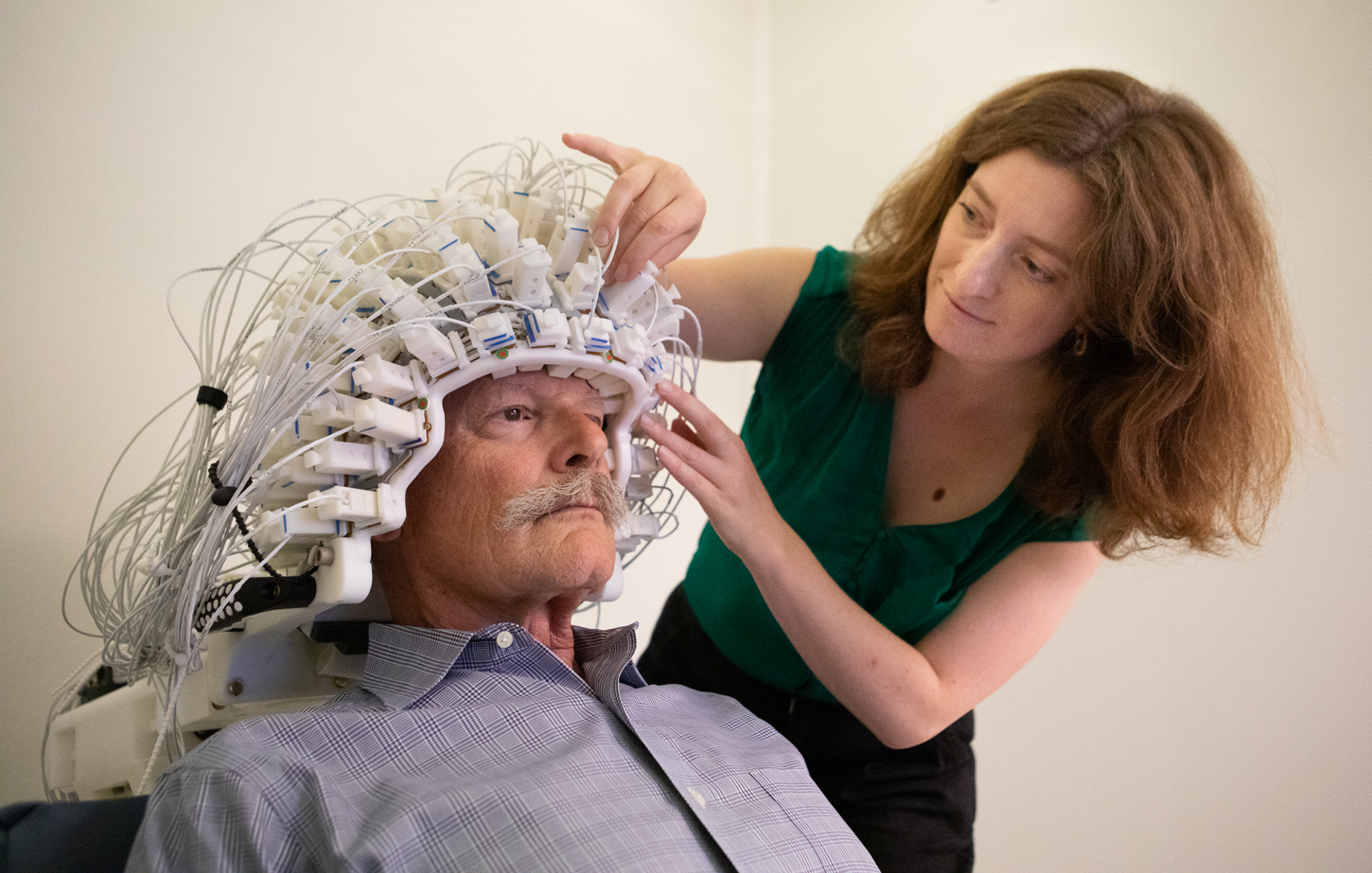
The Wu Tsai Neurosciences Institute is now home to one of the most advanced brain-scanning technologies in the world – OPM-MEG, which stands for magneto-encephalography with optically pumped magnetometers.
The cutting-edge OPM device is the first MEG on campus and the first OPM-MEG on the West Coast, and one of the most advanced systems of its type in the world. It is housed in Wu Tsai Neuro’s Koret Human Neurosciences Community Laboratory, a shared resource for human brain imaging and stimulation experiments available to researchers across campus.
OPM-MEG technology is poised to transform human neuroscience. Drawing on quantum sensors, OPM picks up magnetic fields generated across the brain with millisecond- and millimeter-scale precision while remaining small and light enough to allow research participants to move around and interact with others.
Together, these features will allow Stanford researchers to study the inner workings of our brains in more detail and in more natural settings than nearly any other brain-scanning technology, said Laura Gwilliams, a faculty scholar at Wu Tsai Neuro and the Stanford Institute for Human-Centered AI (HAI) and an assistant professor of psychology at Stanford Humanities and Sciences.
OPM-MEG is now available to the entire Stanford community thanks to an effort led by Gwilliams, Anthony Norcia, a research professor of psychology, emeritus, in the School of Humanities and Sciences, and Koret Lab Director Milena Kaestner, who worked with Stanford’s Community of Shared Research Platforms (C-ShaRP) and researchers around campus to purchase the equipment and bring it to campus.
Soon, researchers will be able to study questions such as how speech is processed in different parts of the brain in real time, the mechanisms that determine what infants pay attention to, or patterns of brain activity that might signal the onset of neurodegenerative or psychiatric disease – all in more detail than ever before. Kaestner said she is particularly excited about the prospect of studying brain activity in children, which is much more feasible with OPM than traditional MEG technology. And, she said, the Koret Lab is eager to hear more ideas and support researchers in the community as they plan and execute OPM experiments.
With this new neuroimaging technology ready for research, we talked with Gwilliams and Kaestner about how OPM works, what it took to bring the OPM here, and what they hope for its future at Stanford.
The OPM project was funded in part by the C-ShaRP Shared Instrumentation & Enhancement Program, the Knight Initiative for Brain Resilience at Wu Tsai Neuro, the Center for Computer Research in Music and Acoustics, the Department of Psychology, the Graduate School of Education, and the Department of Neurology & Neurological Sciences in Stanford Medicine.
What is OPM, and how does it compare to other methods?
Kaestner: OPM is a special kind of MEG (magnetoencephalography). MEG measures brain activity using magnetic fields, and that has several advantages over other types of neuroimaging people may be familiar with. For example, fMRI (functional magnetic resonance imaging) uses changes in blood oxygenation as an indicator of brain activity. This is relatively slow, so although fMRI is good at measuring where brain activity occurs, it's not precise about when it occurs.
EEG, or electroencephalography, measures electrical signals themselves. These signals get distorted as they travel from neurons through the brain, the fluid around the brain, and the scalp, which all conduct electricity. As a result, EEG has the opposite problem of the fMRI: it’s good at measuring when brain activity occurs, but not as precise about where it occurs.
OPM is the Goldilocks – the best of both worlds. The sensors detect magnetic fields generated by brain activity, and unlike electrical signals, those don’t get as distorted by intervening tissue as they travel through the head. As a result, OPM gives you both a good idea of where brain activity occurs at the millimeter scale and when it occurs at the millisecond scale.
What makes OPM special compared to other kinds of MEG?
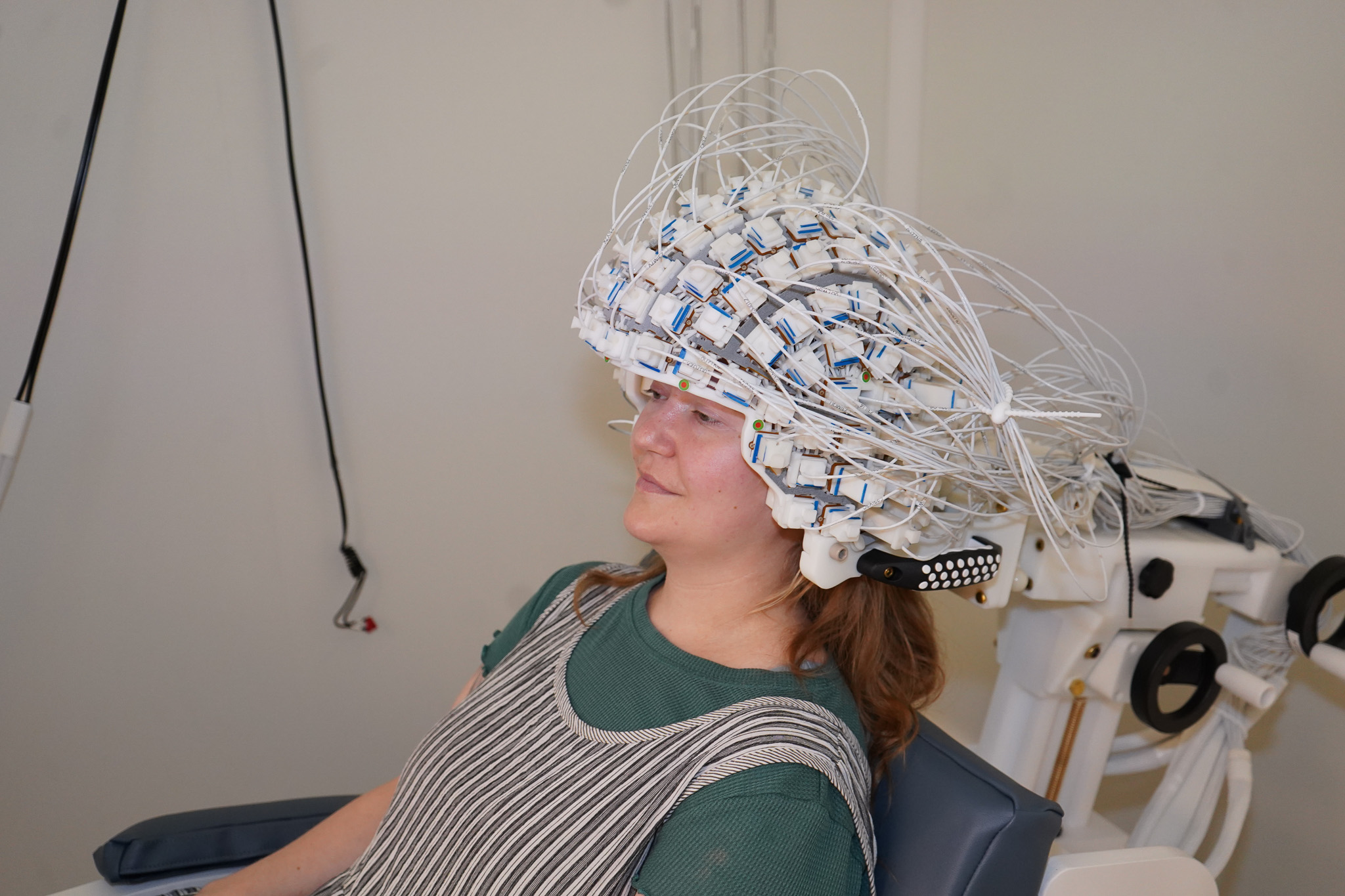
Kaestner: OPM has several advantages. In older devices, the sensors sat in a gigantic helmet – maybe four or five feet tall – and had to be cryogenically cooled. OPM allows us to more accurately measure brain activity using sensors placed directly on the scalp, which means we can get a stronger signal and more accurate information about what’s happening in the brain.
Because they’re small, the OPM sensors are also much more wearable than in the old cryogenic systems. They’re not fixed inside a helmet, so they can be arranged to suit different head sizes and shapes, so participants can move much more freely and interact more naturally with others during an experiment. This opens new realms of social neuroscience. I’m excited to see more of those studies come through the Koret Human Neurosciences Community Lab.
Gwilliams: Our OPM system is also special because, to my knowledge, it has the most sensors of any OPM worldwide. These 144 sensors will give us a view into the whole human cortex and allow us to verify brain activity across multiple sensors. We’ll be able to interpret our data with more confidence.
What new kinds of experiments are now possible with this device?
Gwilliams: In my lab, for example, we are excited to use this technology to study how the human brain produces and understands speech. Because speech unfolds rapidly over time, answering these questions requires the fine-grained temporal resolution that OPM offers.
We’ve heard a lot of excitement about this from the broad research community, too. One idea that’s been mentioned is studying how the brain switches between different circuits for encoding or retrieving memories. We’ve heard from researchers who are thinking about how we could use OPM to look for signs of neurodegeneration and track how Alzheimer’s progresses. We could also study real-time brain activity in neurological conditions like autism and psychiatric disorders like depression. One faculty member is interested in looking at how music affects our brains, which with OPM’s time resolution is something we could study in a lot of detail. And those are just a few examples. We’re excited to hear more ideas from Stanford researchers.
Bringing this tool to campus was a major undertaking that took years of preparation and months of actual installation and testing. What were some of the special considerations you took into account?
Kaestner: We’ve been so careful in designing the lab to ensure that no ambient magnetic fields can interfere with the brain signals we want to measure. Only really, really sensitive technology can detect these signals, which measure around 10 femtotesla. For context, that’s around 6 billion times weaker than the Earth’s magnetic field. It’s so sensitive that it could pick up the magnetic field of a bus driving past the building.
Bringing the OPM to Stanford took significant remodeling. We had to build a magnetically shielded room that weighs 13,000 pounds – comparable to a full-grown Asian elephant – with 25-centimeter-thick shielding metal just to keep all those tiny magnetic fields out. You can think of this room as magnetically silent, which allows our OPM sensors to operate without being flooded with signals unrelated to brain activity.
But we also need to present different stimuli, have participants respond, and keep the lights on, in a space where we can’t have any electromagnetic noise at all, so there’s a lot of special equipment for that. We light the room with fiber-optic bundles, we use pneumatic headphones, and a projector that shines through a small hole in the wall to present stimuli. All the electrical equipment and wiring sits outside the chamber, so it doesn’t cause issues for the signals we want to measure.
What are you most proud of when it comes to this new technology? What are you looking forward to?
Gwilliams: This was very much a team effort. Tony Norcia and I dreamed up this wild idea of trying to get one of these sophisticated, powerful systems. It took a lot of teamwork from Wu Tsai Neurosciences leadership and staff from the facilities office, as well as many Stanford faculty, postdocs, PhD students, and staff across different departments to make the space viable for this system, and it will remain a team effort going forward. I’m proud to look back on where we started and see how far we've come. I’m so excited about the collaborative, creative research we'll be able to do with this.
Kaestner: I am really excited that this system will be available to anyone at Stanford who wants to incorporate OPM into their research. We hope this will become a meeting place for researchers across campus. We’ve been busy making it as easy as possible for Stanford researchers to jump in and enjoy this incredible new space. We are so excited to finally be able to share the fruits of this long and complicated journey, and to support the innovative research that this facility will enable.
