
Neuroscience students named 2026 Stanford Interdisciplinary Graduate Fellows
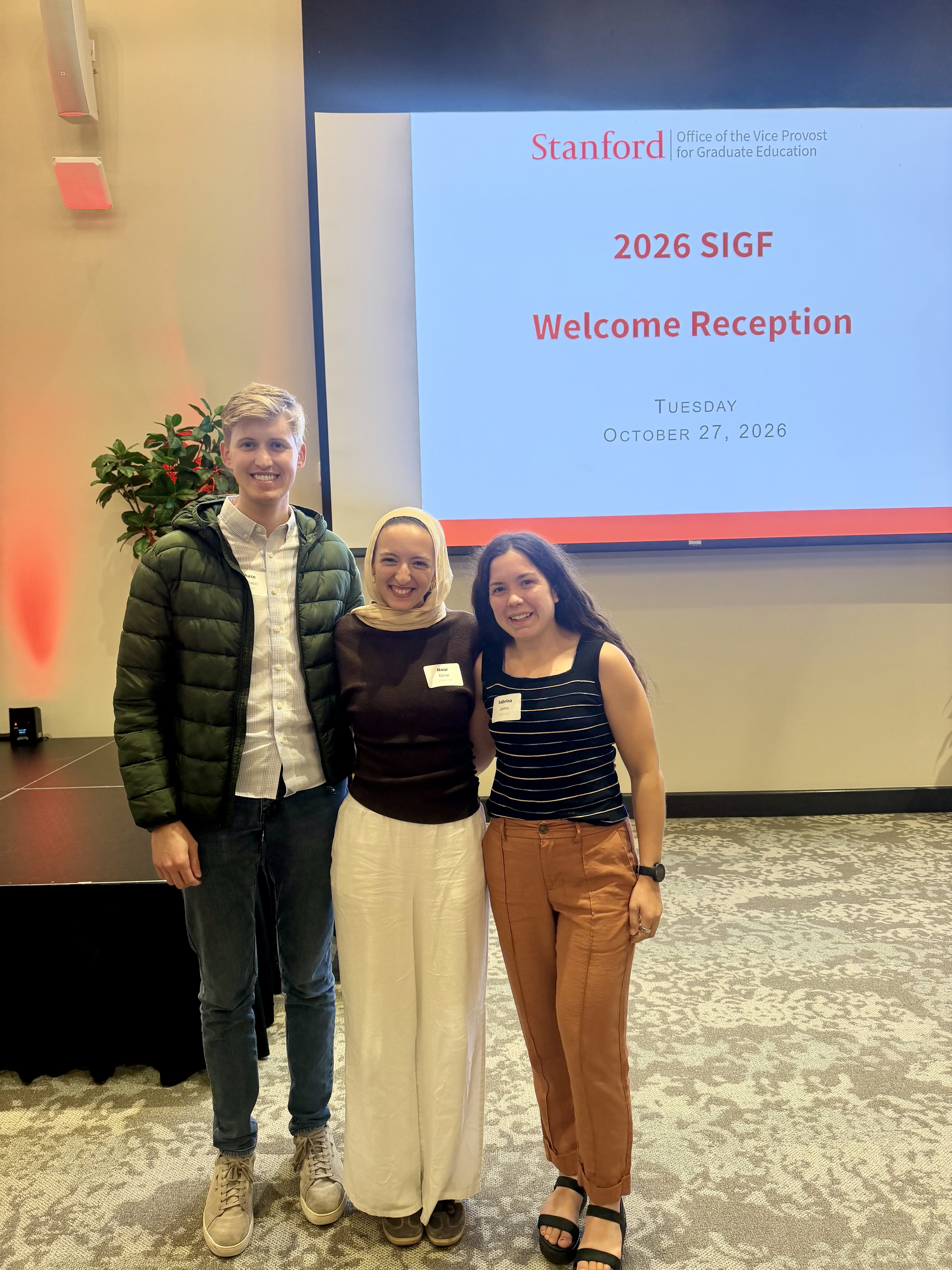
The Wu Tsai Neurosciences Institute exists at a nexus of academic disciplines, from genetics and biology to statistics and even physics – and progress in neuroscience needs contributions from across the spectrum of academic study.
In recognition of that fact, Wu Tsai Neuro is proud to sponsor Stanford Interdisciplinary Graduate Fellows (SIGFs) in the neurosciences whose work exemplifies the cross-disciplinary spirit of the institute and its mission to accelerate discovery and deepen our understanding of the brain.
Managed by the Office of the Vice Provost for Graduate Education, the SIGF program has supported outstanding Stanford doctoral students pursuing interdisciplinary research since 2008. This year, Wu Tsai Neuro is sponsoring three fellows from the Neurosciences Interdepartmental Program working in the departments of Psychology and Neurology.
“My research sits between fields that don’t usually share a lab bench,” said Nour Omar, the Ketterer-Vorwald Interdisciplinary Graduate Fellow and a student member of Wu Tsai Neuro’s Center for Mind, Brain, Computation and Technology (MBCT) program who works with Juliet Knowles, an assistant professor of neurology and neurological sciences and of pediatrics at Stanford Medicine.
Omar studies how seizures early in life shape the brain circuits involved in social interactions. “The question I’m asking doesn’t have a single-method answer. Seizures are an electrical problem, myelination – an important step in forming connections between neurons – is a cellular and structural problem, and social behavior is a systems-level problem,” Omar said. “SIGF gives me the time, resources, and independence to bring these threads together and ask questions that no single one of these fields could answer on its own.”
Sabrina Jones, the David L. Sze and Kathleen Donohue Interdisciplinary Graduate Fellow, shared that view. “Interdisciplinary work is foundational to what I do,” said Jones, who works with Jay McClelland, the Lucie Stern Professor in the Social Sciences and a professor of psychology in the School of Humanities and Sciences.
Jones’s research combines cognitive science, systems and cellular neuroscience, and computational modeling to understand why our brains learn more efficiently when we can build on prior knowledge – for example, why a seasoned professor might get more out of a research seminar than a new graduate student.
Jones, who is also an MBCT member, said that one of the key things the MBCT and SIGF programs provide is community, both locally and in the neuroscience field at large. “I am looking forward to continued opportunities to engage with interdisciplinary researchers and to contribute to the furthering of this research approach through the SIGF,” she said.
Stanford Interdisciplinary Graduate Fellow Chase Antonacci is studying how childhood adversity affects mental health later in life. “Early life adversity is one of the strongest predictors for mental health problems, but it is still remarkably difficult to predict which children will go on to develop difficulties and which will remain resilient,” said Antonacci, a Neurosciences IDP graduate student, working with Ian Gotlib, the Marjorie Mhoon Fair Professor and a professor of psychology in the School of Humanities and Sciences.
Like Omar and Jones, Antonacci is looking forward to expanding the community he’s built as an MBCT member. “One of my favorite things about it has been meeting people who approach familiar problems in ways I never would have considered. My work increasingly draws from neuroscience, psychology, psychiatry, and machine learning, and it’s been wonderful to have a community where conversations across those areas happen so naturally. I’m excited for SIGF to deepen those relationships and hopefully lead to collaborations that change how I think about my own science.”
Meet the 2026 Wu Tsai Neuro SIGF trainees

Nour Omar
Ketterer-Vorwald Interdisciplinary Graduate Fellow
PhD Candidate, Neurosciences IDP
Primary Faculty Advisor: Juliet Knowles, neurology
Faculty Co-Advisor: Erin Gibson, psychiatry & behavioral sciences
Faculty Collaborators: Jennifer McNab, radiology
Impact of Generalized Epilepsy on SynGAP1-Neurodevelopmental Disorders
SYNGAP1-related neurodevelopmental disorder is characterized by high prevalence of epilepsy and autism with social deficits emerging after seizure onset. We demonstrated that blocking absence seizures in SynGAP1+/- mice prevents social deficits, suggesting a causal relationship between epilepsy and autism phenotypes. Given that myelin plasticity mediates epilepsy progression, I hypothesize that callosal developmental myelination is abnormal in SynGAP1+/- mice, but it is seizure-induced myelin plasticity of callosal projections promoting social deficits. Integrating ex-vivo oligodendroglial cultures, longitudinal in-vivo MRI-myelin mapping, and conditional genetic manipulation of seizure-induced myelination will define myelin remodeling as a causal, modifiable bridge between epilepsy progression and social impairments.

Sabrina Jones
David L. Sze and Kathleen Donohue Interdisciplinary Graduate Fellow
PhD Candidate, Neurosciences IDP
Primary Faculty Advisor: Jay McClelland, psychology
Faculty Co-Advisor: Ivan Soltesz, neurosurgery
The Neural Basis of Prior Experience Dependent Learning
Human learning is efficient: prior knowledge guides how we learn. This interdisciplinary project examines the neural basis of this efficiency employing a Complementary Learning Systems framework to identify how hippocampal–neocortical interactions facilitate rapid encoding and consolidation of prior-knowledge consistent information. Using a virtual-reality paired-associates task in mice, I test how prior experience accelerates cue-reward learning and cortical consolidation. Planned chronic, simultaneous CA1 and retrosplenial recordings will quantify replay, representation stabilization, and hippocampal-cortical coupling across learning. A biologically grounded computational model elucidates how CA1 activity instructs cortical plasticity online and offline, linking behavior, neural dynamics, and modeling across levels of analysis.

Chase Antonacci
Stanford Interdisciplinary Graduate Fellow (Anonymous Donor)
PhD Candidate, Neurosciences IDP
Primary Faculty Advisor: Ian Gotlib, psychology
Faculty Co-Advisor: Kilian Pohl, psychiatry & behavioral sciences
Faculty Collaborators: Johannes Eichstaedt, psychology, and Russell Poldrack, psychology
Naturalistic Language and Distributed Brain Systems: Mapping Neurodevelopmental Pathways of Mental Health Risk
Early life stress is a potent risk factor for adolescent mental illness; however, current assessment methods cannot reliably identify children who will develop psychopathology following adversity. This project introduces a scalable, mechanistic framework that treats naturalistic language as a window into how adversity is mentally processed and biologically embedded. By integrating NLP with multivoxel fMRI and longitudinal clinical outcomes, I will identify distributed brain systems that encode stress-related linguistic representations and test whether these neural signatures predict risk for depression. This work establishes an interpretable, developmental pathway from experience to brain function, enabling earlier identification and prevention for at-risk youth.


